The Whitlingham Bird Report for 2025 is now available to download from the Bird Reports page or from here

Showing posts with label Harvestman. Show all posts

WHITLINGHAM: Harvestmen and fungi

Late November 2022

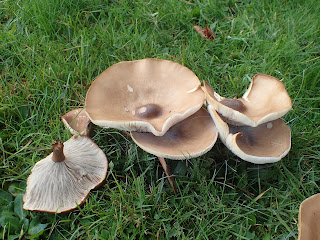
Earlier in the month Vanna Bartlett had found some interesting harvestmen at Whitlingham, and she kindly offered to help me look for them. It was raining steadily as I picked her and Jeremy up, but by the end of our visit the rain had almost stopped. Despite the damp conditions we did see fout species of harvestman, including two that were new for me - Oligolophus tridens and Lophopilio palpinalis. We saw a nice selection of fungi too, including Goldleaf Shield and Olive Salver (Catinella olivacea). Striped Millipede was another new one for me.

Oligolophus tridens 
Lophopilio palpinalis
Striped Millipede
Pluteus romelii
Catinella olivacea
Wrinkled Peach

WHITLINGHAM: A few July invertebrates

17th July 2022

The Whitlingham WeBS count for July was one of the quieter ones I've done, with no real species or counts of particular note. In terms of non-avian highlights, Opilio canestrinii is a common harvestman but not one I'd recorded at Whitlingham before, Alder Signal moth (Stathmopoda pedella) is a fairly scarce moth and Uroleucon aeneum aphids on Musk Thistle was a new species for me.


NORWICH AREA: Ringland Church Hill Common

Late April 2022

With a couple of hours free I decided to visit Ringland Church Hill Common, a known site for a moth I'd not seen before called the Bluebell Conch. The common itself turned out to be an interesting place, with a centre of short grassland surrounded by a belt of deciduous woodland (albeit something of an island in a sea of agricultural land). It took a little while to find the largest area of Bluebells, by which time the weather had become rather overcast, and with the time to return to Norwich approaching it was disappointing but not a great surprise that I didn't see my target moth. I did see a new harvestmen and cranefly (Platybunus triangularis and Limonia nubecolsa respectively). Probably the most interesting theig I found was on my way back to the church. I saw a black mass on Garlic Mustard and from a distance wondered if it was a smut. It turned out to be a cluster of Grenade Aphids, Lipaphis alliariae, which based on the Influential Points account seems like a good find.


NORWICH: Earlham Cemetery invertebrates with Vanna

21st November 2021

Yet another rainy weekend, but this time I met up with Vanna Bartlett to have a look at some of the interesting invertebrates that she has been finding in Earlham Cemetery recently. We started off checking some gravestones for longhorn beetles (without success), but did find a couple of Orsillus depressus, a bug associated with Lawsons Cypress, along with the spider Zygiella atrica. In a different area we saw a very unusually patterned Eyed Ladybird (the biggest UK ladybird), the first time I'd seen this species since childhood. We then moved on to checking branches amongst leaf-litter for my main target, the harvestman Dicranopalpus larvatus. This species was new to Norfolk when first found here by Vanna and is still the only county site for it as far as I know. We managed to find both male and female specimens, which was good.


Exploring the rest of the cemetery I added another new species, Brown Larch Aphid (Cinara cuneomaculata) from Larch branches. A Parrot Waxcap (usually green) had started to turn pink, which apparently is something that happens after a frost. Across the other side of the ring road we followed some directions from Ian (mostly OK with the exception of a left/right mix-up!) to find a group of Grooved Cavaliers (Melanoleuca grammopodia). This was the first time I'd seen this species since 1995!


NORTH NORWICH: Broadland CP fungus foray

6th November 2021 

At the start of November I attended a Norfolk Fungus Study Group foray at Broadland Country Park, where NNNS are one year into a three-year monitoring project. It was very well attended, the downside of which is that people end up straggling out all over the place, with the positive being more eyes to look for fungi. I had hoped to see a few of the scarce birch species that have been found here in the past such as Ghost Bolete, but as that part of the site has been well recorded we instead moved quickly past the first compartments to spend some time in the damper areas further along.

The fungus list for the day was well over 100 species, although I didn't see all of them. Some of my highlights included Heningomyces candidus, Conifer Shield (Pluteus pouzarianus). the slime mould Leocarpus fragilis, Isaria farinosa on a dead Glow-worm and a very glutinous Yellow Webcap (Cortinarius delibutus).


There were a few interesting invertebrates seen too, in particular I had hoped to see the harvestman Nemastoma bimaculatum and one was under the first log we checked!


WHITLINGHAM: Snails, trees, fungi & a moth

31st October 2015

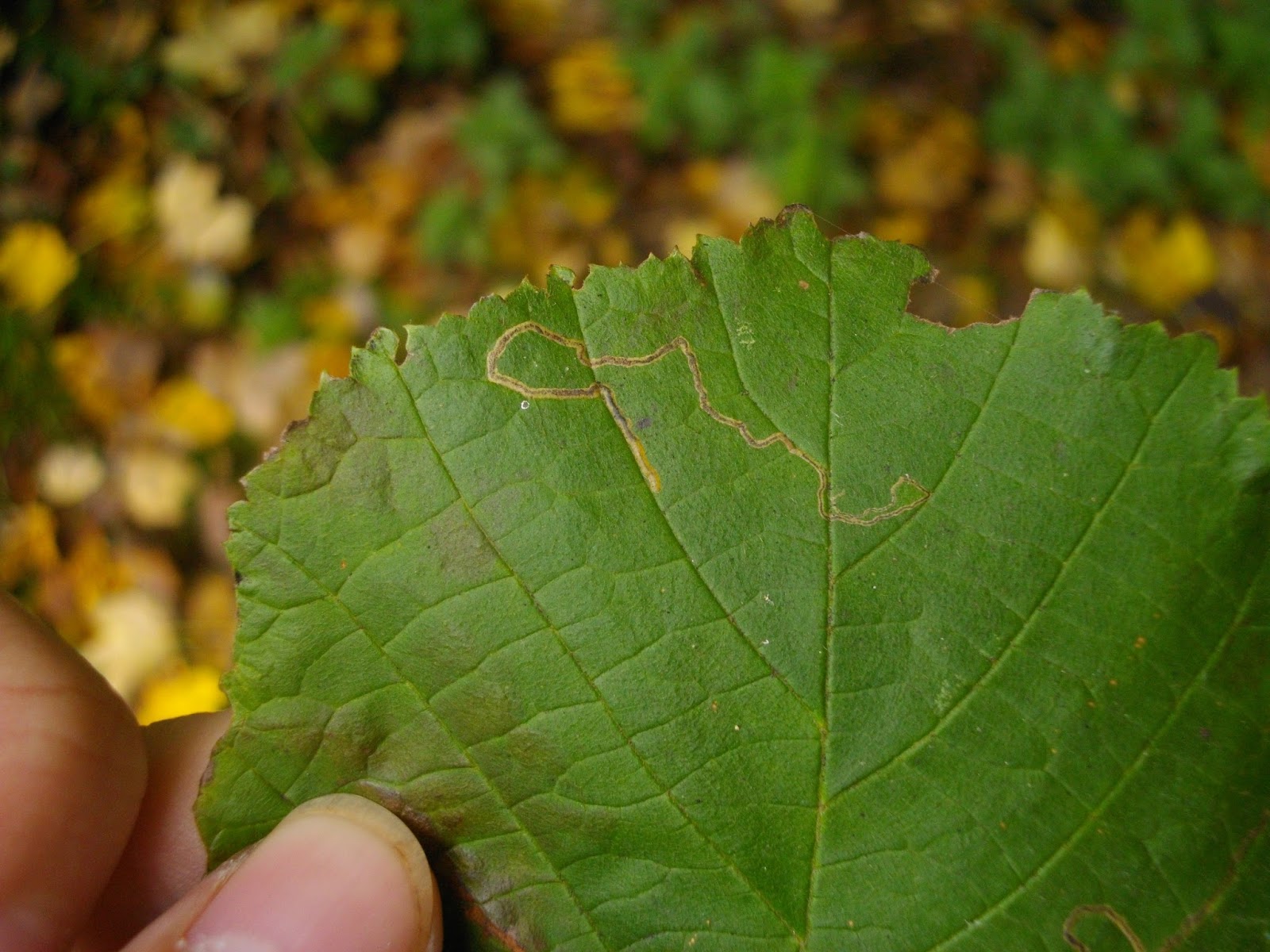
On Saturday I headed down to Whitlingham, but as it was a sunny day and rather busy, I decided to start off in the woods. As I entered the woods I noticed some Norway Maple saplings. I had previously not counted Norway Maple on my patch list as it would have been planted originally, but as it appears to be regenerating naturally, on it goes (958). The next thing I noticed was a caterpillar inside a leaf mine on a Hazel leaf. I photographed this, hoping that the pattern of the mine and the 'frass' (leaf miner poo!) would enable me to identify it at home. I was almost right - I got it down to two species of micro moth, but have been advised that I need to take a picture lighting up the mine more clearly to be sure which one it is.

 Norway Maple
Mine in Hazel caused by a Phyllonorycter sp.

As it has been a wet week there were lots of snails about. Many of them were different patterned versions of the White-lipped Banded Snail, but I did find a new species for me, Hygromia cinctella, which I keyed out at home (959). Plaited Door Snail was another interesting snail, but one that I had seen in the woods several times before. There was a bit of fungi about, but not as much as there has been in the other places I've visited recently. One interesting species was the Fire-rug Inkcap, so called because the mycelium forms an orangey-brown furry mat, which is often visible on logs. Along the telegraph pole alley I photographed an adult Hawthorn Shieldbug, which I will add to my Shieldbugs species guide soon (currently there is only a late instar photo in it).

 Hygromia cinctella
 Plaited Door Snail
 Fire-rug Inkcap - note the orangey 'fire rug'
 Hawthorn Shieldbug

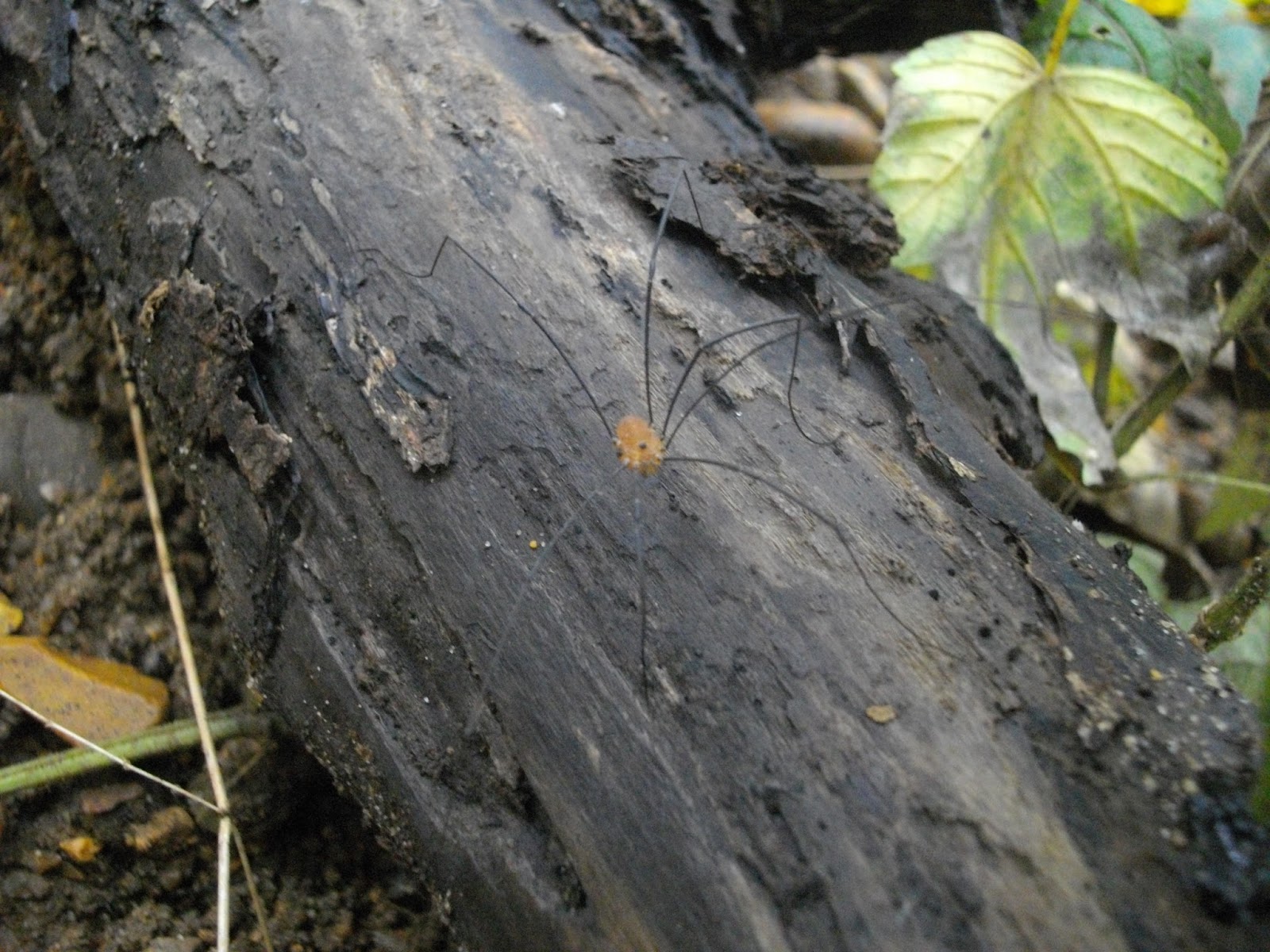
The next new species on my list was a Harvestman, Leiobunum rotundum (960). The males of this species are round and orangey, but they need to be looked at carefully to separate them from L. blackwalli. The key bit to look at is between the eyes, which is black on rotundum but white on blackwalli. In a hedgerow I saw the bright pink flowers seed cases of Wild Spindle. I wasn't sure whether this would have been planted or grown naturally, however I later saw it in a second location. The most recent Flora of Norfolk says that Spindle is "not infrequent on base rich soils", and given the chalky nature of Whitlingham Woods I reckon this is reasonable (961).

 Leiobunum rotundum
 Wild Spindle

Emerging from the woods I walked back as far as the island to scan for birds. A flock of Tufted Ducks flew east and most of the gulls had left the water and were circling around, making me suspect a Peregrine had just flown through, but I didn't see it. When the birds settled I picked out at least six Pochard and seven Great-crested Grebes, but not much else of note. I walked as far as the eastern end of the broad to scan over to Thorpe, but didn't see any of the Goldeneye that have been frequenting Thorpe Broad of late. On my way back I did noticed some very inconspicuous fungi, Slender Clubs, growing on some bark chippings (962). These could easily be mistaken for dead bits of leaf or shoots, and was a species that I hadn't seen for years, so were pleasing to see.

Slender Clubs

There was still time for a couple more interesting sightings. Firstly a brightly-coloured Comma butterfly was resting on some ivy. Probably the latest I've seen one flying, only a day off November. The second sighting was pure luck, I spotted a 'growth' on a tree branch and upon investigation it was a Vapourer moth cocoon, covered in eggs. Well camouflaged next to it I found the female moth. Female Vapourers are flightless, having only stubby vestigial wings. They emerge from their cocoon, attract a male by releasing pheromones and then lay their eggs on the cocoon they emerged from, often hardly moving at all as an adult! I think several other moths undergo a similar life cycle, but Vapourer is the most familiar one.

Female Vapourer moth and eggs