The Whitlingham Bird Report for 2025 is now available to download from the Bird Reports page or from here

Showing posts with label Ferns. Show all posts

WHITLINGHAM: A couple of new woodland plants


18th February 2017

After my Ringland visit I headed to Whitlingham Woods for a quick walk around before picking Cathy up from the city. Whilst there I noticed some Spurge Laurel, a plant I’ve not recorded here before. Further along I went to check a fern (I’m still looking for Borrer’s Scaly Male Fern here, which was recorded on a vegetation survey years ago) and was surprised to discover it was Soft Shield Fern, only the second time I have seen this species. I just had time to check some Box bushes, finding one of the same galls seen at Catton Park, before heading back.


LINCOLNSHIRE: Burghley House

10th August 2016

To celebrate our wedding anniversary Cathy & I went to Burghley House, a stately home in south Lincolnshire. We had a nice look around the house and a meal at the orangery restaurant, but for the purposes of the blog I will mention a few of the insects that we saw within the grounds. As we walked across to the entrance Cathy spotted a pair of Common Blue Damselflies at the side of the road:


In the afternoon we walked through the sculpture garden, taking in a large lake. A Red-eyed Damselfly was seen in vegetation along the edge, and a Figwort Sawfly was on its foodplant close by. The most interesting sighting for me was a Common Furrow-bee (Lasioglossum calceatum) feeding on Water Mint.


There were also a couple of plant sightings of interest, but neither likely to be 'wild'. Firstly I was looking at some ferns in the water garden. I didn't recognise one of them, and as it was growing with Maidenhair Spleenwort I thought it might be native to the area, however as there were lots of planted ferns a bit further on it probably wasn't. The second plant was a Corncockle. These attractive pink flowers used to occur as arable weeds, but are now very rare. The reason you are likely to have heard the name if you are not a botanist is because there was a ridiculous scare story about them in the papers a few years back. They are poisonous, likely many plants, but only if you eat them. As a result, the Telegraph were outraged that seed packets contained Corncockle Seeds. You can still read Patrick Barkham's response in the Guardian here: https://www.theguardian.com/lifeandstyle/shortcuts/2014/aug/26/corncockle-countryfile-bbc-packets-seeds-poisonous

 Unknown and dubiously wild fern sp.
 Corncockle. Don't look at it too long or it might get you.

NORTH NORFOLK: Southrepps Common & environs

26th May 2015

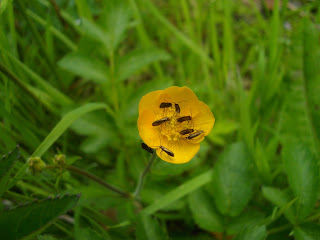
Having given Cathy a lift to Tuttington I had a couple of hours free, so I decided to visit Southrepps Common. After a slight detour (the road to Felmingham was closed so I had to turn round and go via Colby) I parked up at Southrepps. The site is actually a collection of several commons, but I concentrated on the largest one, which is an SSSI. A few yards on to the boardwalk I saw a Muntjac Deer walking off into the undergrowth, and a large frog hopped across the path. Looking at some buttercups I noticed large numbers of a tiny golden micro moth in the flowers. These were the aptly names Plain Gold moth (thanks to Andy for the ID).

A bit further along I came to the main area of interest, a cut area containing some orchids. Being relatively early in the season all of the orchids seemed to be Southern Marsh Orchid. The site is also good for sedges apparently, but they are rather beyond my identification skills at the moment. The main species I wanted to see was Narrow Buckler Fern. I did see some tri-pinnate ferns that looked different from the Broad Buckler Fern in the nearby woods. The pinnae look right, but as the scales on the stem hadn't matured and that was the main feature I was going to use, I'm still not completely sure. Despite the likely looking conditions and sunny weather, two falcons flying overhead turned out to be Kestrels rather than Hobbies.


Leaving the common I headed along a public footpath through The Warren, a nearby woods. I didn't see much in the wood, but along the edge I saw Goldcrest, Whitethroat and most pleasingly a Spotted Flycatcher. Just afterwards I took a different path to the one I was aiming for, and ended up halfway between Southrepps and Trunch. Walking back I found lots of Early Purple Orchids on a couple of roadside verges, and also a Nelson plaque with 'site no. 37' written on it in pen. Do any local history enthusiasts know what this plaque is marking, and if there really is another 36+ of them around?


NORTH NORFOLK: Edingthorpe

26th April 2015

After a visit to some family in Edingthorpe, Cathy & I took a walk around some of the lanes that I used to walk when I was growing up. As well as boring her with my reminiscences ("I once saw a Turtle Dove on those wires" etc) we stopped every so often to admire the flowers growing on the verges. There were Bluebells and Meadow Saxifrage, hinting at old woodland here in the past, along with Wild Strawberry, Greater Stitchwort, Primroses and Yellow Archangel (the latter probably a throwout from cultivation). The highlight for me was Soft Shield Fern, a new species for me. We also saw quite a few bees and a friendly horse. I did scan the paddocks hoping for Ring Ouzel, but only managed to find a Mistle Thrush.


NORFOLK: Sculthorpe Moor

2nd November 2013

It had been a while since we had visited Sculthorpe Moor, so with a free Saturday Cathy, Margaret & I headed there for a look around. We were hoping to get good views of two winter staples here, Bullfinch and Brambling. Whilst both were around somewhere, they steadfastly refused to come to the feeders whilst we were there. The Whitley Hide bird table was dominated by families of Chaffinch and Greenfinch, whilst a Lesser Redpoll also showed well on the ground as it drank from the pond. A large flock of Siskins swirled over, Marsh Tits were numerous and my first Sculthorpe Nuthatch was on the feeders at the start of the boardwalk.

There was a bit of fungi in the woods, including a distinctive looking but as yet unidentified Lepiota sp, and I did manage a new species from the trip, Lady Fern.


EAST NORFOLK: Looking for Crossbills

27th October 2013

This afternoon Cathy & I went for a walk in Witton (aka Bacton) Woods. Having grown up in North Walsham, it was here that I saw my first Common Crossbills in the early nineties, so it seemed a fitting location to attempt to see Parrot Crossbill. I had been given directions to an area of trees where they had been seen earlier in the week, but other than Coal Tit and Goldcrest there weren't many birds about. The strong wind hindered any attempts to listen for distant calls or falling pine cones. Hopefully they will continue to be seen, and I can have another go later in the year.

On our way round we did see quite a bit of fungi - Cathy found an unopened Parasol and a number of Mycena sp, whilst there were also Fly Agaric, Amethyst  Deceiver and Beech Sickener. We also saw some Hard Fern, a species that I have presumably seen here before but not recorded. On the way back to North Walsham a Stoat ran across the road.

Hard Fern
Parasol

NORWICH: Rustyback Fern

6th September 2012

Back to work, but that doesn't mean that the fun stops. This unobtrusive fern growing on a wall near Magdalen Street is a Rustyback Fern, which is only found in ten or so locations around Norfolk, and in the absence of birds was very interesting.

Rustyback Fern