The Whitlingham Bird Report for 2025 is now available to download from the Bird Reports page or from here

Showing posts with label Ground Beetle. Show all posts

NORWICH: Catton Park invert additions

26th April 2018

Having been on a course during the day, I was able to call in at Catton Park on my way home. There was  still a bit of sunshine so I was hoping there would be lots of insects about, but it was still too early for the wildflower meadow so I kept to the edge of the woodland, focusing on the band of Dandelions growing in the rough grassland and the sporadic Alexanders and Cow Parsley. There was a lot of hoverflies, but almost all that I inspected were Melanostoma scalare, with the exception of a single Baccha elongata and some Eristalis sp.

 Melanostoma scalare
Baccha elongata

Pleasingly I did actually find two new species for me, a plant bug, Stendodema laevigata and a small carabid, Demetrias atricapillus. A tiny Dark Bush-cricket nymph was my earliest ever, and a Dock Bug was my first of the year to complete a productive hour.


YARE VALLEY: Roman Wood

24th September 2017

With the winds seemingly not great for migrant birds, and plenty of fungus forays to come, I decided to focus on insects for a bit longer. I was aware of some interesting stuff being recorded at Roman Wood on the edge of Acle recently, including two species I was keen to see (Bishop's Mitre Shieldbug and Rhombic Leatherbug), so I arranged to meet Tim Hodge there to see what we could find.

Roman Wood has a couple of differing compartments, but the area we focused on were recently cut grassland bordered by 20 year old planted trees and bushes. There were plenty of Pestle Puffballs growing around the edges, and the warm sunshine ensured there were quite a few hoverflies around too.


One of the methods of surveying that Tim had been employing at Roman Wood was seiving of the grass piles. I was surprised by the sheer volume of creatures this produced, but many of them were very small. The tiny ladybird Rhyzobia litura was of interest. Nearby a bee bank had been established, and a metallic green Lasioglossum (or possibly Halictus) was inspecting the soil. With no sign of any shieldbugs in the piles we moved on to a bit of sweeping, and this came up trumps with my first Bishop's Mitre Shieldbug.

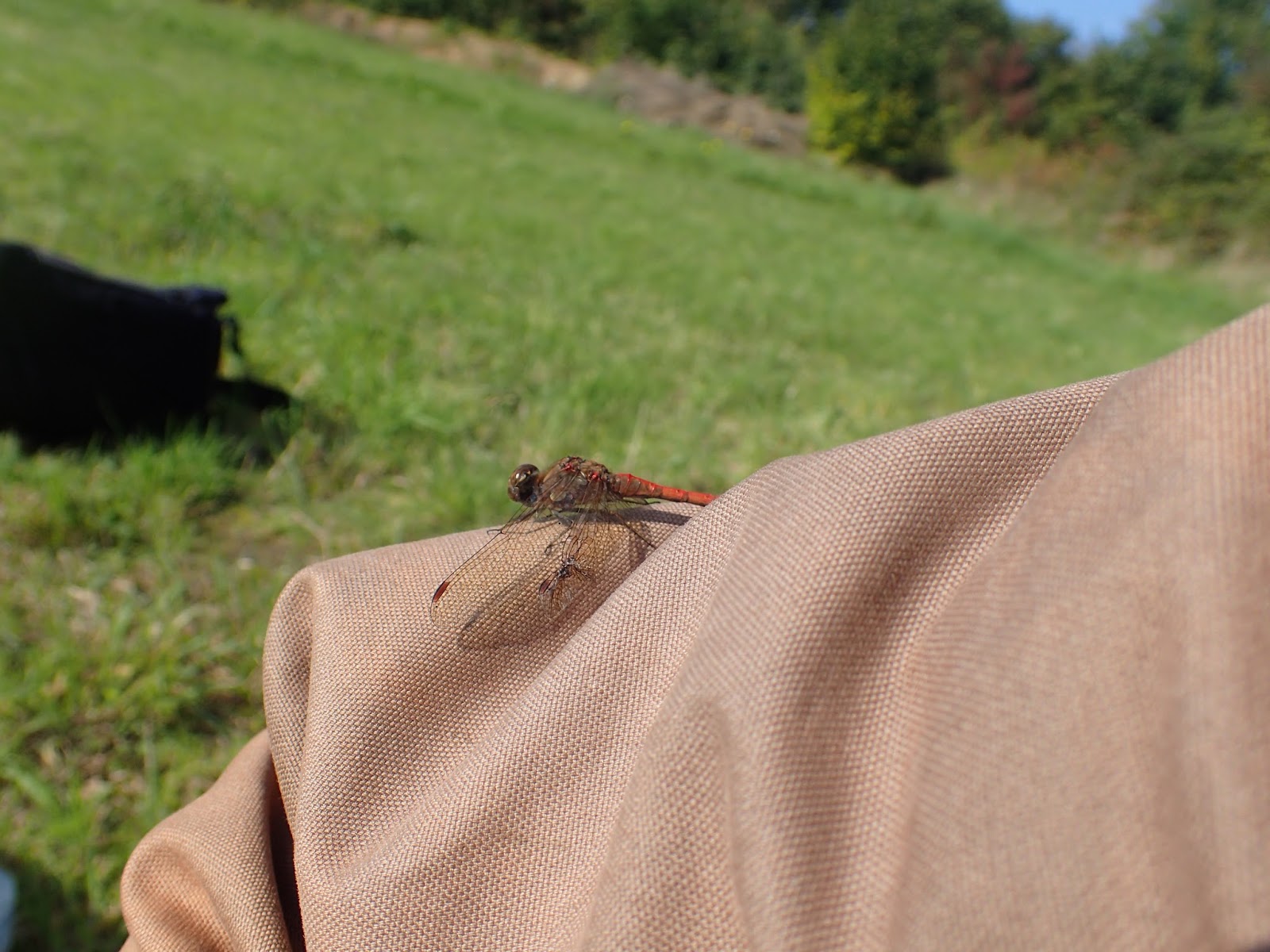
Whilst sitting on the grass a Common Darter landed on me several times, although I had to twist to photograph it. A couple of Agromyzid mines were noted, including a new one for me, Agromyza plantaginis, on Greater Plantain.


At the eastern edge of the site there is a ditch, and as we headed that way Tim pointed out a Willow Emerald. They really are quite widespread now, I've seen them at many sites this year. A rust fungus on Agrimony was a good find and a few other bits were noted, including some mines in Poplar and Alder. Seiving of one final grass pile turned up two Notiophilus palustris beetles, part of a genus of ground beetles that have large eyes and stalk Springtails.


THORPE MARSH: Sunset moths, beetles and birds

22nd May 2017

Recently Ricky had been getting some great views of a Grasshopper Warbler at Thorpe Marsh, so I agreed to meet him there on Monday evening. He was running a bit late, which worked well for me as I was able to have a look for moths and beetles in the vegetation along the edge of the dykes. One species of moth was particularly common, although I haven't identified it. Presumably it is something I've seen before - I'll keep working on it.


A longhorn moth was easier to identify, it was the Meadow Longhorn, whilst I also saw my first Drinker Moth caterpillar of the year. Of the beetles there were quite a few Donacia simplex reed beetles, but also two new ones, Hydrothassa marginella (seen here photobombing a Donacia) and an odd-looking carabid Demetrias imperialis.


Once Ricky had arrived, along with Matt, Steve and Phil we took a stroll along the path in the direction of a distant reeling Grasshopper Warbler. We then heard a closer one behind us, and returning back a bit we got good views as it reeled from amongst the sedges. As the sun set I was preparing to go when a Hobby flew over us, an excellent end to the evening.


MID-NORFOLK: Sculthorpe Woodcock & beetles

17th July 2016

One of Cathy's aunts has been staying with her mum this week, and they had asked if we could go out for the day and see some wildlife. Rather than go to the coast, which would probably be packed with sun-worshippers, we went to Sculthorpe Moor. There were relatively few visitors, although the Hawk & Owl Trust were having a party for their volunteers in the visitors centre.

There weren't many birds visible on the first section of the boardwalk, although a couple of Marsh Tits were coming to the feeders at old gits corner. We stopped a while on the bridge over the stream, and further along I noticed some ripples. Suspecting a Water Vole, I moved position so that I could see past some overhanging vegetation to the source of the movement. To my surprise it turned out to be a Woodcock! There was enough distance between it and us that we could all watch as it bathed along the stream edge, stretching and occasionally flapping. A very unexpected but pleasing sight.


Along the river we watched Emperors and Four-spotted Chasers disputing territory, with Large Red, Azure and Blue-tailed Damselflies amongst the vegetation. At the next hide along we watched a family of Collared Doves on the bird table and a Buzzard flew over. Cathy was enjoying watching some small fish spinning side one, showing a silvery gleam, until a Little Grebe came right up to the hide and started eating them.


On the way back Cathy was carefully watching the boardwalk as she had found several small frogs and toads earlier. This time she found something more unsusual, a Sausage Ground Beetle*. As we got back to the car I noticed a pale cream coloured ladybird. It turned out to be a 14-spot Ladybird, which I see quite regularly, but usually with a deeper yellow colour and with some spots joined up.


* so named because the small raised areas between the ridges resemble a string of sausages