The Whitlingham Bird Report for 2025 is now available to download from the Bird Reports page or from here

Showing posts with label Bee. Show all posts

SOUTH NORFOLK: Shotesham lichen meeting

30th March 2024

Norfolk lichen recorder Rob Yaxley had organised a few informal meet-ups to survey churchyard lichens, and I managed to attend one at Shotesham, a village a few miles south of Norwich. We looked at three churches (two 'proper' ones and a ruin) and as expected racked up a good lichen list. The presence of quite a few experienced naturalists meant that we also turned up various other species across a wide range of groups. The pictures below are a small selection of highlights, but things that spring to mind include a lichenicolous fungus that appears to be new to Norfolk (Spiloma auratum), my long-awaited first Bristly Millipedes, the inconspicuous ladybird Rhyzobius litura, Ashy Mining Bee and smut fungi on aconite and sweet violet and the pseudoscorpion Chthonius isochneles.


NORWICH: Sweetbriar Marsh invertebrates

Early August 2022

One day after work I called in at Sweetbriar Marshes, where Vanna Bartlett had recently seen Andrena denticulata on the Fleabane. I managed to find a few, along with Red Bartsia Bee and a few other bees. On the reedmace I found Chilacis typhae bugs, some half buried in the seedheads, and an adult Orchestes hortorum weevil as on an Oak leaf. The most interesting find was a small micro moth on Skullcap. Unfortunately there are two rather variable species, both rare, so whilst I think this one is likely to be Small Metal-mark, Prochoreutis myllerana, it would require a specimen to confirm it. There are only 11 Norfolk records since 1900 The only previous record from TG20 is from Charles Barrett, the early moth chronicler back in 1874.


YARE VALLEY: A sunny day at Wheatfen

Late July 2022

My annual summer visit to Wheatfen was pleasant as always, with lots of insects and a large emergence of harvestmen, with four species noted, three of them in quite large numbers. Highlights included a Sulphur Beetle (rare outside the Brecks and coast), a Bronze Shieldbug, a lacebug Derephysia foliacea, a Three-lined Soldierfly (Oxycera trilineata) and some Yellow Loosestrife Bees.


NORWICH: Snakefly and an unusual lichen

First half of May 2021

Various sightings on my walks to and from the city, culminated with the finding of my second ever Snakefly. Identification relies on the pattern of veins in the fore and hind wings - fortunately I managed to get a photo of the hindwing of this one to confirm that it was Xanthostigma xanthostigma.


Other sightings included Regal Piercer, a micro moth associated with Sycamore, the beetle Bruchus rufimanus and some Tawny Mining Bees. The first Swifts returned to our housing estate on 9th May, and on the same day I found an out of place Reed Warbler singing from scrub along a pathway at Waterloo Park, well away from any suitable habitat.


Finally, having seen it mentioned online I searched for and found Phylloblastia inexpectata. This is a foliicolous lichen (i.e. one that grows on leaves) and is almost certainly hugely overlooked, with this being the first VC27 (east Norfolk) record.


NORWICH: Some nice bees

5th July 2020

After completing the WeBS count I detoured home via Jeremy and Vanna's garden. The main reason for the visit was to pick up my copy of Vanna's book "Arthropedia" (previously reviewed on this blog but using a digital copy as publishing and then lockdown restrictions meant I couldn't get a physical copy). True to form there were lots of bees in the garden including a little and large double act with the Hylaeus (Yellow-face) bees. Several male Large Yellow-face Bees (Hylaeus signatus) were on some Weld, whilst Vanna had just caught a Small Yellow-face Bee (Hylaeus pictipes). Also in the garden was one of the beautiful Hedychrum nobile/niemelai ruby-tailed wasps, and because it would be rude to go home without seeing something new Vanna caught and confirmed a Colletes similis bee that was feeding on some flowers in the garden (a species I've probably seen before but has to be caught and keyed to be sure).


NORWICH: Garden lockdown list days 85 & 86

DAY 85 - 14th June 2020

After getting brief glimpses of what initially looked like a small leafcutter bee, I was finally able to confirm that we had at least one Orange-vented Mason Bee visiting the garden. My pride and joy, some Viper's Bugloss purchased last year at Natural Surroundings, had also come into flower which was nice.


170. Osmia leiana (bee)

DAY 86 - 15th June 2020

Whilst out in the garden with Rose we watched a Buzzard soar over - it seems strange to think I'd not seen any up until this year, but it clearly is just related to the amount of time we have spent out in the garden this spring. I heard a family party of Long-tailed Tits nearby, which after checking was confirmed as a new lockdown garden bird, whilst I also found a Diamond-back Moth on the wall outside. I also noticed that the first of the Large White butterfly eggs that we had watched being laid had hatched.


171. Long-tailed Tit (heard only)
172. Diamond-back Moth


NORWICH: Garden lockdown list day 73

DAY 73 - 2nd June 2020

Another five new species for the lockdown garden list saw me break through the 150 mark. Of these the highlight was a new bee for me, White-zoned Furrow Bee, feeding on the Catsear in the lawn. The other species were Sage Leafhopper, Meliscaeva auricollis, Small Dusty Wave and Field Grasshopper.


148. White-zoned Furrow Bee (Lasioglossum leucozonium)
149. Sage Leafhopper 
150. Meliscaeva auricollis
151. Small Dusty Wave
152. Field Grasshopper.

NORWICH: Garden lockdown list days 42 & 43

DAY 42 - 1st May 2020

Daily visits from a pair of Magpies have given a bit of variety to the daily birds, but could mean any birds breeding in our tree or nest box will be in trouble. In the garden a Common Carder Bee was new for the year but avoided the camera, whilst a cranefly was the fairly distinctive Tipula vernalis. At this rate I might actually hit 100 species before midsummer!


95. Common Carder Bee
96. Tipula vernalis (a cranefly)

DAY 43 - 2nd May 2020

A pair of Chaffinches are now visiting more regularly and I got a record shot of the female today to go with all of the other blurry through-the-window shots. Some aphids and mildew were found on a Dandelion but no names for them so far.


NORWICH: The lockdown cometh - Day 1

Late March 2020

So as everyone will be aware, we are now in the unprecedented situation of being 'locked down', and with the exception of those fortunate enough to live in remote locations or on the edge of a nature reserve the focus of wildlife attention is likely to fall on our gardens. The Emerson family garden is a  smallish rectangle of space, with a lawn in the centre, a shed at the back and flower beds along three sides. It was fairly barren when we first moved in with the exception of three established conifer trees and a large Rose of Sharon bush. We have since planted it with various things, created a small pond and put up bird feeders.

Whilst we are in this situation I shall be recording and blogging about the wildlife that we see, partly as my own wildlife diary, but also to encourage others and perhaps help with the identification of thigs that you might be seeing. This will not have the depth that a 'proper' bioblitz would have , partly because my garden spells are likely to be accompanied by my young daughter, and partly because there are a range of things I will leave without identifying them to species as I won't be dissecting anything during this period. I also won't be blogging every day, because some days there just won't be anything interesting to blog about.

Boris Johnson declared the lockdown on the evening of Monday 23rd, but it was obviously coming so I began my listing on Sunday 22nd March, so that is my 'day 1'.

DAY 1 - 22nd MARCH

The first six species are ones that we see in the garden daily (the Lesser Black-backed Gulls flying over, the rest actually in the garden). Until quite recently Starlings were only occasional visitors, but having been given a mealworm feeder they now visit several times, in a group of up to 12, to empty the feeder. Maintaining it might end up being quite expensive, but they are nice to see!

1. Woodpigeon
2. Collared Dove
3. Blackbird
4. Blue Tit
5. Starling
6. Lesser Black-backed Gull

Goldfinch fly around our housing estate constantly, so are heard, and usually seen, anytime when I have spent more than about ten minutes in the garden. Chaffinches have frequented our garden a bit recently but can also usually be heard from the back garden.

7. Goldfinch
8. Chaffinch

Coal Tits are periodic visitors to our big conifer tree - fortunately this was one of the days when one turned up. House Sparrows are scarce actually in the garden (we have put up a terraced nest box for them but there has been no interest so far), but there is a small flock nearby and I heard them calling, enough to add them to the lockdown list.

9. Coal Tit
10. House Sparrow

We have lots of solitary bees flying around our Rose-of-Sharon and also on the Mahonia that grows against our outside wall. I suspected that they were Buffish Mining-bee (Andrena nigroaenea), and this ID was confirmed on the BWARS Facebook page.

11. Buffish Mining Bee (Andrena nigroaenea)


Whilst in the back garden I noticed a small fly twitching its wings in an unusual way. I suspected that this would be one of the Ulidiidae, picture winged flies, but couldn't find a match online. Posting it on Twitter I got some help from Ryan Mitchell, a Diptera enthusiast who works at the Oxford University Museum of Natural History, who identified it as Geomyza tripunctata, a new species for me so a good start to the lockdown!

12. Geomyza tripunctata (an Opomyzid fly)


One other thing noted was a caterpillar spinning leaves together on the Rose-of-Sharon (Hypericum sp). I have seen similar things online identified as Lathronympha strigana larvae, but I don't know enough to be sure at the moment.


WHITLINGHAM: August insects and new sightings

4th August 2019

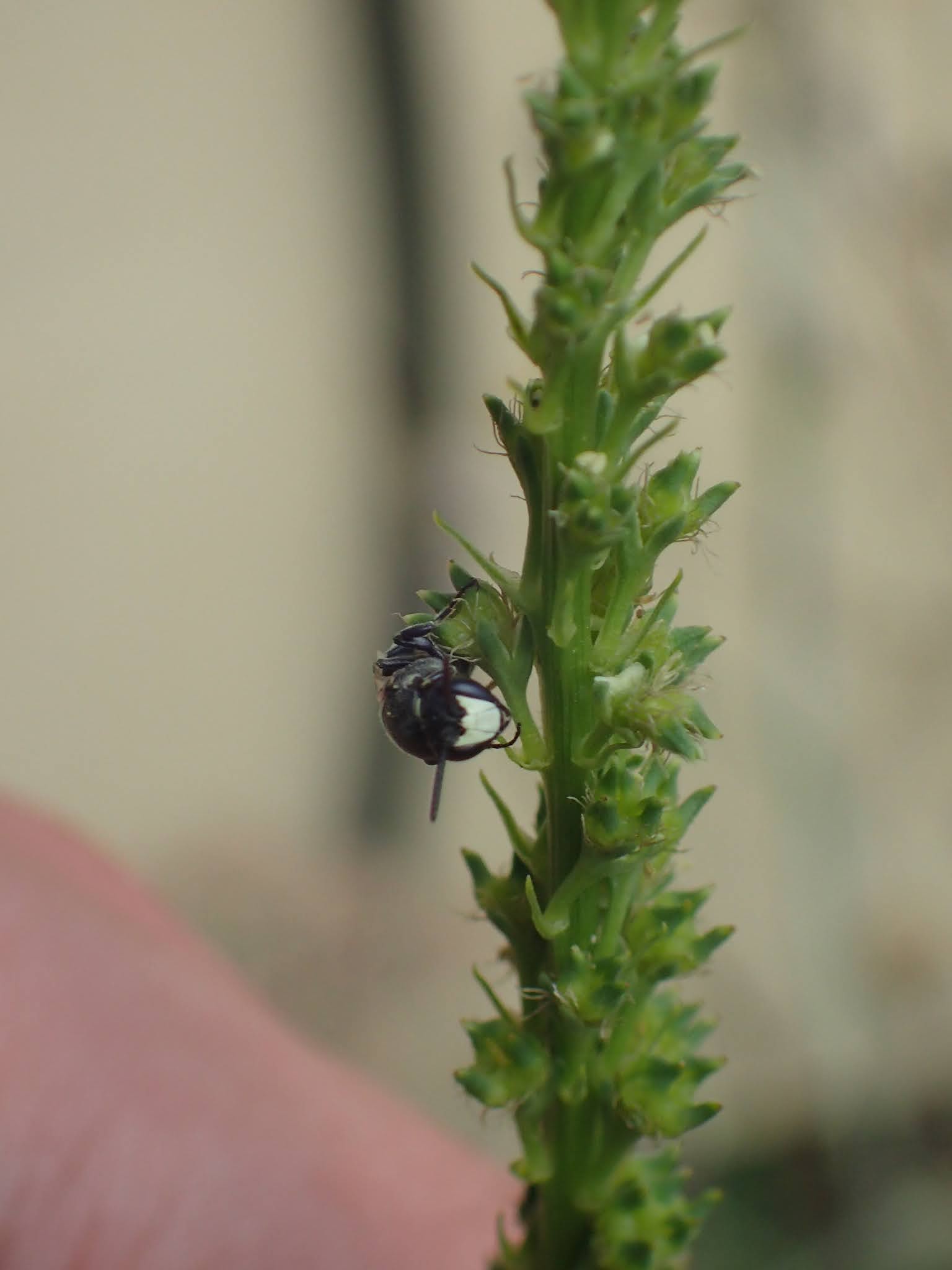
Another early date for the monthly WeBS survey, and with Justin counting Thorpe I only popped in for a quick look before heading to Whitlingham. This was long enough to add a new species of damselfly to my patch list in the form of Small Red-eyed Damselfly. This species has been seen on a few dates in August over the past few years, but numbers have still to take off. This one was in the mooring basin alongside quite a few 'large' Red-eyed Damselflies. A young Tortoise Shieldbug was a surprise find, having previously only seen them in the Brecks or at Foxley Wood, but I found two at Thorpe and a further example at Whitlingham. A male Megachile (leafcutter) bee was also new to the patch list, although frustratingly I couldn't see it well enough to confirm an ID - M. centuncularis is the commonest local species whilst M. ligniseca is known to visit Burdock, so those are the main two candidates.


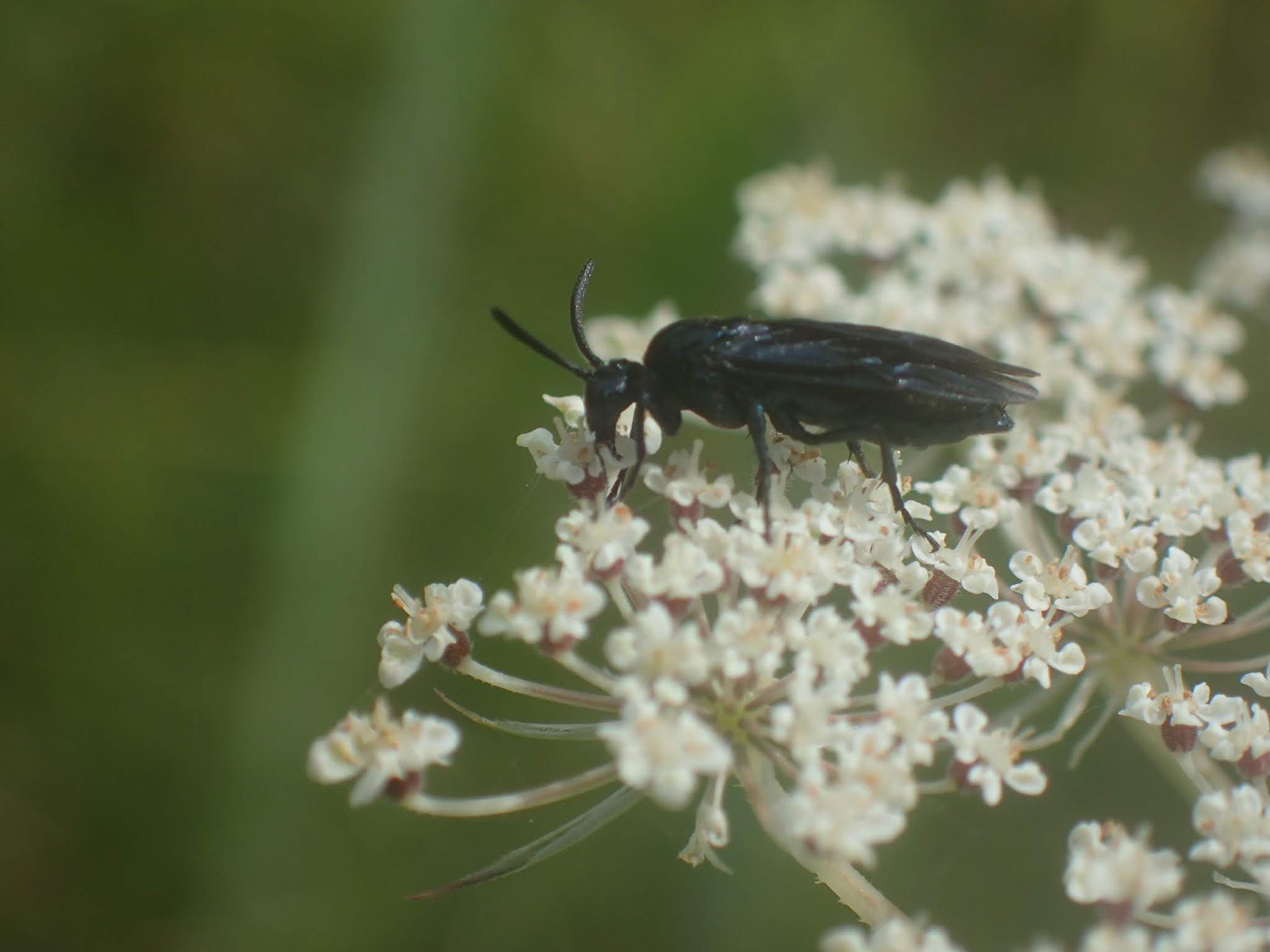
Round to Whitlingham and the number and species of wildfowl were all rather standard for the time of year. Mallard numbers just pushed three figures (101), no Gadwall or Tufted Ducks were seen and a gathering of large gulls on the Great Broad was mostly Lesser Black-backed Gulls (204) with a few Herring Gulls (10). Non-avian sightings included Four-banded Longhorn Beetle (an occasional find here) the distinctive ichneumon Gasteruption jaculator (new for me) and an all-black Arge sawfly (either A. berberidis or nigripes - a specimen needed for ID).