The Whitlingham Bird Report for 2025 is now available to download from the Bird Reports page or from here

Showing posts with label Bee Orchid. Show all posts

WHITLINGHAM: Local mega - Lesser Emperor dragonfly

4th June 2017

On Sunday monring I received a message from Dave Andrews to tell me that he had seen a probable Lesser Emperor dragonfly at Whitlingham, so to keep a look out. Shortly afterwards he got better views of a second individual and was able to confirm that there definitely were some present. This species is a rare migrant to Norfolk, but has seemingly established low-level populations at Ormesby Little Broad and possibly Felbrigg Lake. As far as I'm aware this is the first Whitlingham record.

I headed down to Whitlingham late morning, and after a while managed to get a couple of flypast views, enough to identify the dragonfly as Lesser Emperor, but too quick to get my camera on it! The sun went in and I didn't see it again, so I had to leave for home. I also saw a couple of Emperors, lots of Black-tailed Skimmers and several species of damselfly. At least another two people managed to see a Lesser Emperor later in the day, around the pump-house area.

If anyone does manage to get photographs of the Lesser Emperor(s) then I would be grateful for one to add to my Whitlingham odonata guide, and also to ease the passing of the record with the county recorder. If you are going to look then the area to focus on is the south shore, anywhere from about level with the main island eastwards to the end of the Great Broad.

On my way back I checked a couple of areas that had Bee Orchids last year, but only found one flowering spike, near the entrance to the barn car park.


EAST NORFOLK: Winterton lichens

3rd June 2017

Earlier in the year I had attended a walk at Sparham looking at lichens with the county recorder, Peter Lambley. Afterwards Peter had agreed to hold several other walks later in the spring for anyone who wanted to learn a bit more about lichens in different habitats. I had been unable to attend the first of these at Salle church, but met Peter on Saturday at Winterton dunes to have a look at some dune Cladonia species. I had previously been on a lichen workshop in the Brecks, so this gave me the opportunity to compare some inland heath and coastal heath species.

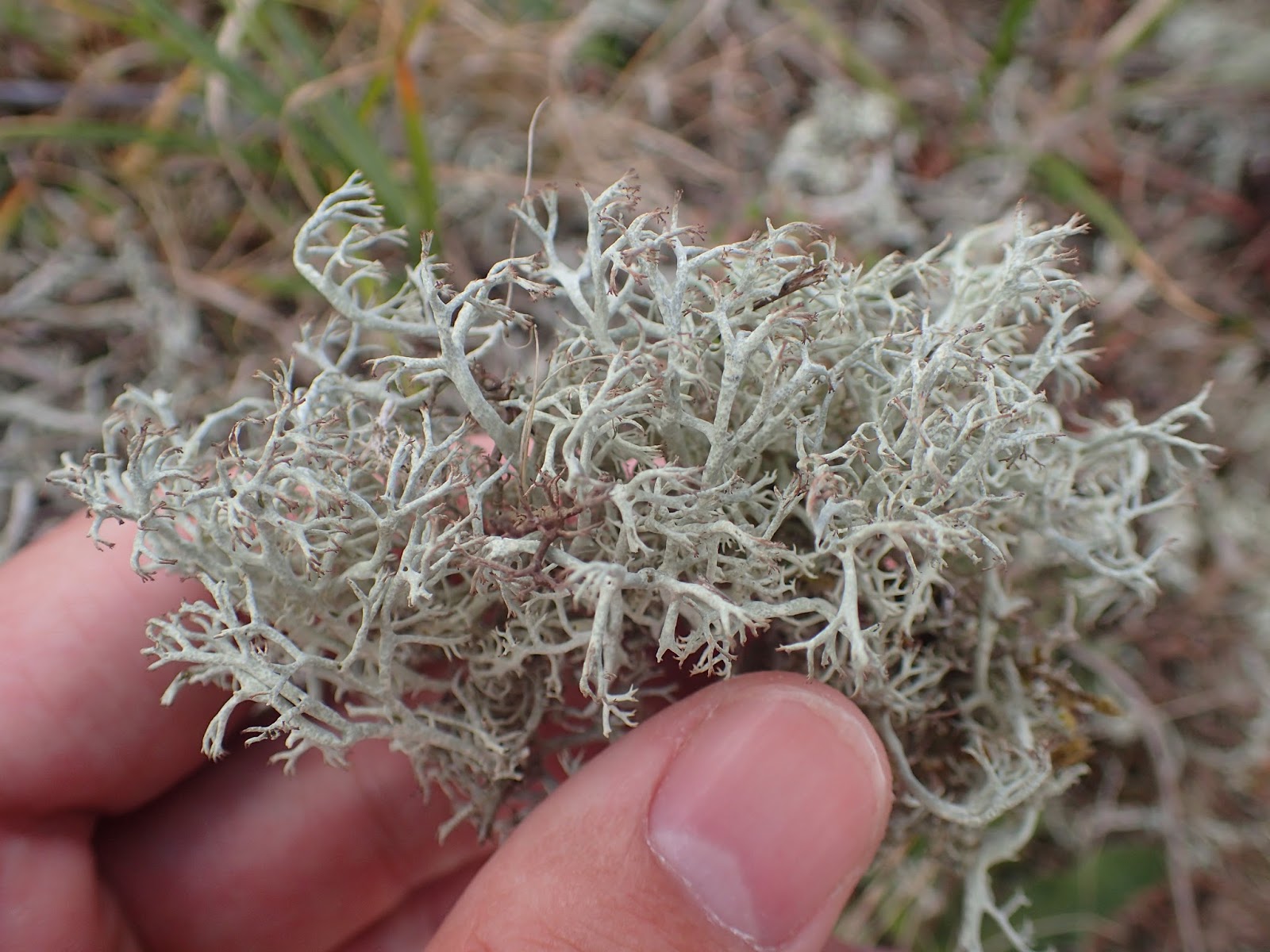
Whilst the dunes didn't hold as many different species as woodland, churchyards etc, the species present occurred in good numbers. We had a look at Cladonia arbuscula, which had long bent-over tips with 3 or 4 branches near the end and swept in the same direction, and compared it with the abundant Cladonia portentosa which had the tips swept in different directions.

 Cladonia arbuscula
 Cladonia portentosa

One of the highlights for me was seeing lots of red-tipped lichens. I must have seen these before but don't remember it, and despite their small size they look spectacular. Most were Cladonia diversa, with red blobs around the edge of the 'cups', but there was also Cladonia floerkeana, which has the blobs on thin stalks.


Most of the lichens we looked at were growing on the ground or on the stunted trees, but we did also see four species growing on a concrete telecoms block, and an unassuming new species for me, Lecanora conizaeoides, was found on the totem pole. In addition to the lichens we saw a good stand of Royal Fern, two Red-veined Darters (the first of which was more obliging than the one I saw at Beeston earlier in the week), a gall on Aspen, Marram Weevil and around 30 Bee Orchids.

 Lecanora conizaeoides


My thanks to Peter Lambley for giving up his time to show me the lichen flora of this area.

WHITLINGHAM: A ringed goose, orchids and hoverflies

w/c 3rd July 2016

A couple of evening visits to Whitlingham this week turned up a range of interesting sightings. If you have visited recently you may have noticed that one of the Greylag Geese has an orange neck collar on with the code FKC. Neck-collars are sometimes used to mark geese because they are easier/more likely to be seen at a distance.  A few years ago there was a project to collar over-summering geese at Hickling, so we assumed that this was one of them, but it turns out that this one was ringed at Thetford, so it had made a rather interesting journey.


Whilst near the visitors barn I made a short diversion to see some flowering Bee Orchids. I usually walk along the broad edge so would have missed these - thanks to Clare and Lily for the email about them.


Walking between the barn and the broad I noticed that there was some feeding damage on a thistle. Looking closer I found the culprit, the larva of a Thistle Tortoise Beetle. They are very unusual things - worth zooming into the photo. They sometimes camouflage themselves with bits of dung or debris, but this one is uncovered.


Thistle Tortoise Beetle larva

Other insects from my second visit included two 'new to the patch' hoverflies - Epistrophe diaphana and Eupeodes luniger, Black-tailed Skimmers and the longhorn beetle Rutpela maculata.

Epistrophe diaphana - the black lines curve forwards on the side, and it was noticeably orangey-yellow in the field.
 Eupeodes luniger


MID-NORFOLK: Alderford Common area

29th June 2014

On Sunday I went to Attlebridge for the latest part of 'Wildflowers revealed' - an ongoing series of walks with Norfolk Flora Group and NNNS to help beginner botanists. On my way I the rain got steadily harder and I wondered whether anyone would turn up. I need not have worried, with around 15 people braving the rain for the walk. The showers were a feature of the morning, but after lunch the sun came out and it was actually very pleasant.

The first part of our walk took us east along part of Marriott's Way. We had a brief look at some of the commoner plants along the first stretch such as Rough Chervil and Herb Robert, but the first interlude of real interest was when there was a gap in the hedge allowing us to see the edge of an arable field. A number of plants were growing here, but the highlight was my first Night-flowering Catchfly. As a result of the overcast weather the flowers were open during the day too.


A bit further along Marriott's Way we took another footpath off to Upgate Common. As we reached the Reepham Road we saw two 'salt alien' species (coastal plants that have spread inland as a result of the salting of roads in winter) one of which was Reflexed Saltmarsh Grass. A burst of sunshine saw a large number of Ringlet butterflies emerge, and I saw another two new plants in the form of Venus' Looking Glass and Parsley Piert. We stopped for lunch at Upgate Common, where the highlight was a Hobby that flew through the hirundines.

After lunch we set off along another footpath across the fields towards Alderford Common. Here we saw more Night-flowered Catchfly, compared Redshank and Pale Persicaria and saw some Flixweed. Reaching Alderford Common we went into a wooded part to look at an area of Small Balsam, before re-tracing our steps and entering the common further along.

Just onto the common we walked past a nice Bee Orchid, one of several on the common. Common Twayblade, Common Spotted orchids and Souther Marsh orchids were also present. We concentrated on an area of former marl pits, the best chalk grassland in east Norfolk apparently. Lots of Eyebright was scattered around, along with Greater Wild Thyme and Wild Basil. A pond held a Stonewort sp (a sample was taken for determination) and some Great Crested Newt tadpoles. On top of all this I saw some grasses and sedges that are probably very common but I just hadn't been able to identify before. All in all a very worthwhile trip in terms of learning about plants and seeing an unfamiliar area.