The Whitlingham Bird Report for 2025 is now available to download from the Bird Reports page or from here

Showing posts with label Target species. Show all posts

NORTH NORFOLK: Bank holiday part 3 - Morston

Our afternoon destination was Morston, apparently along with hundreds of others. Most of them seemed content to stay around the quay or head to Blakeney though, so when we took the coast path towards Stiffkey we were soon away from the crowds. I spotted some Sea Wormwood and had a quick look for Scarce Pug caterpillars without success. I'm not sure if they are found this far east, as the distribution is mainly the north-west of the county.


Our target here was Sea Aster Bee (Colletes halophilus), which as its name suggests is an autumn flying bee that specialises in collecting pollen from Sea Aster, a fact that is very useful as otherwise it looks very similar to other members of the genus. To start off we struggled to find any large areas of Sea Aster, but then on the off chance we checked a bit of saltmarsh and found quite a bit in flower. It was mostly the rayless form, and hence had gone overlooked as we were looking for areas of purple. On the yellow flowerheads we found 15-20 Sea Aster Bees, somewhat tricky to photograph but niec nonetheless. This was my 49th bee species - not a spectacular total but double the number I'd seen at the start of the year.


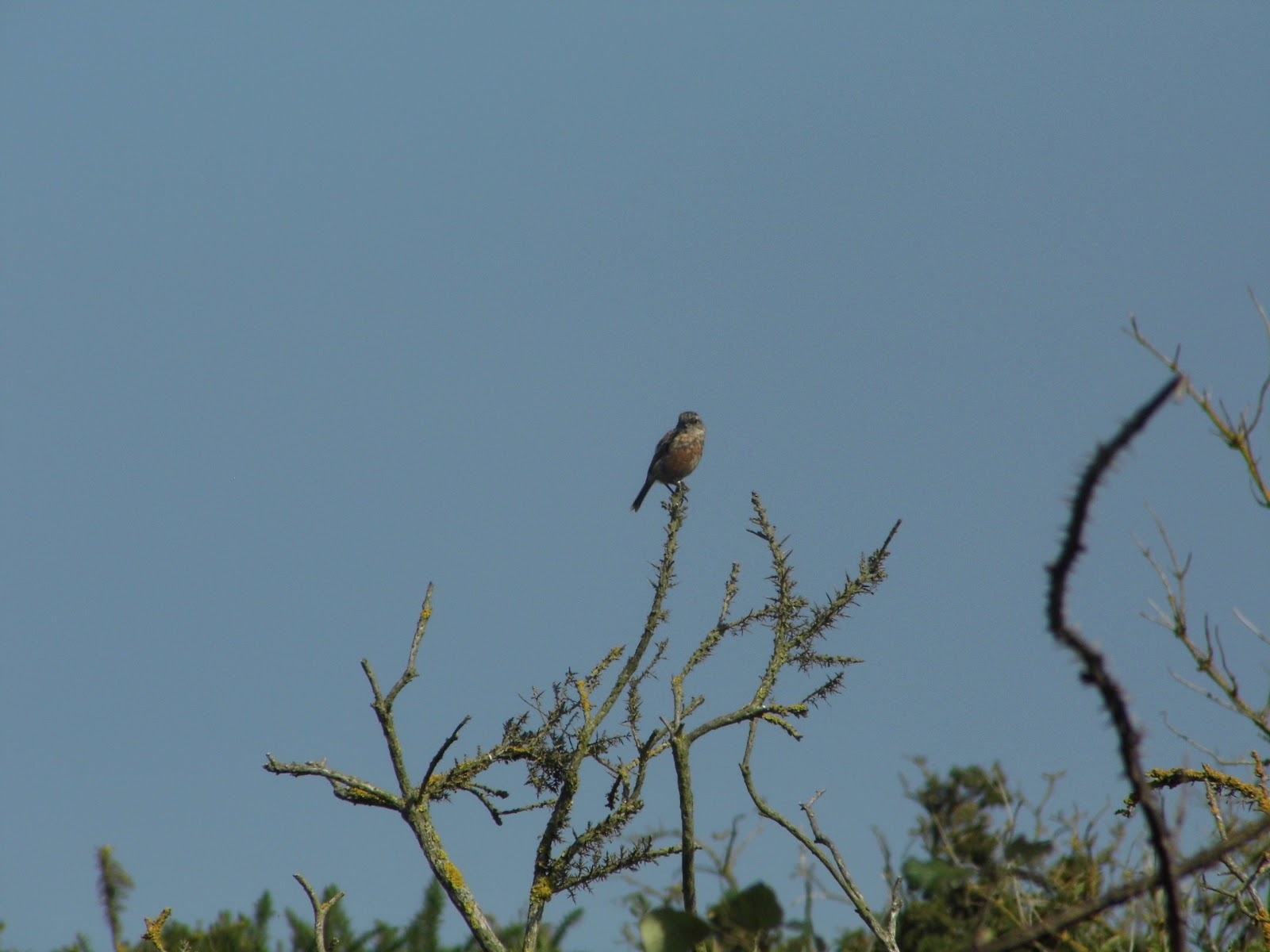
We carried on past the bees to Stiffkey Fen, where we stopped and had lunch. The birds were quite distant, although a flock of 37 Spoonbills stood out. On the way back we paid more attention to the scrub and saw several Stonechats, presumably a family group.

Back at Morston Quay we headed to the toilets and Adam noticed a Frosted Orange moth on the wall. Looking up we realised that there was actually a good range of moths over the ceiling and walls, so once it was empty I quickly moved about and photographed a few. There were more on the outside of the block too. Given the nearby saltmarsh and the coastal location I was hopeful that some of them might be rare, but there was nothing I'd not seen before. Rosy Rustic, Chinese Character and Pale Eggar were some of the scarcer ones. We had a quick look from the observation tower and a tasty sausage roll before leaving.


TARGET SPECIES: Fen Mason Wasp

This week I took a couple of hours out to look for another one of my target species, the Fen Mason Wasp, (Odynerus simillimus). This species was considered to be extinct in Britain as recently as the 1980s, but was rediscovered in 1986 and has since been recorded at a handful of sites in Norfolk, Suffolk and Essex. I had left it late - the main flight period is June/July, but I was hoping there would still be a few about.

Probably the best site in Norfolk for this species is Sutton Fen, which is closed to the public, but fortunately I had been told about another colony along a public footpath in east Norfolk. I was told that the easiest way to find them was to keep an eye on an area of Ox-eye Daisies that they visited regularly. You can imagine my thoughts therefore when I arrived and found that the vegetation along the path had been strimmed, eliminating said daisies.

The only thing I could do is hope to locate the nest holes and keep watch in the hope of seeing a Fen Mason Wasp enter or leave. I headed off, and eventually found a series of holes in the path. There were no turrets, but then these could easily have been knocked down so I wasn't too concerned. I looked down a few holes and saw tiny faces looking back up at me. I was uneasy - they didn't look like my target species. Eventually a few emerged, and as suspected they were a different species, Ornate-tailed Digger Wasp.


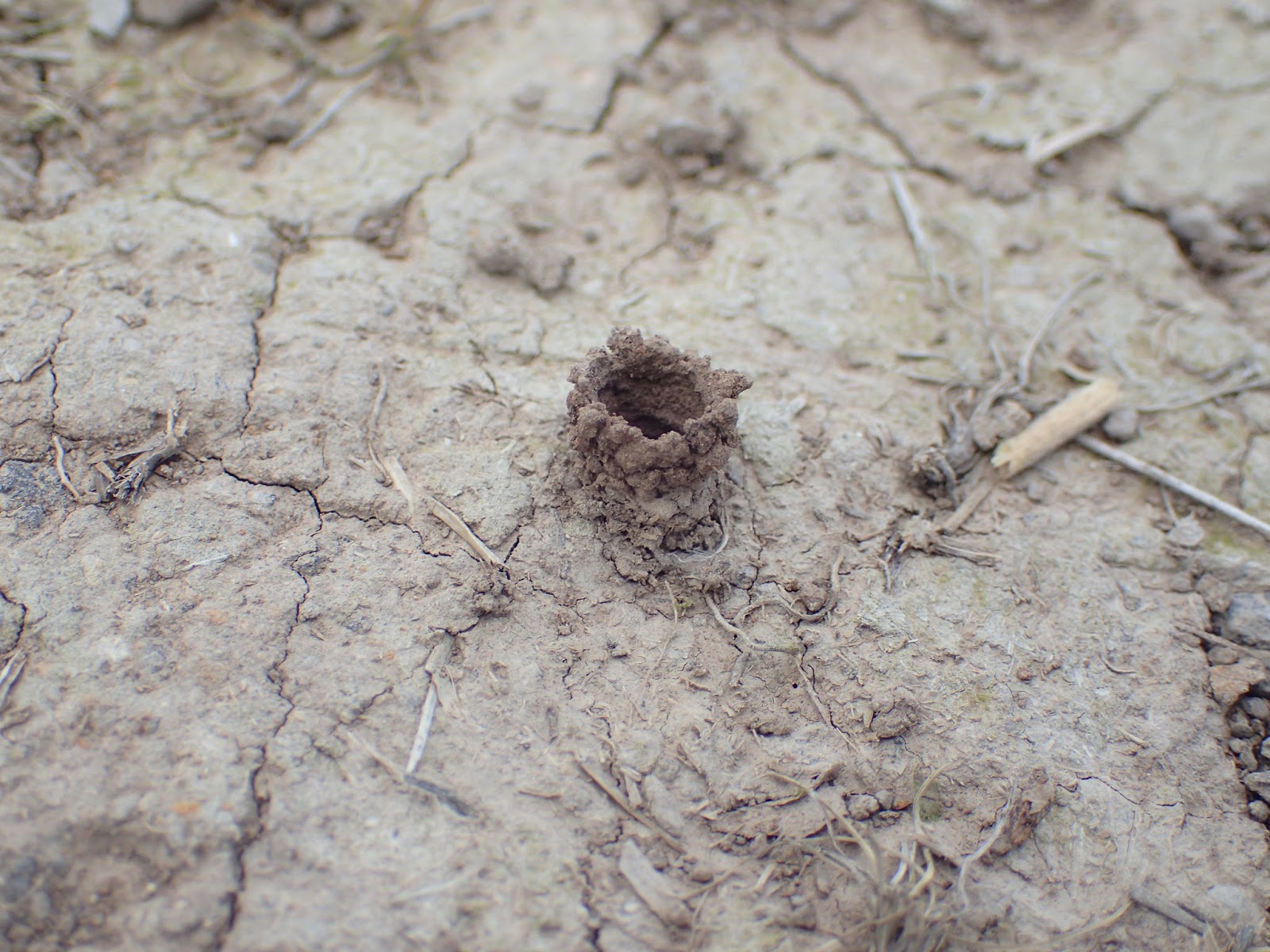
I walked a bit further on but didn't see any more holes. I decided to turn round and double-check I hadn't missed anything, but also texted Tim to check I was in the right place. Fortunately he got back to me before I had given up, telling me that I needed to head a bit further along the path. With renewed hope I turned round and kept searching, and eventually found the holes, this time complete with tiny turrets. A Fen Mason Wasp emerged for one, was on view for about a second and flew off. Hurrah! I had hoped to see one for longer though.


I waited a few minutes to see if the wasp would return, but when it didn't I went a bit further down the path to look for more holes. I didn't find any more, but I did come across some Yellow Loosestrife Bees nearby, which was nice. Heading back to the turrets, I found a place to sit and wait (and have lunch) and after a while a few Fen Mason Wasps returned. One in particular landed in front of me, and walked to a previously unseen whole under a clump of grass. After taking a few photos I left the wasps. It was only then that I could really appreciate the rest of the landscape, the open marshland, low-flying Marsh Harriers and pinging Bearded Tits. An hour ago I was feeling frustrated at missing out on my target, but now I was enjoying being out. A fickle thing this nature watching.

Yellow Loosestrife Bee - note the bicoloured hind legs

TARGET SPECIES: Serotine Bat

15th July 2017

In the evening I headed out to help with a bat survey. Ecologist and Norwich Bat Group member Abi had been working with a church that was in the process of commissioning a new roof, and had discovered Serotine and Pipistrelle bats using the church. She had identified where most of the Pipistrelles were exiting, but wanted to locate the Serotine exit points so that gaps could be left in appropriate places. The simplest way of doing this was for people to be placed around the churchyard watching different points. Fellow Norwich Bat Group member Graham and I both volunteered, whilst several locals also came along, making eight of us in total.

I arrived at the church about half an hour before sunset, and was shown a Barn Owl perched up in a tree just inside the churchyard, a silent white sentinel keeping watch on the church. Abi showed us inside the church, where we saw the piles of droppings indicating the likely roosting areas, and also some feeding signs - the bats clearly had a liking for Yellow Underwings!


Twenty minutes before sunset we had assumed positions around the church. My main focus was the flashing between the main roof and a gable where a smaller part of the church joined on. I pitched my camping chair and sat back to begin my vigil. It was surprisingly serene, despite the traffic noise and a nearby combine, that only stopped working at dusk.


Dusk came and went, a lone Swift flew over and a Kestrel did a couple of flypasts. Ten minutes later our first bat emerged, a Soprano Pipistrelle. It was to remain in the churchyard for the rest of the time we were present, circling and darting in front of us. Thirty minutes after dusk and we were beginning to wonder where the Serotines were when I picked up one on my detector. Graham confirmed it (he was using a more advanced detector that displayed sonograms), but neither of us could see that bat. More Pipistrelles were seen, but finally at ten o'clock another Setotine was detected, and flew right in front of us. It defintely didn't come from our 'sectors', and appeared to have flown through the trees rather than from the church.

We remained in place until an hour after sunset, when the light was almost gone and the only sound was a distant Tawny Owl and the static of our detectors. There was one more Serotine flypast, again seen and detected, but it was probably the earlier individual. The most likely explanation for the low number of sightings and no sightings of exiting bats is that they are currently roosting somewhere else close by and using this church to feed in. So not the ideal result, but an interesting experience for me, seeing a new species of bat and reassuring me that I would recognise the echolocation signature of Serotines. Thanks to Abi for allowing us along and for showing us the signs in the church.

TARGET SPECIES: Northamptonshire Wood White

25th June 2017

After our successful Glapthorn visit we moved on to Salcey Forest, a Forestry Commission woodland. Upon arrival we had found a picnic table to have lunch on, however a sharp shower had us retreating to the car. With good weather we would have been confident of seeing Wood White here, but now with 100% cloud cover and showers our chances were not looking good at all.

We set off into the woods, paying particular attention to the wider rides with Meadow Vetchling and Vetch spp. We reached one edge of the wood without seeing a single butterfly species, although a couple of Ringlets appeared shortly afterwards. Ringlets seemed to be either hardier or more numerous than the other species, as we saw several more close by. A Sabre Wasp was off interest, and Cathy found two tiny eggs on a blade of grass.


After retracing our steps to the last crossroads we took another path along the woods. Having accepted that very few butterflies were on the wing at the moment, we were now checking the undergrowth for roosting whites. This was unsuccessful, but the extra scrutiny did turn up a number of other insects, including a Blood-vein moth, an Alder moth (unfortunately a bit on the dead side), the beetle Ischnomera cyanea and a new hoverfly for me (Leucozona laternaria). A Fox on the path in front of us was another highlight.


We continued around the wood until we got to an open crossroads area, where Carl had seen several Wood Whites the previous year. A search of the area turned up one Large Skipper. It was now a question of how long we were prepared to wait. In the distance there appeared to be a small patch of sunshine, so we agreed to wait and see if that passed over, then call it a day. 

There was a bit of a breeze, so it wasn't too long until there was enough sun to feel the warmth, and almost immediately a White Admiral flew out of a nearby tree. Carl called out that he could see two Silver-washed Fritillaries, but this was ignored as Cathy had spotted a smallish white butterfly. We rushed over and tried to keep watching it as it flew over some scrub. Our hopes were dashed however, when Carl noted that there was a small amount of black on the wingtips - it was a Small White.

The sunny spell was already passing us, but having stayed in the area where the Small White had been I spotted another white butterfly. This one immediately looked better, with a weak lolloping flight and rounded wings. I called the others over and we all agreed it was indeed our target, a Wood White. Not to be outdone, Cathy then found a perched one just to the right of the one we were watching. With the sun now behind the cloud it showed no signs of going anywhere, and we managed to get some good views and photos. Hurrah!


Before we headed off I noticed an odd-shaped insect in the vegetation opposite, which upon closer inspection turned out to be a Dusky Cockroach, another excellent addition to the day's species list.


Thanks to Carl for an excellent tour (if you are interested then you can see a list of tours that he runs here: https://www.wildlifetoursandeducation.co.uk/tours/special-day-tours/)

TARGET SPECIES: Northamptonshire Black Hairstreak

25th June 2017

Last year Cathy & I spent an enjoyable July day in Northamptonshire watching Purple Emperors with Carl Chapman. As I have seen few species of butterfly outside of East Anglia, this year we again joined Carl for a trip to Northamptonshire, this time hoping to see two new species, Black Hairstreak and Wood White.

The first of our targets was the Black Hairstreak. This species can be quite tricky to see, due to a combination of scarcity, a short flight period, an arboreal nature and a habit of only flying in bright sunshine. We arrived at Glapthorn Cow Pastures, which despite the name is now an area of woodland with lots of Blackthorn scrub. The sign on the corner made it clear that no horses were allowed on the reserve, so reluctantly we all dismounted and stabled them before carrying on*.


A bit further along we reached the gate onto the reserve. A neat sign gave an update on the Black Hairstreaks, and it wasn't promising. Apparently they had emerged two weeks early this year (the flight period is often only around three weeks in total) and at the time the sign was written only two tatty butterflies were being seen. It concluded by stating that ny the open day, which was today, it was expected that none would be present. All that remained was to work out whether the author of the sign was a realist or a pessimist.

The other thing we had against us was the weather, which was meant to be largely overcast with some showers. Fortunately for the time being the sun was shining, and a Silver-washed Fritillary flew past us. As we checked out a sunny area of Blackthorn we also saw Brown Hawker and Emperor dragonflies. A few more common butterflies were seen, but then we noticed a small group intently watching something up ahead. Catching up with them we found that it was indeed a Black Hairstreak, which quickly flew round in an arc. Would this be our sole sighting? Well no, because instead of flying off it landed close by on a patch of brambles. It remained here for over 20 minutes, providing my closest views of any hairstreak.


Eventually we decided to investigate further along the path, stopping briefly to photograph a horsefly. We hadn't gone far when we were called back by a shout of Purple Emperor. It turned out that one of the group, who were presumably mostly from the local Butterfly Conservation branch, had spotted a Purple Emperor feeding from a sap run, apparently a first for the site!


The Purple Emperor flew off shortly afterwards, so again set off down the path, and again were called back. This time it was to say that there was a glade close by with multiple Silver-washed Fritillaries present. Following the directions we found the area, which looked very similar to a number of other sunny areas, so why the fritillaries found it so attractive was a bit of a mystery.


After a while we retraced our steps, seeing a White Admiral fly briefly into the treetops. We had been told that a second hairstreak had been seen near the entrance gate, but there was no sign of it. There was a male Gatekeeper, upholding its duties by sticking to the hedge around the entrance. With part one of our trip successful we returned to the car for a cup of tea.


* I might have made that bit up.

TARGET SPECIES: Currant Clearwing

24th June 2017

In recent weeks I had been seeing lots of pictures of Clearwings online, so was aware that if I were to see Currant Clearwing, one of my 2017 targets, I needed to go and look for them soon. I hadn't had time to go to North Norfolk, where a particular fruit farm is known for having many of them, but fortunately a friend with an allotment gave me permission to visit and have a look there.

Given the recent warm weather I was hopeful that it would be sunny and I would stand a good chance of seeing a Currant Clearwing either on some Currants or on nearby flowers. Saturday turned out to be overcast, and having failed to find any clearwings on a search of the vegetation, I resorted to my back-up plan, a pheromone lure. This worked within a few minutes, and I soon saw my first Currant Clearwing, swiftly followed by a second one. I retrieved the lure so as to cause minimal disturbance to any others nearby, and had a good look at the one male that remained nearby.


After spending some time with the clearwings I had a quick look around the rest of the allotment. I saw two plants of interest, Weasel's Snout and Henbane, growing amongst the beds.


In terms of other insects the highlight was one of the ruby-tailed wasps, Hedychridium roseum, whilst there was also a Cerceris wasp sp. As I was leaving I noticed a black Crossocerus sp, an all black wasp with huge eyes - very alien looking! I had planned to head over to Earlham Park to look for hoverflies, but fortunately had looked on the EDP website earlier and realised that there was an 80s Pop concert going on there, so instead I headed to Trowse, which I will post about separately.


BRECKLAND: Weeting Moths

17th June 2017

Saturday was initially the date for a fungus study group foray at Sculthorpe Moor, but this had been rescheduled. There were a range of places I could have gone, but I had settled on a moth and butterfly event at Weeting in the hope of seeing some Breckland specialist moths. Cathy had agreed to come with me, although she perhaps regeretted it when it became evident how hot it was going to be. Two of the main species I hoped to see were Lunar Yellow Underwing and Cream-spot Tiger moth, rare and spectacular respectively.

The event was advertised as 10-12, so I assumed that this would be about an hour going through a moth trap, followed by a short walk to look for butterflies and day-flying moths. This turned out to be a mistake on my part, as when we arrived the moth trap had been checked and the species were neatly laid out on a table, complete with labels. We had a look at them, then were taken out for a two-and-a-half hour walk!


Sadly there was no Cream-spot Tiger, but Lunar Yellow Underwing had been caught. There were several other new species for me as well, including Brown Scallop, Satin Wave, Four-dotted Footman and Plain Wave. Festoon was also new, and slightly ironic as Gary had caught one in Norwich the previous evening and invited me round to see it that afternoon.


The walk started well, I found a new plant bug, Capsus ater, and Cathy found a Dune Chafer, a nice metallic species which depsite the name does occur in some sandy inland areas like the Brecks. A bit further on a couple of birders got a Stone-curlew in their 'scope for us. After that most of the walk could be summarised by the phrases 'very hot' and 'another Meadow Brown'. It was interesting to see an area of the reserve that I'd not walked along before, including a recently reverted field. There were quite a few Small Heath butterflies, Cathy spotted two Grey Partridges and a Brown Plume was a new moth to add to the earlier ones. Once we got to Hockwold Heath we turned round, and despite the heat made it back to the car in good time.


By now rather hungry, we called in at the Brandon Country Park cafe for lunch before heading back to Norwich.

TARGET SPECIES: May Lily

19th May 2017

With a busy weekend ahead, I had arranged to go to the north Norfolk coast after work on Friday to see May Lily, another one of my target species for the year. I had previously searched for them without success, but this year John Furse had very kindly found their location and checked on them earlier in the month to ensure that some had begun to flower before I looked. We met nearby and convoyed to the edge of the heath, before taking a track to a small area of woods. Here May Lilies were growing on both sides of the path, and looking good despite the drizzly conditions.


After looking at the May Lilies we walked back, looking for moths as we went. The few that we did see well enough to ID were all Grey Gorse Piercers. I also found Coleophora cases on birch and rowan.


BRECKLAND: Breckland Speedwell & Brandon invertebrates

April 2017

The second of my target species for 2017 was Breckland Speedwell, a species that I had looked for in 2016 but not seen. Once of the remaining Norfolk sites for this species is a roadside nature reserve at Thetford, where it grows alongside the very similar Fingered Speedwell. The verge is quite a small one, so Cathy & I set about searching for small blue flowers. Most of these turned out to be Early Forget-me-not, but I did locate a single flowering spike of Breckland Speedwell. This year was a complete reversal of last year, when Ian & I only found the Fingered Speedwell.

 Early Forget-me-not
 Breckland Speedwell

Having successfully located our target species, we headed off to Brandon Country Park for lunch and a walk in the woods. Outside the cafe I had a look at a hoverfly and found that it was one I'd not recorded before, Meliscaeva cinctella. A Rosemary Beetle was present on the lavendar nearby, a regular find here.


After lunch we went down to the lawn near the lake. I had been told that one of the Cedars that grows nearby had Cedar Cup fungus growing around it earlier in the season, but we couldn't find any. Some tiny Spring Vetch was found, and we watched a column of ants moving from one tree to another. Avian highlights of our walk included a flyover Crossbill and a Brambling, whilst we stopped to watch a hole in the path that Cathy had noticed and were rewarded with views of two female Tawny Mining Bees.