The Whitlingham Bird Report for 2025 is now available to download from the Bird Reports page or from here

Showing posts with label Solitary wasp. Show all posts

WHITLINGHAM: Ectemnius and a Backswimmer

September 2021

A couple of visits to Whitlingham, one of which was the WeBS count, but the most notable things were a large Ectemnius wasp (I had hoped that with reasonable photos I might be able to identify this to species - E. cephalotes was my suggestion, but the resounding silence on the BWARS Facebook page suggests it probably has to stay at genus) and Notonecta glauca, one of the Backswimmer family of water boatmen.


THORPE MARSHES: A scattering of new insects

17th June 2018

After completing the WeBS count at Whitlingham I nipped round to Thorpe to count there in case Justin didn't get time. It was marginally better than Whitlingham, with 2 Tufted Ducks, 1 Gadwall and 3 Lapwings of note. I did a quick lap, but still managed to see some interesting insects, mostly on patches of Ox-eye Daisies.

 Twin-lobed Deer Flies
 Volucella pellucida
 The alien-like face of a male Lindenius albilabris solitary wasp
 Colletes daviesanus
Fen Snout (a soldierfly)

TARGET SPECIES: Fen Mason Wasp

This week I took a couple of hours out to look for another one of my target species, the Fen Mason Wasp, (Odynerus simillimus). This species was considered to be extinct in Britain as recently as the 1980s, but was rediscovered in 1986 and has since been recorded at a handful of sites in Norfolk, Suffolk and Essex. I had left it late - the main flight period is June/July, but I was hoping there would still be a few about.

Probably the best site in Norfolk for this species is Sutton Fen, which is closed to the public, but fortunately I had been told about another colony along a public footpath in east Norfolk. I was told that the easiest way to find them was to keep an eye on an area of Ox-eye Daisies that they visited regularly. You can imagine my thoughts therefore when I arrived and found that the vegetation along the path had been strimmed, eliminating said daisies.

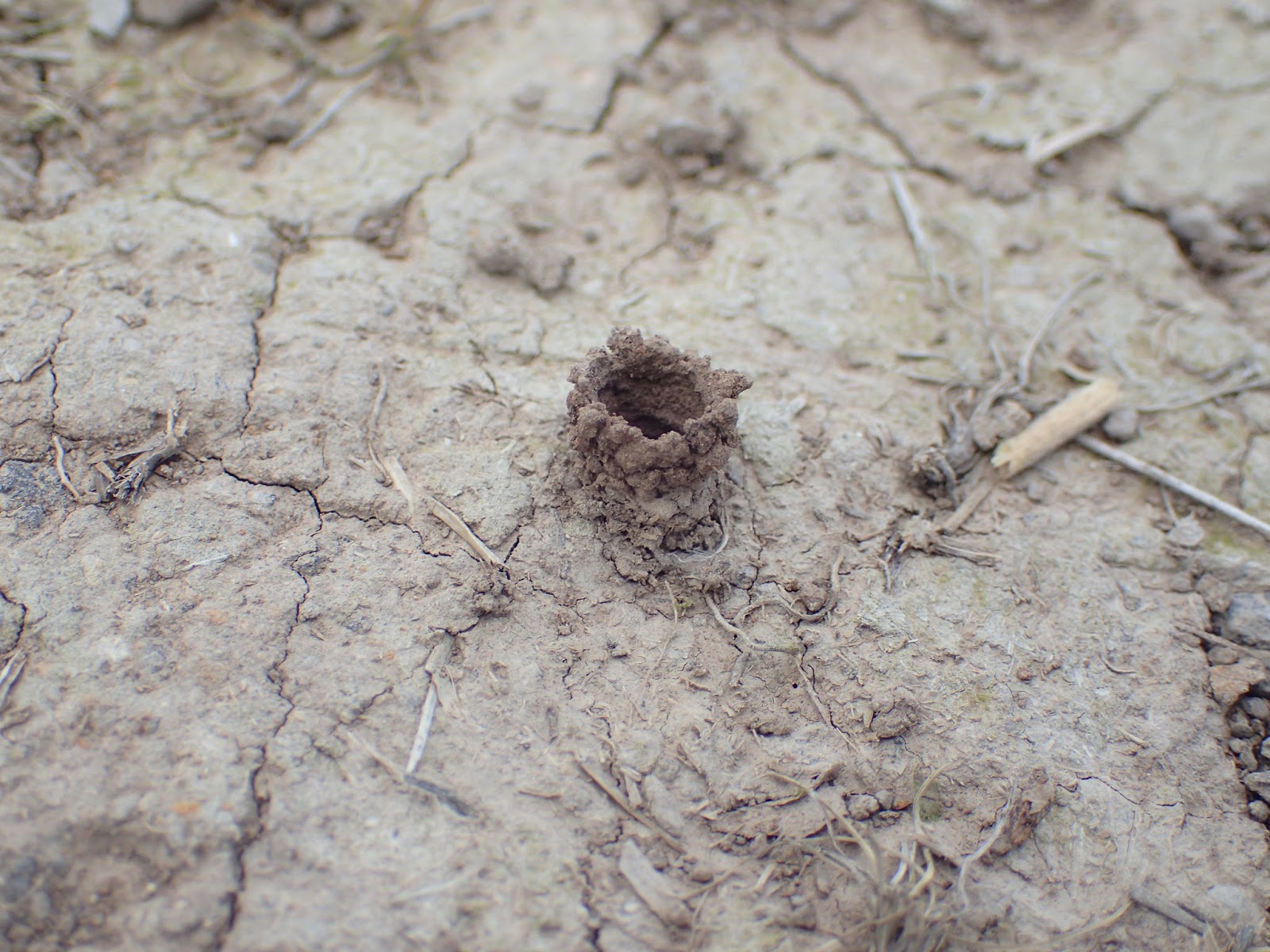
The only thing I could do is hope to locate the nest holes and keep watch in the hope of seeing a Fen Mason Wasp enter or leave. I headed off, and eventually found a series of holes in the path. There were no turrets, but then these could easily have been knocked down so I wasn't too concerned. I looked down a few holes and saw tiny faces looking back up at me. I was uneasy - they didn't look like my target species. Eventually a few emerged, and as suspected they were a different species, Ornate-tailed Digger Wasp.


I walked a bit further on but didn't see any more holes. I decided to turn round and double-check I hadn't missed anything, but also texted Tim to check I was in the right place. Fortunately he got back to me before I had given up, telling me that I needed to head a bit further along the path. With renewed hope I turned round and kept searching, and eventually found the holes, this time complete with tiny turrets. A Fen Mason Wasp emerged for one, was on view for about a second and flew off. Hurrah! I had hoped to see one for longer though.


I waited a few minutes to see if the wasp would return, but when it didn't I went a bit further down the path to look for more holes. I didn't find any more, but I did come across some Yellow Loosestrife Bees nearby, which was nice. Heading back to the turrets, I found a place to sit and wait (and have lunch) and after a while a few Fen Mason Wasps returned. One in particular landed in front of me, and walked to a previously unseen whole under a clump of grass. After taking a few photos I left the wasps. It was only then that I could really appreciate the rest of the landscape, the open marshland, low-flying Marsh Harriers and pinging Bearded Tits. An hour ago I was feeling frustrated at missing out on my target, but now I was enjoying being out. A fickle thing this nature watching.

Yellow Loosestrife Bee - note the bicoloured hind legs

NORWICH: More from Catton Park

29th July 2017

On Saturday afternoon I paid another brief visit to Catton Park to look for insects. No jazz gig this time, but there was a theatre production of Alice in Wonderland going on in the picnic meadow, so that part was off limits. I noticed some Large White butterfly caterpillars near the picket fence, before moving around to the areas of knapweed.


The knapweed was attracting lots of bumblebees, but not too much else, so I switched attention to the Wild Carrot. Here I noticed quite a few individuals of a solitary wasp that I didn't recognise - fortunately Stephen Boulton on the BWARS facebook page was able to identify them as Tiphia femorata. There was also a Pompilid (Spider-hutning wasp), but most of them need a specimen to identify them to species level.


Other species of interest in the meadow included the distinctive Tachinid fly Nowickia ferox, a lateish-instar Long-winged Conehead (the nymphs of Short winged and Long-winged Coneheads look the same, but if its a female you can separate them once the ovipositors have grown) and some Small Tortoiseshell caterpillars.


Rather than carry on around the meadow I looped back round into the woods. An agromyzid leaf mine in Hedge Woundwort was a new one for me (Amauromyza morionella) and I was also pleased to find a mine in Rowan caused by Stigmella nylandriella, which up to that point had not been recorded in TG21 (or the other main Norwich square TG20, so I'll have to look for it at Whitlingham too). My final species of interest was also on the same Rowan tree, a well camouflaged Brimstone Moth caterpillar.


NORWICH: The disappearing plant

1st July 2017

On Saturday I headed to Thorpe St Andrew, where I was looking forward to seeing a plant of Purple Viper's Bugloss, a scarce plant not mentioned in the Flora of Norfolk and therefore possibly a county first. It had been found at the start of the week on a roadside verge by Chris Durdin, who fortunately recognised it from leading wildlife tours on the continent. Recognising that this was the sort of thing I'd be interested in, he kindly emailed me with directions.

As it was on a main road, I parked nearby and walked across to the verge. I had seen a photo so knew it was a tallish plant, so I was a bit concerned when I couldn't find it. Naturally I thought I was in the wrong place, so extended my walk a bit in each direction, with no luck. Slowly it dawned on me that the rest of the vegetation was very short. The verge had been recently cut, and the Purple Viper's Bugloss had been completely destroyed. I contacted Chris just to double-check I was in the right place, and he confirmed I was and the plant was gone. Darn. Hopefully it might grow back either this year or next, but if not then it has to be one of the shortest stays of a rare plant in Norfolk.

Whilst in Thorpe I had a look around, hopeing to see a few more plants of interest but again with no luck. I did manage to find something new, a red-and-black wasp that predates shieldbugs and goes by the for some reason excellent name of Astata boops.


WHITLINGHAM: Grasshoppers and lots more

16th August 2016

On Tuesday evening I headed out after work, intending to have a quick stroll around Trowse Meadow and the common behind the church, which I haven't visited in years. A combination of work and football parking meant that there was nowhere to pull up along Whitlingham Lane, so I changed plans and instead headed off to the woodland car park.

My first port of call was the woodland watchpoint, although tree growth in front of it means that hardly any of Thorpe Marsh can be seen. I had a look at a decaying tree nearby in case the Coral Tooth fungus was fruiting, but there was no sign of it yet. Out of the woods I visited the lime tree that had attracted so many insects on my last visit, but it was no longer flowering. There were quite a few hoverflies on the Buddleia and knapweed flowers, so I decided to walk along the wildflower meadow to the Great Broad, then to the east end of the Great Broad before retracing my steps.

I saw lots of invertebrates, so this account is just the selected highlights. During a period of sunshine I stopped and heard some grasshoppers calling. Previously I have only recorded Field and Meadow Grasshoppers here, so I was keen to check them both out as Common Green Grasshopper should occur here too. The first grasshopper was green, and looked promising, but I was a bit concerned about the lack of white on the edge of the scutellum markings, and after posting I double-checked and I now think it is a Meadow Grasshopper. The second one was definitely Meadow Grasshopper. Dark Bush Crickets were also calling, but I didn't attempt to find any.

 Meadow Grasshopper - greener than the more 'typical' one shown below
 Meadow Grasshopper

Along the Great Broad shore I noticed a dark looking wasp. I had seen one a few visits ago and it had eluded me, but this one at least allowed one photo before vanishing. It appears to be a worker Median Wasp, a new species for me. As is so often the case whilst I was inspecting the foliage carefully I found another interesting species, the very colourful Black Willow Bark Aphid (you may need to click on the photo to see the white and orange spots).


Despite checking lots of hoverflies, they all appeared to be species I'd seen before except two. The first one. Epistrophe grossulariae, is new for me provided I've identified it correctly. The second looked initally interesting in the field, but turned out to be Eristalinus sepulchralis, a species that I have recorded here once before.


Scorpion flies are a common sight throughout the country, but not everyone realises that there is more than one species. Only the males can be identified in the field, and then it requires a good view of the genital capsule. I saw one basking and thought it looked a bit daintier than normal, but I managed to get close enough to photograph it and it was Panorpis germanica, the commonest species.


On my way back I stopped to look at a Caddisfly on an Alder. Whilst looking at it I saw a large sawfly larva on the next leaf up. The appearance and host plant suggest that this is the Large Alder Sawfly, Cimbex connatus, that was only re-discovered in Norfolk five or so years ago after a long absence. We currently don't have a Norfolk Sawfly recorder, but I have asked Tony, one of our top dipterists, if he is aware of any other Norwich area records.

 Caddisfly sp.
 Sawfly larva on Alder

In fact there was another new species too, a solitary wasp called Lestiphorus bicinctus. So there we go, a highly productive hour and a half, particularly as I hadn't intended to go to that area originally.

Lestiphorus bicinctus