The Whitlingham Bird Report for 2025 is now available to download from the Bird Reports page or from here

Showing posts with label Gulls. Show all posts

WHITLINGHAM: August WeBS, pesky gulls and patch additions

12th August 2018

With the summer continuing apace, I headed to Whitlingham for the August WeBS count. The Little Broad is becoming increasingly tricky to count as the vegetation grows up, but in summer there isn't usually much to worry about. A lone adult Egyptian Goose had three young goslings, which will hopefully fare better than the first brood. This species did used to cycle through nicely when I first started coming, but of late not many young seem to be reaching adulthood here.

On the Great Broad there wasn't much of note, a single Tufted Duck asleep on the island the most noteworthy. There was a lot of large gulls dropping in though, mostly Lesser Black-backed, and given that I reckon I miss some Yellow-legged Gulls in the younger plumages I photographed a few of the ones in slightly different plumages just in case.


Of the common stuff (combined with Justin's Thorpe Broad count):
Mute Swan:52 (2017: 43)
Egyptian Goose: 29  (2017: 16)
Mallard: 136 (2017: 137)
Coot: 12 (2017: 17)

So numbers similar to the previous year. The Egyptian Goose count is almost double the 2017 figure, but in July this year was only 8. In July last year it was 33, so basically there has been a yearly peak of around 30, but this year it's just a month later.

I added a few bits to my all-species patch list. An odd addition was Ploughman's Spikenard beside one of the main paths. I must have been walking past this for years without noticing it - I can only assume it's because the flowers look a bit like dying Ragwort. A couple of species were completely new to me, a nice red beetle called Platycis minutus and the hoverfly Dasysyrphus albiostratus. I also added a couple of leaf mines, which on this occasion I won't bore you with.


WHITLINGHAM: Watching the gulls go by

11th March 2018

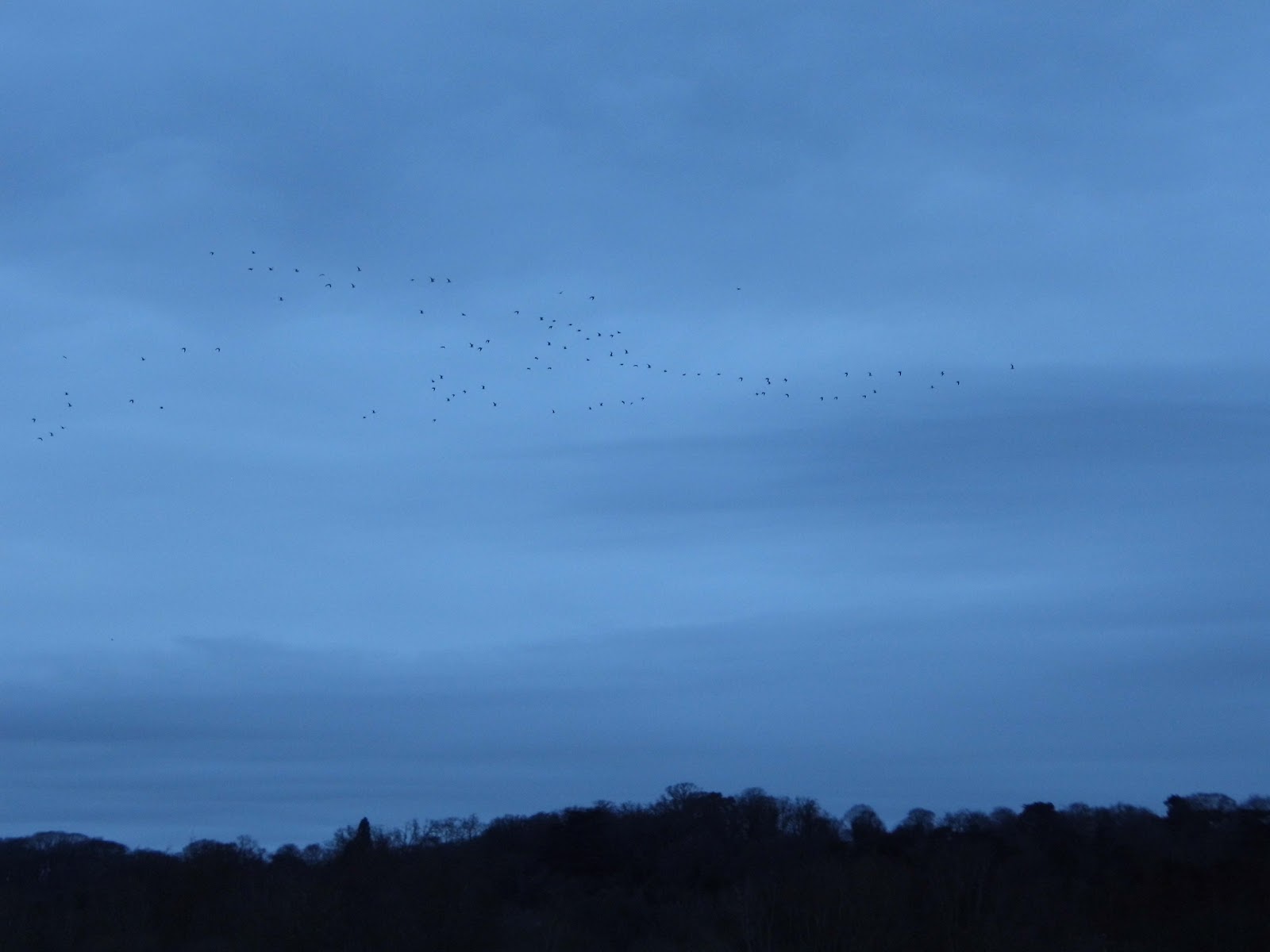
After a busy couple of weeks I headed down to Whitlingham on Sunday evening to watch the gulls flying off to roost. This is quite a relaxing thing to do, although it had a bit more purpose about it on this occasion as I was checking them out in the hope that the erratically appearing Norwich Glaucous Gull would be amongst them. Having had a look at the new pond dipping pagoda, I walked as far as the island I turned back to watch them coming from the city, all the while serenaded by a Blackbird singing from trees along the lane. A Green Woodpecker yaffled sardonically from the picnic meadow, seemingly not fancying my chances of seeing my target.


After a while the traffic noise from the A47 became just a loud hum in the background, a reminder that unlike a big grazing marsh the site sits properly on the border between urban and rural landscape. For some reason the period around dusk seems to fit well with this liminal atmosphere. A flock of a couple of hundred Starlings flew west with barely a murmur - presumably going to join up with a bigger flock for aerial manoeuvres. Most of the wildfowl was silent, save for the occasional frenzied honking of the geese. Jackdaws began to congregate on the far side of the broad - in the past few years a roost of hundreds has established itself on the main island. As the evening wore on they rose and chacked loudly, spiralling over their favoured tree like a Hitchcockian Buckenham-lite.


Despite these sensory diversions (and some interesting bands of cloud) I was mainly concentrating on the gulls, which tended to be passing over in bursts. I let the ones that were slighlty behind me or too high to see well go, but tried to check out the rest, particularly the ones that looked larger than their flying companions. These were typically Herring amongst the Black-headed Gulls, and after a while I headed back to the car. The light looked good for a Barn Owl to be out, but it was not to be.


NORFOLK: Some wildlife snippets

w/c 5th July 2017

I'm not actively participating in the Wildlife Trust's 30 days wild thingy, but if I was, then the following observations (mostly around Norwich) would have been of note.

Lesser Black-backed and Herring Gulls have been moving into towns and cities for some time now - last week I noticed these LBB Gulls mating on a flat roof in the city centre.


When Cathy & I found a beetle on its back in our porch, the most likely species would have been one of the violet ground beetles. However, when I turned it over (carefully - look at the jaws!) it was a Lesser Stag Beetle.


I regularly walk down Lakenham Way, and there are quite a few different types of Cranesbill growing there. This group can be tricky to identify, but this is a relatively easy one because of the nice pattern, called Pencilled Cranesbill.


On Friday Karl and I went to a beer festival at Buxton Church as part of the Twelve Towers Festival. Beer was supplied by Wildcraft Brewery, who are particularly into foraging for ingredients. Three of the beers I tried contained foraged ingredients - the pictured one was made using Sloes, whilst I also tried beers containing Stinging Nettles and Yarrow. The Sloe one was nicest (although one using cherries got Karl's vote).


THORPE MARSH: Jack Snipe & some fungi

16th February 2014

I had a bit of time to go out, and I decided that instead of going to Bowthorpe to see the Great White Egret I should head to Thorpe and have a look round the marsh. After parking up I walked back to the green to see if I could find the Med Gull. Despite the large amounts of gulls present there was no sign of it - as far as I'm aware it hasn't been seen since 9th Feb - please let me know via the comments if you have seen it since then. I did see a couple of ringed gulls, the Norwegian white-ringed bird J0AR and a metal-ringed 1st winter that I couldn't read the ring of.


After a while I headed back along the road and across the heavily scaffolded footbridge to Thorpe Marsh. There wasn't much on the flood and a pair of Kestrels were the only birds of interest flying around. When I got as far as the wooded area between the path and the river I decided to have a look for some fungi. I moved closer to one of the ditches and nearly stood on a Jack Snipe! It flew up from a couple of feet away, silently flew across the path and dipped down close by but out of sight amongst the rushes. This brief encounter was all the better for being the first time I've seen a Jack Snipe here for about five years.

I carried on as far as Bungalow Lane, checking extra carefully for any more Jack Snipe, but without success. I suspect there are a few (along with lots of Common Snipe) scattered throughout the innaccessible parts of the marsh. In terms of fungi I found a small Scarlet Elf Cup, Willow Barkspot, Blushing Bracket, Southern Bracket, Turkeytail, Velvet Shank and probable Bleeding Broadleaf Crust.


On the broad there were lots of gulls, 10 Pochard, c30 Gadwall and c40 Tufted Duck, plus some Lapwings on the shingle spit. Whilst I was scanning through the gulls I spotted a large bird of prey fly through my view. It dipped below the reeds, but when it emerged I was able to ID it as a Marsh Harrier. Marsh Harriers are fairly regular at Thorpe, but given my visits here are more sporadic than Whitlingham it was still a good patch bird to see early in the year. On my way back to the railway bridge I spotted a male Sparrowhawk perched up too so quite a productive visit!


WHITLINGHAM: New Year's Day

1st January 2015

Having stayed overnight in North Walsham my first bird of the year came in the form of a flock of Long-tailed Tits. I heard them calling outside, and looking out of the window they were in a nearby Silver Birch tree before flying into the hedge a couple of feet from the house. We saw another five species from the house, combined with a few more on the journey back to Norwich.

After lunch Cathy & I headed to Whitlingham for a quick look around. On the way down Whitlingham Lane it became apparent that not only was it quite busy, but quite a few people had got together and made a new year's resolution to ignore the path and wander obliviously down the road. I'm not convinced they will be able to keep it up all through the year though.

Having safely dodged the pedestrians we set out back towards the Little Broad, passing a flock of 32 Greylags on the meadow. We quickly added Gadwall and Tufted Duck to the year list, whilst Cathy spotted a sleeping Wigeon (a bird I didn't see here until December in 2014) along the far shore. A bit further round was a Shoveler, and there were two more at the east end. There were hardly any small birds around, but we did stop to look at a log with a lot of Olive Oysterling fungi on.

Scanning across the Great Broad Cathy pointed out a Cormorant that was acting strangely. Upon closer inspection it became apparent that it had caught an Eel and was trying to swallow it. This took quite a while, and even when it had got the Eel completely inside you could still see it squirming in the Cormorant's throat. As we carried on I looked through the gulls and noticed a 1st-winter Great Black backed Gull, a decent January 1st bird here. It was defending a crust of bread against all comers. Further along we scanned towards the island, adding Grey Heron and Teal, whilst a Fieldfare flew over. We finished on 34 species, 25 of which were at Whitlingham.