The Whitlingham Bird Report for 2025 is now available to download from the Bird Reports page or from here

Showing posts with label Broads. Show all posts

BROADLAND: Few fungi but a rare case-bearing moth

17th April 2021

After more than a year's absence, Fungus Study Group events recommenced with a trip to a private Broadland location, with numbers restricted to groups of six. It was a beautiful sunny day in an unspoilt area, and although the dry conditions restricted us to a small number of mostly tiny plant fungi it was really nice to be out with the group again. We watched some hares chasing in a nearby field, a couple of Cranes flew over and some Bearded Tits flew down a dyke. 

 Of the fungi, the new species were all aforementioned small obscure ones, including Rush Disco (Lachnum apalum), Ascodichaena rugosum (a black fungus on Oak branches) and Ophiognomonia ai-viridis (tiny black spikes along the petiole of dead Alder leaves).


 We stopped for lunch near a mass of flowering Gorse, which contained well over 20 Gorse Shieldbugs, loads of Gorse Weevils and my first Large Red Damselfly of the year. A Water Measurer was of note on a pool, whilst species of the day was an occupied case of the rare micro moth  Water Dock Case-bearer (Coleophora hydrolapathella)


YARE VALLEY: In search of the Cowbane Rust

Mid-August 2019

The Norfolk Fungus Study Group meets regularly throughout the year to survey sites for fungi, but the group also conducts ad-hoc searches or monitoring for particular species as suggested by the Lost & Found fungus project here: http://fungi.myspecies.info/content/lost-found-fungi-project-rusts-smuts-and-allies. In recent years we have successfully found the (previously considered) rare rust Puccinia cladii on Saw Sedge, and it was suggested that the group should look for the rust on Cowbane, Puccinia cicutae. Cowbane is quite a scarce plant nationally, but is locally common in the Broads along the edge of waterways.

With all this in mind, the group had obtained permission to survey Wheatfen in the hope of finding Cowbane Rust. This meant going out on a boat, as most of the Cowbane isn't accessible from the paths. The amount of waterweed meant motor vessels were out, and before our visit the warden had found that there was too much vegetation for the work boat to go out either. It was therefore down to six of us to take out three small boats that could still get down the dykes that link Wheatfen Broad and Deep Waters. I should point out that any form of canoeing or boating is not allowed at Wheatfen other than for conservation purposes and with permission of the warden/Ted Ellis Trust.

Will and Kevin helped us launch the boats, and we spent a very pleasant couple of hours travelling along the dykes and edges of the larger waterbodies, checking every clump of Cowbane we encountered. Sadly for us it all looked healthy, although of course it could be that the rust would have developed later in the year, so another visit at some point might be wise.


After a rest and a drink we then went out for a walk around part of the reserve. We were shown some of the plants that Ted Ellis had planted and have now naturalised, namely Greater Burnet-saxifrage and Broad-leaved Ragwort, which don't occur anywhere else in Norfolk. We were then taken off-piste into one of the boggy areas of tidal woodland, where after some searching and loss of wellies Will managed to locate a small population of the very rare moss Timmia megapolitana, whose only UK population is at Wheatfen.


Despite not seeing the rust I did see a new fungus - there hadn't been space in the boats for Neil so he had gone for a walk instead, and he returned with an Iodine Bolete (Boletus impolitus), which as the name suggests has a strong smell of Iodine at the base. 


Many thanks to Will and the Ted Ellis Trust for helping us with the survey and walk, it was a privilege to visit some new parts of this excellent site.

BROADLAND: A rare fungus on Monkey Puzzle trees

11th August 2018

I am aware that some of my interests are somewhat niche, even within wildlife circles, but it isn't just me. I was reminded of this before a fungus study group meeting in mid-August. We were going to Burgh Common, an out of the way site managed by the NWT, so had met in a car park nearby. Stewart Wright had arrived early to check out a local churchyard, where he had looked for fallen Monkey Puzzle scales (I don't think they are classed as leaves on this species) and had found some with a micro fungus growing on. The species, Phomopsis araucariae, was new for Norfolk and one of only a handful of UK records. I presume that like the species I found on Ginkgo last year this will turn out to be present on most Monkey Puzzle Trees.


BROADLAND: How Hill fungi

16th September 2017

Todays fungus study group foray was at How Hill, and as I headed there the steady rain and copious amounts of standing water made me wonder if I had made the right decision to attend. The thought that my other option for the day had been a freshwater snails workshop at Carlton Marshes (further away and less shelter) cheered me up a bit. As expected the weather and the fact that it was the second foray of the month meant a slightly reduced group, although numbers were built up by four members of the How Hill staff.

We headed off into the woods and began to accrue species straight away. Crepidotus sp are common on forays, but one taken by Tony turned out to be Crepidotus versutus which was a new one for me. Purple-edge Bonnet (Mycena purpurescens) was another good one, amongst the 20 or so species we saw before the heavy rain drove us back to the house. Most places we visit have very little shelter, so we were lucky to have a lounge with hot drinks and cake!

View from the not-quite-aptly named sun room

Once the rain had eased a bit we headed back out. Picking up where we left off we were shown some Spectacular Rustgills that fruit each year, along with Stump Puffballs, Crested Coral and Rutstroemia echinophila for the second foray in a row. A good range of Mycenas were being found, about 14 or 15 different species providing Yvonne with lots of work back at home. I found some cup fungi growing on the petiole of an Oak leaf to go with the related cups on bark and Chestnut casings.


We stopped in the secret garden for lunch at the summerhouse, before exploring the lawns nearby. Lizzy, who had been quite prolifically finding new species for the day list seemed disappointed when a clump of white spheres turned out to be Grass Snake eggs rather than a fungus - several of us rushed back to have a look. Sadly rotten, but the first time I've seen them. Fungi kept being found, with a rust on Potentilla, Larch Bolete, Birch Knight and Deer Shield. The sun actually came out for a spell, and insects were suddenly visible, including Willow Emeralds and a Rhododendron Leafhopper.


Checking the area alongside a path we saw Papillate Pinkgill (confirmed by Alex)  and some Moor Clubs. There was a distinct lack of moorland, which puzzled us, but Tony confirmed later that they were indeed this species. We finally left the secret garden and crossed the woods, where I found three Lion Shields, completing the set of the three yellow shield species for me.


Out on a large lawn we were hopeful for some Waxcaps and other associated species, but unfortunately we were either too early or it wasn't as good as it looked. Pink Domecap was a decent find, but some part-mown Yellow Clubs were the only CHEG species. Just off the grass some Jellybabies were found under the wooded edge.


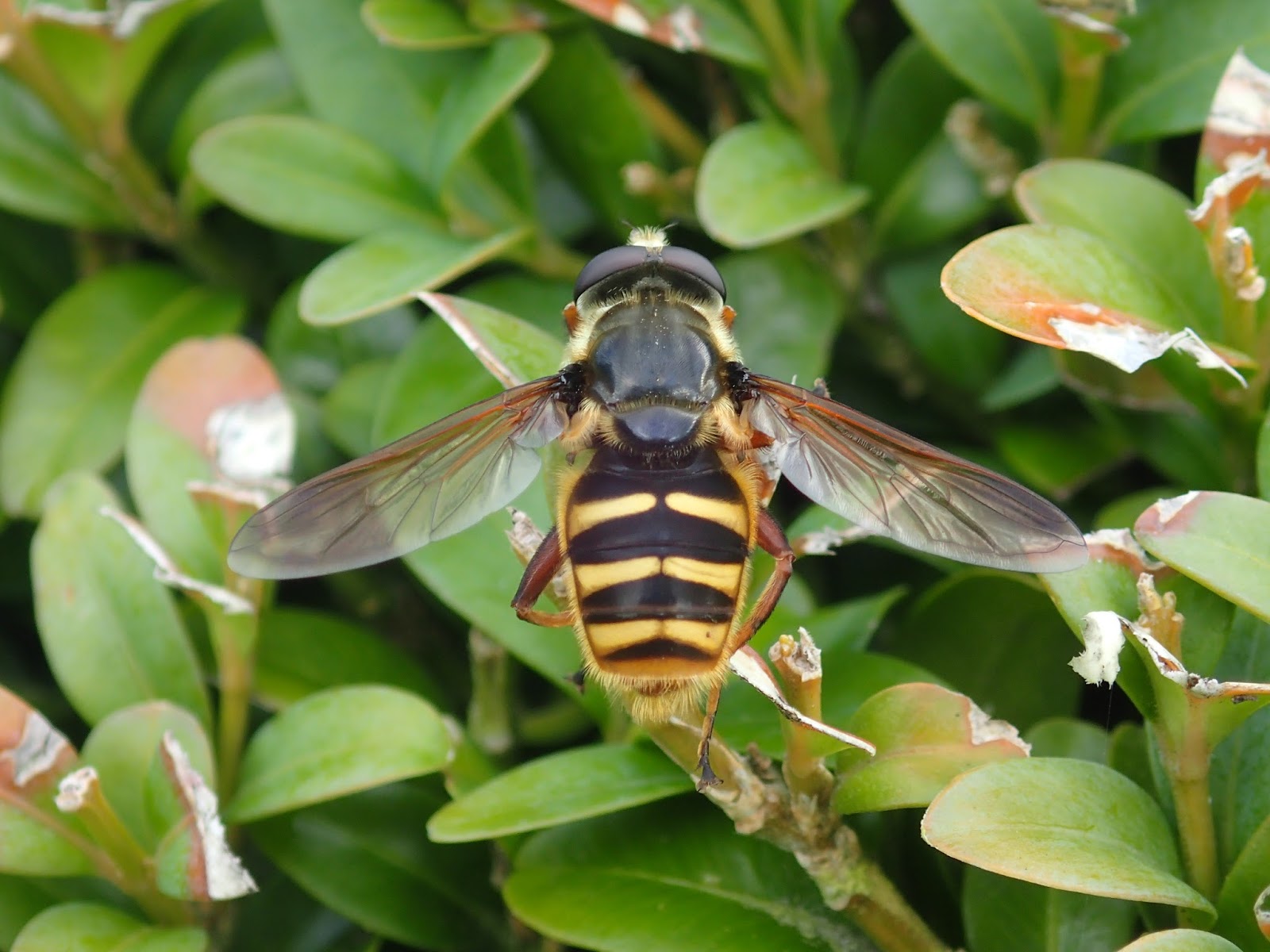
Before leaving we had a look around the car park and the lawn in front of the house. A few more species were added, including Meadow Coral, although the pick was probably some small ascomycetes that Yvonne found growing on a Dryopteris fern. They turned out to be Psilachnum chrysostigmum, the second Norfolk record. An obliging Sericomyia silentis hoverfly was also nice to see. Altogether we managed over 110 species, the most I remember on a foray for quite some time, so I'm glad I wasn't put off by a bit of rain!


BROADS: A first visit to Alderfen

15th July 2017

I started a wildlife-filled weekend with a visit to Alderfen Broad, one of the few Norfolk Wildlife Trust reserves in east Norfolk that I hadn't previously visited. The reason for going was as part of the Norfolk Fungus Study Group programme, but I suspected that given the time of year I was more likely to see new insect species than fungi. The reserve is down a long un-made and un-signed track - fortunately Yvonne was posted on the road to direct us, although I still got the impression that we could end up in a farmyard or discovering a long lost tribe as I travelled along it.

Whilst waiting at the car park I looked around and found an interesting beetle, Malthinus flaveolus. This is one of a sub-family related to the soldier beetles, and my first of this genus. Once we had all assembled we headed off around the circular trail. Tim took the path into the open area, whilst the rest of us went into the woods. We found a few microfungi, including some small black spots on Holly twigs that are probably a second for Norfolk. Tawny Grisette and a Bolete sp. were two of the larger species found.


It began to drizzle, but this first shower just passed over. Raspberries, Redcurrants and Blackcurrants all grew near the path, distracting the hungrier amongst us. A few more small agarics were found, Tubaria, Rickenella, Marasmius and Mycenas. A couple of Willow Emerald Damselflies were present, along with a Chrysotoxum bicinctum hoverfly.


Out in the open we met up with Tim. He pointed out a few things he had found on his walk, including Swallowtail caterpillars at various stages and an interesting moth caterpillar, possibly Pebble Hook-tip. He had also caught a Xylota-type hoverfly that turned out to be Chalcosyrphus nemorum, which was new for both of us.


Tony had a look in the reedbed by the path and found probably the most interesting fungus of the day for me, some tiny cups growing on a dead umbellifer stem. After lunch some of the group headed back into the reedbed, whilst the others tried the woodland. By now it was raining steadily and there didn't seem much about amongst the Bracken, so I returned home to spend some time with Cathy before heading out later that evening. 

As yet unidentified!

BROADLAND: Calthorpe fungus foray

3rd September 2016

The first fungus foray of the autumn for the Norfolk Fungus Study Group was held at Calthorpe Broad, a national nature reserve that is usually off-limits to the public. Parking was limited, so we convened at Hickling and transferred into two cars for the final bit of the journey. As we walked along the track to the nature reserve we noticed lots of Marsh Cudweed and several Sericomyia silentis hoverflies, which seem to be doing well at the moment.

We had been warned that the site can be very wet, but in part due to the recent dry weather it wasn't too bad at all. We started in a wooded area, and soon found a couple of Russulas and some Tawny Grisettes. Burnt areas have their own fungal flora, and one here had lots of cup fungi growing on it, including Charcoal Cup (Peziza echinospora). Nearby was an unusual looking rush, which I identified at home as the viviparous form of Bulbous Rush. We also noted a couple of Sausage Ground Beetles near some decaying wood.


Charcoal Cup

Taking another path we headed through a birch clearing, which didn't have much fungi but did hold several Common Groundhoppers. Several people waded into a ditch to look for some of the specialist species that grow on reed stems, and the small Mycena bulbosa was found growing on Purple Small-reed. There was large stands of Royal Fern and a few insects were found nearby, including my first Golden-haired Robberfly.


We stopped for lunch before heading further onto the reserve. In an area of Alder carr we saw my first Cinnamon Bracket and some small Milkcaps growing under Alder. A Kingfisher flew past us and lots of Ruddy Darters were seen. It began to rain lightly, and several of us had other plans for the afternoon, so we split in two, with several members staying to foray further and the rest of us heading back. It was interesting to get a look at this site, and hopefully once the determinations are done it will turn out that there were a few more new species from the visit.


BROADS: Filby dragonfly dip

22nd June 2014

After a busy Saturday I noticed that two Lesser Emperor dragonflies were still being seen at Filby Broad (as well as at several other sites around the county). Having done the shopping I had a couple of hours free, so I headed to Filby for a look. Upon arrival Carl warned that they were being elusive, with one brief sighting in the last hour or so. I waited around 45 minutes, seeing Norfolk Hawkers, a Brown Hawker, Black-tailed Skimmers and Red-eyed Damsleflies, but no Lesser Emperor. The sun had got out and I was slowly cooking, so I gave up and headed back to the car park. Before leaving I did have a quick look along the ditch running north alongside Ormesby Little Broad, again with no success. Hopefully this influx will either continue or result in an emergence next year so that I can catch up with this species at another time.

View from Filby Broad boardwalk
Red-eyed Damselfly resting on a Water Crowfoot sp.

BROADLAND: Catfield Fen

9th June 2013

Today was the open day at Catfield Fen. This broadland reserve, owned by Butterfly Conservation, is usually closed to the public due to the unsafe boggy ground and only visible from a path along the western boundary called the Rond. I had wanted to visit for several years now, so despite the overcast conditions Cathy & I set off early to get there in time for the opening of some moth traps that had been left out overnight.

Arriving around nine we gathered in a cut grass area being used as a makeshift car park for the open day. In keeping with the year in general the moth catch wasn't very large, but habitat meant that several of the moths caught were new for me. The most numerous species was May Highflyer, whilst the pick of the rest were Oblique Carpet, Silky Wainscot and Flame Wainscot. We didn't see a single butterfly, but Andy Brazil did show us a female Azure Damselfly that he had found.

Oblique Carpet

Later in the morning we went on a guided walk into the fen. This was mostly centred on an area of carr woodland, and although it was interesting to look around the area, there wasn't much in the way of insect life or flowers due to the conditions. We did see some Water Violets and Royal Ferns, whilst a Great-spotted Woodpecker called in the background.

Water Violet
Royal Fern

WHITLINGHAM: Some butterflies, and a question

19th May 2012

Lets start with a quiz question...

The scenario is this: You are at a wildlife trust reserve, complete with nice visitors centre, and you find a fairly rare bird.  The reserve collects donations from visitors, and its a week day so you are unlikely to be deluged by too many twitchers all at once.  So, do you:
a) Release news
b) Watch the bird all day then release news the next day.

Please send your answers on a postcard to:
Why Didn't We Know Earlier?
Birds & Beer Office
Norwich

A winner will be selected at random and sent a copy of the book "Knowing How To Separate Rhetorical and Literal Questions".

Anyway.  I went to Whitlingham in the hope of finding my own Night Heron.  The broads were both being used for a range of watersports activities, and were accordingly rather barren.  Two broods of Mute Swan cygnets have hatched, including the ones from the nest by the bird screen track.  Looking across to Thorpe I found a lone Oystercatcher, and on the Great Broad there was one Common Sandpiper.  The day was a bit more productive butterfly-wise, with 8 Orange-tips, 2 Green-veined Whites and one tatty Peacock.  I also saw my first Large Red Damselfly of the year and several teneral Damselfly sp.

BROADLAND: Rollesby & Wroxham

27th December 2011

Cathy was still ill, and politely disputed my notion that a good long walk in the fresh air would do her good, so we went out for a look at places with less than 5 minutes walking involved. First stop was Rollesby Broad, where a Great Northern Diver was floating along. It was distant, but still easily visible to the naked eye. Whilst watching it the bird didn't dive once, but did spend a lot of time with its head submerged.


Next we went to Wroxham Broad, which presumably had been disturbed recently as there wasn't a single Aythya present. I picked out one Little Grebe and a Marsh Harrier hunted over nearby alder carr, but that was it. Deciding to try closer to home, we stopped at Old Lakenham Mill, where the semi-resident Little Egret was feeding in the river. A flock of apparent swans near Caistor St Edmund was actually 4 Mute Swans and 7 White Domestic Geese. Finally we went for a look along the river between Bawburgh and Marlingford, which was bird-lite.

BROADLAND: Cockshoot Broad

16th October 2011

A brief visit to Cockshoot Broad saw me make two basic errors. Firstly I presumed that it would be quite quiet, and secondly I thought I'd be able to see some ducks. As it turned out, loads of tourists were moored at the Cockshoot staithe, and there was a constant stream of people in and out of the hide. With regards to the visibility, the angle of the sun meant that all of the birds on the broad were completely silhouetted. There were definitely Teal, Mallard and Tufted Ducks. Bird of the trip was a Kingfisher, which did a double-flypast. Afterwards we took a detour to the Caistor St Edmund area, where a large covey of Red-legged Partridges was the highlight.

EAST NORFOLK: Rollesby Waterside

28th July 2011


Today we visited the relatively new Waterside restaurant at Rollesby, which if you believe the hype is the best thing to happen to the broads since some bright spark decided to dig up some peat near the river. We had a bit of cake and a drink on the terrace overlooking the broad. It was nice. There was a nagging feeling though, that the broads aren't really meant to be nice. They're meant to be wild and windswept rather than seen from posh decking with food on square plates (I am not a fan of plates with corners. Round ones are just fine thank you). My conclusion was that it is fine for tourists, but its rather too sanitised for my liking. Bird wise it looks like Common Terns have had a productive year, with c25 loafing on a jetty on Rollesby Broad. Scanning Ormesby Broad I located a Grey Heron in a tree and a few more Common Terns.