The Whitlingham Bird Report for 2025 is now available to download from the Bird Reports page or from here

Showing posts with label Catton Park. Show all posts

NORWICH: Catton Park beetle extravaganza

Early May 2022

Whilst at Thorpe Marshes I had spoken to Susan Weeks, who had told me that she was once again seen Rose Chafers in north Norwich around the Catton Park area, so on a sunny afternoon I headed down for a quick look. In the end I didn't even get round to the area where the Chafers had been seen because there was a great patch of Alexanders under some Oak trees that was covered with insects. Beetles were the order of the day, with including Deathwatch Beetle (Xestobium rufovillosum), the weevil Curculio glandium, a cylindrical bark beetle Bitoma crenata and a smallc arabid Badister bullatus.


NORWICH: Catton Park winter fungi

18th December 2021

Suffering from a bit of cabin fever I went to Catton Park for a quick walk. It was foggy, which at least made a change from the rain that has been something of a feature of late. A flock of Pink-footed Geese were calling from above the park, otherwise a few slime moulds were of interest and there was a large group of Stump Puffballs, a fresh patch of Oak Bleeding Crust and a Wrinkled Peach, which I'd not recorded here before.


NORWICH: Some winter fungi at Catton Park

8th December 2019

It had been a few weeks since I'd managed to get out and go for a walk, so I took a quick walk down to the wooded edge of Catton Park before strong rain saw me return home. There were very few birds about, but there was still some fungi, the most interesting of which were Ramaria flaccida, a type of coral that grows beneath conifers, and Fenugreek Stalkball, a tiny species that grows in cracks in tree trunks and smells of fenugreek when dried.


NORWICH: Catton Park hoverflies

Mid-April 2019

Local naturalist Susan Weeks had told me about some of the hoverflies that she had seen at Catton Park during April, and two of them were species that I'd not seen before, Parasyrphus punctulatus and Melangyna cincta. The former seems to be having a good year judging by online sightings. I had made a brief visit to Catton Park earlier in the month, but conditions were overcast and there were few hoverflies about. This time it was sunnier and I was more successful, finding Melangyna cincta basking on some leaves.


A circuit around taking in some more likely basking spots and flowers turned up some other insects, although no Parasyrphus. The highlight was a new plant bug for me, Deraeocoris lutescens, whilst some Common Oak Purple moths, Adonis Ladybird and a mating pair of 10-spot Ladybirds (a very variable species - I initially mistook them for Cream-streaked Ladybirds) were also seen.


NORWICH: Catton Park fungi

17th December 2018

I got out for a brief walk around Catton Park, and was pleased to see quite a bit of fungi still around. I went to look for some coral fungi that had been seen earlier in the autumn but couldn't find any, but did see a Pipe Club on the path nearby. Yellow Brain and Wrinkled Crust were also noted.


NORWICH: Catton Park invert additions

26th April 2018

Having been on a course during the day, I was able to call in at Catton Park on my way home. There was  still a bit of sunshine so I was hoping there would be lots of insects about, but it was still too early for the wildflower meadow so I kept to the edge of the woodland, focusing on the band of Dandelions growing in the rough grassland and the sporadic Alexanders and Cow Parsley. There was a lot of hoverflies, but almost all that I inspected were Melanostoma scalare, with the exception of a single Baccha elongata and some Eristalis sp.

 Melanostoma scalare
Baccha elongata

Pleasingly I did actually find two new species for me, a plant bug, Stendodema laevigata and a small carabid, Demetrias atricapillus. A tiny Dark Bush-cricket nymph was my earliest ever, and a Dock Bug was my first of the year to complete a productive hour.


NORWICH: Catton Park winter fungi

4th February 2018

Yet another grey day as I set off for a walk around Catton Park for the first time this year. It was too cold and damp for insects, so I decided to stick to the wooded edges and look for fungi. This proved to be quite a good idea, as I found some nice Grass Oysterlings (Crepidotus epibryus) growing on dead Sycamore leaves, as well as some tiny pink blobs of Illiosporiopsis christiansenii. Other fungi included Jelly Ear, Oyster Mushrooms, Toothed Crust, Yellow Brain and Smoky Bracket.


 Most Crepidotus spores are ellipsoidal, but this species has longer, thinner spores.


Mid-winter isn't a great time for leaf mines, but I did manage to find four species including Phytomyza leucanthemi in Ox-eye Daisy basal leaves, which was a species I've been keeping an eye out for.


NORWICH: Catton Park ground beetle

14th September 2017

After work I headed to Catton Park. There had been strong winds for the past few days, and I was interested to see if many branches had come down, possibly bringing species usually above head height down to the ground. Before entering the park I checked out the road verge nearby, where I confirmed some naturalised Soapwort that I had tentatively identified from the car a few weeks ago.

Going along an area of woodland edge I noticed some black fungal spots on Elm leaves, which Tony Leech kindly identified as Dothidiella ulmi, which has five previous Norfolk records. I then cut across the grassland and found a ground beetle buried head down in a Knapweed head. It turned out it was just feeding on the seeds, and was quite speedy when disturbed. It turned out that it was Curtonotus aulicus, and this behaviour is quite typical. A range of common Oak galls completed the evenings recording.


NORWICH: More from Catton Park

29th July 2017

On Saturday afternoon I paid another brief visit to Catton Park to look for insects. No jazz gig this time, but there was a theatre production of Alice in Wonderland going on in the picnic meadow, so that part was off limits. I noticed some Large White butterfly caterpillars near the picket fence, before moving around to the areas of knapweed.


The knapweed was attracting lots of bumblebees, but not too much else, so I switched attention to the Wild Carrot. Here I noticed quite a few individuals of a solitary wasp that I didn't recognise - fortunately Stephen Boulton on the BWARS facebook page was able to identify them as Tiphia femorata. There was also a Pompilid (Spider-hutning wasp), but most of them need a specimen to identify them to species level.


Other species of interest in the meadow included the distinctive Tachinid fly Nowickia ferox, a lateish-instar Long-winged Conehead (the nymphs of Short winged and Long-winged Coneheads look the same, but if its a female you can separate them once the ovipositors have grown) and some Small Tortoiseshell caterpillars.


Rather than carry on around the meadow I looped back round into the woods. An agromyzid leaf mine in Hedge Woundwort was a new one for me (Amauromyza morionella) and I was also pleased to find a mine in Rowan caused by Stigmella nylandriella, which up to that point had not been recorded in TG21 (or the other main Norwich square TG20, so I'll have to look for it at Whitlingham too). My final species of interest was also on the same Rowan tree, a well camouflaged Brimstone Moth caterpillar.


NORWICH: Catton Park Six-spot Burnet emergence

9th July 2017

After lunch I headed to Catton Park for a walk around in the sunshine. As I arrived I noticed signs advertising a swing concert in a couple of hours time, which sped me up a little. I have nothing in particular against swing music, but I'm not convinced it does anything to improve your observation and ID skills.

The first thing I noticed was that there had been a big emergence of Six-spot Burnet Moths. I saw at least 30, some feeding on Knapweed and Scabious flowers, others buzzing slowly over the meadow. I also saw several vacant chrysalises poking out of the yellow cocoons - see photo below.


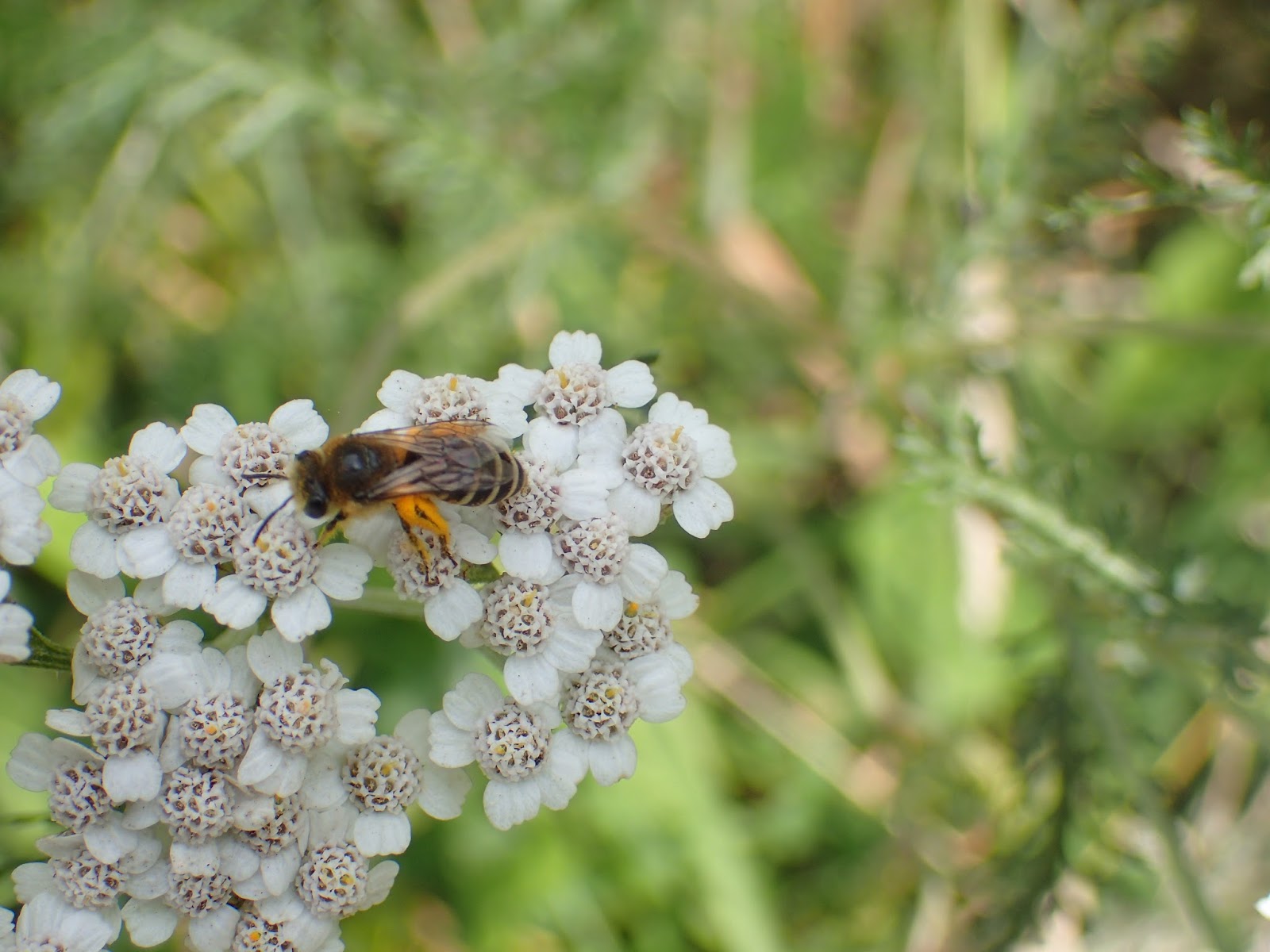
There was a lot of different species about, so this is only a selection of highlights. Some Colletes bees were feeding on Yarrow - technically these cannot be assigned to species without closer examination, but the size, location and flower choice point very strongly to them being Colletes daviesanus, which I've not seen before. Of more interest to me it is the host of a very cool looking bee Epeolus variegatus, which I'll certainly be keeping an eye out for.


I had a close look at quite a lot of Skippers and confirmed both Small and Essex (mostly Small). There were three sawfly species, of which I could only identify one. I'll give Norfolk's new Sawfly recorder a few weeks to get used to the role before I trouble him! Two shiny black hoverflies were also seen, Cheilosia pagana and a Pipizella sp. The latter was new to me, but could only be confirmed to species by examining the male genitalia, which I didn't do. Potato Capsid was a new bug too.

 Cheilosia pagana
 Pipizella sp. (probably P. viridula)

Carrying on my leaf mining theme from Saturday I noticed the 'snail-trail' mine of the Poplar Bent-wing moth, which was a new TG21 record. I was considering heading home when a few drops of rain fell, speeding me up. The concert was yet to begin, so as I left the only noise was the constant hum of distant traffic and the names of the many dogs being frantically called by their owners.


NORWICH: Return to Catton Park

21st June 2017

At the start of the year I had decided that I would take advantage of being quite close to Catton Park by visiting at least once a month to track the changes through the year. This lasted until March, then basically the amount of wildlife increased and I split my time between Whitlingham, target species and various other ventures. On Wednesday the weather had reached a warm but not stifling balance, so I decided to pop down after work for an hours walk around.

As it was the start of rush hour I decided that instead of crossing the ring road and heading to the Oak Lane entrance (a walk that would have resembled the start of Horace Goes Skiing), I would cross at the traffic lights and go in through the woods. This immediately paid off as I was only a few paces in when I saw a Vole pearing out of its burrow. It watched me, I watched it. After a minute I reached for my camera, and it vanished into the hole.

With the visit already worthwhile, I had a wander out of the woods and into the meadow, where there was a (probably seeded) area of wildflowers, mostly Ox-eye daisies. A number of moths were flying, but on closer inspection most of them were Garden grass-veneers, which look surprisingly big in flight. I did find a more interesting moth though, the Triple-stripe Piercer (Grapholita compositella). After checking at home I found that this was a new TG21 record, which was satisfying.


A detour to check out an area of bare sandy soil was interesting, because there was a large area of Corn Spurrey, which I'd only seen as an arable weed once before. There was also a fumitory growing nearby.


Back to the meadow, and several Merodon equestris hoverflies were picked out, as well as a Slender-striped Robberfly. This species, which like the piercer was a new one for me, holds its body in a distinct pose, looking a bit like a stubby damselfly.


A quick walk across part of the parkland turned up a few common beetles and bugs, and some dried specimens of Common Broomrape. I should probably make sure I return in July!