The Whitlingham Bird Report for 2025 is now available to download from the Bird Reports page or from here

Showing posts with label Snails. Show all posts

FENLAND: Welney swan feed

Mid February 2023

We headed out to the edge of the fens for a family trip to Welney, timed to see the midday swan feed. If you've never been there is a large, heated hide set up to provide views out over the flooded fenland, providing close-up views of Whooper Swans (the shyer Bewick's Swans are often visible in fields on the approach road but seldom come in for the feed) and large numbers of Pochard. Some species new for the year included Pintail, Dunlin, Black-tailed Godwit and Cattle Egret, although the Tree Sparrows weren't on the feeders when we were looking.


After lunch we went for a brief walk along to some of the other hides. We had a look at some Xanthoria/Caloplaca lichens, searched unsuccessfully for Mousetail and saw a few invertebrates. These included Water Ladybird, the larva of Endothenia gentianeana/marginata in an old Teasel seedhead (you have to examine them closely to see if they have a feature called an anal comb - I didn't) and cases of a snail - Bithynia tentaculata I think.


WHITLINGHAM: December WeBS and aquatic molluscs

19th December 2021

Time for the final WeBS count of the year, and another opportunity to not see a Ring-necked Parakeet, which must spend a great deal of time in gardens at Thorpe laughing manically at me. There were six Shoveler on the Little Broad and the regular drake Mandarin on the Great Broad. I read as many Mute Swan colour rings as I could, and also spotted one of the locally colour-ringed Black-headed Gulls. There was a decent number of other duck species, mostly near the east end of the Great Broad - in total 253 Tufted Ducks, 152 Gadwall, 13 Teal and 110 Mallard (no sign of any Goldeneye or Pochard though).


It was another dreary day with not much else around, although I did find some Coleophora cases on rush (there are two species with identical cases), but I did go and have a look at some pilings along the broad edge having noticed some water mollusc records on iRecord. This turned out to have been worthwhile, as some Zebra Mussels were amassed along the edge, some open and feeding just below the water surface, whilst several Wandering Snails were also present. 


NORWICH: City centre sightings and a White-fronted Goose

1st week of March 2021

A busy week at work, compounded by the knowledge that a Black Redstart was present on my estate during a couple of the days and would have either been visible from the house or possibly even on top of it. Bird sightings on the way into the city have increased, with Sparrowhawks seen on several days, a Kingfisher along the river at New Mills and unexpectedly an Egyptian Goose on the building adjacent to Chapelfield Gardens!


Other wildlife sightings included a new site for Collared Earthstar (Geastrum triplex) - under some trees near the Sainsburys on Queens Road, and a small orange bryophilous fungus growing on a mossy wall, identified by George Grieff as Octospora coccinea s.l.


Throughout February there had been a flock of White-fronted Geese on the marshes at Postwick. These were quite close to Norwich as the crow flies, but quite a trek following footpaths or roads, so I had grudgingly ignored them. During the early part of March there seemed to be a movement of White-fronted Geese south of Norwich, including one that spent a few days at Marston Marshes. Marston is on the edge of Norwich a similar distance away to Whitlingham or UEA, so I went for a walk there and fortunately the White-fronted Goose was still present along the river, an excellent bird for the Norwich area. I also saw my first Ring-necked Parakeet of the year there, and some large aquatic snail shells on flood debris that Mike Hoit had already identified as Lister's River Snail.


WHITLINGHAM: Snails, trees, fungi & a moth

31st October 2015

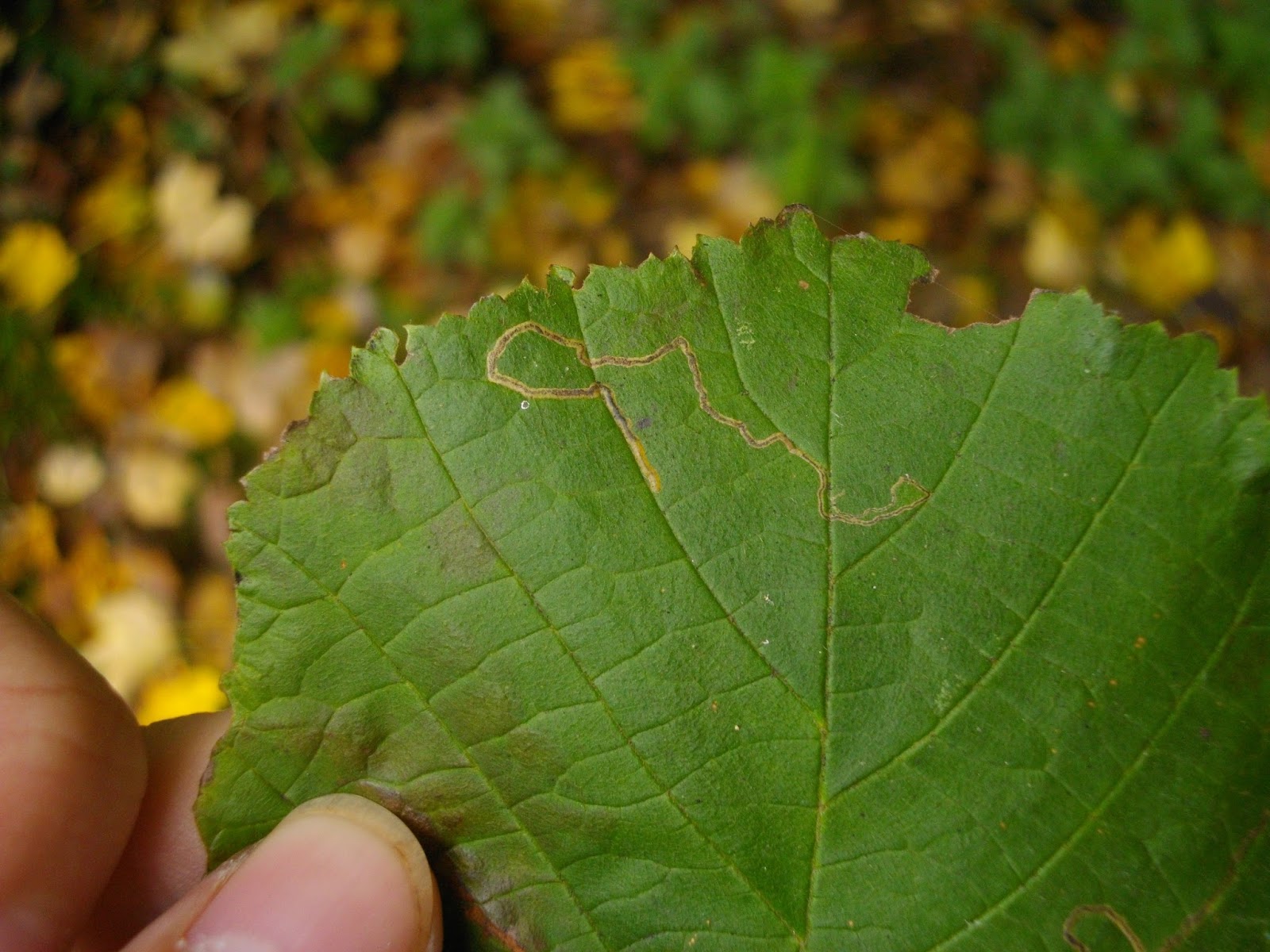
On Saturday I headed down to Whitlingham, but as it was a sunny day and rather busy, I decided to start off in the woods. As I entered the woods I noticed some Norway Maple saplings. I had previously not counted Norway Maple on my patch list as it would have been planted originally, but as it appears to be regenerating naturally, on it goes (958). The next thing I noticed was a caterpillar inside a leaf mine on a Hazel leaf. I photographed this, hoping that the pattern of the mine and the 'frass' (leaf miner poo!) would enable me to identify it at home. I was almost right - I got it down to two species of micro moth, but have been advised that I need to take a picture lighting up the mine more clearly to be sure which one it is.

 Norway Maple
Mine in Hazel caused by a Phyllonorycter sp.

As it has been a wet week there were lots of snails about. Many of them were different patterned versions of the White-lipped Banded Snail, but I did find a new species for me, Hygromia cinctella, which I keyed out at home (959). Plaited Door Snail was another interesting snail, but one that I had seen in the woods several times before. There was a bit of fungi about, but not as much as there has been in the other places I've visited recently. One interesting species was the Fire-rug Inkcap, so called because the mycelium forms an orangey-brown furry mat, which is often visible on logs. Along the telegraph pole alley I photographed an adult Hawthorn Shieldbug, which I will add to my Shieldbugs species guide soon (currently there is only a late instar photo in it).

 Hygromia cinctella
 Plaited Door Snail
 Fire-rug Inkcap - note the orangey 'fire rug'
 Hawthorn Shieldbug

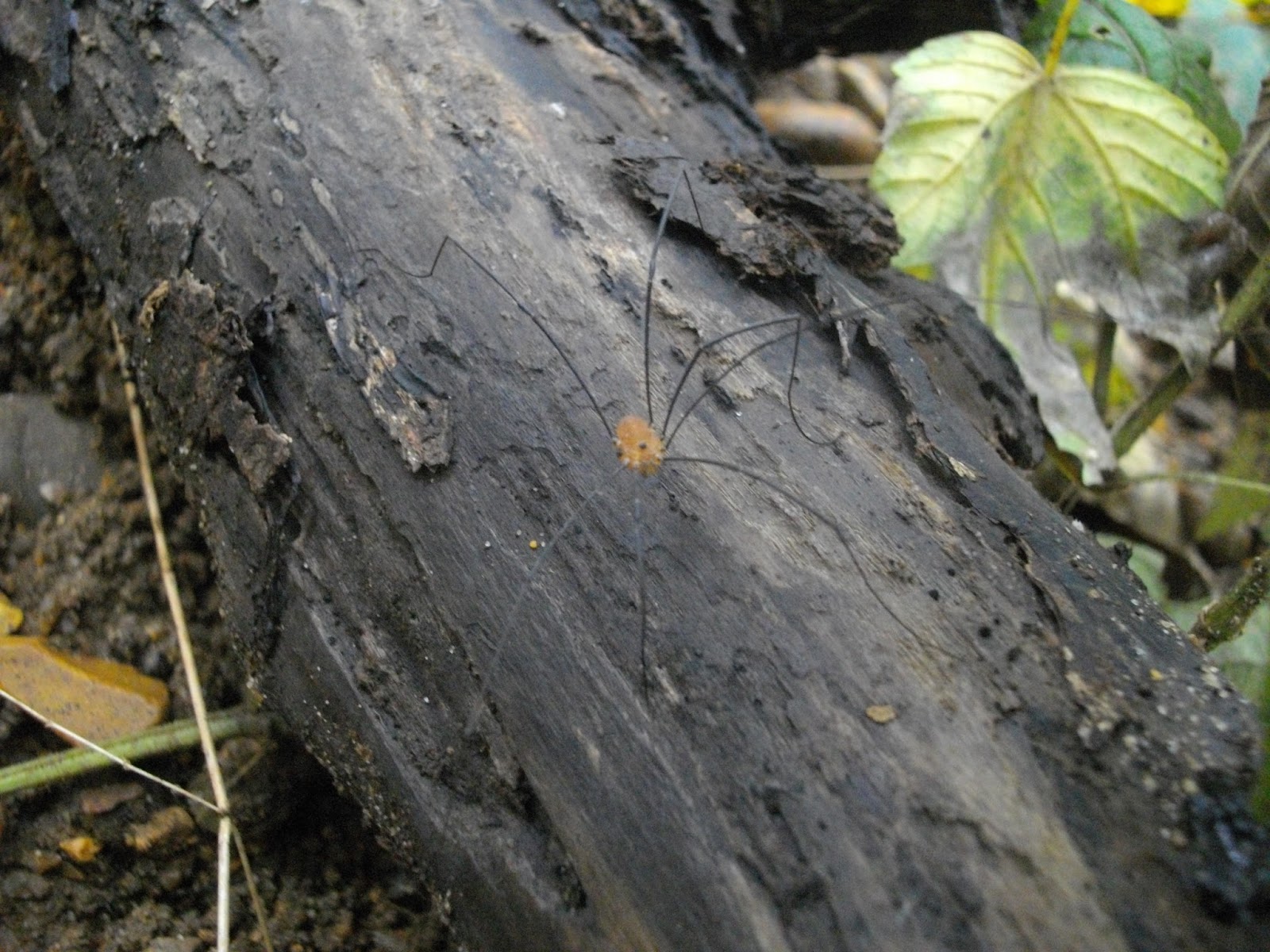
The next new species on my list was a Harvestman, Leiobunum rotundum (960). The males of this species are round and orangey, but they need to be looked at carefully to separate them from L. blackwalli. The key bit to look at is between the eyes, which is black on rotundum but white on blackwalli. In a hedgerow I saw the bright pink flowers seed cases of Wild Spindle. I wasn't sure whether this would have been planted or grown naturally, however I later saw it in a second location. The most recent Flora of Norfolk says that Spindle is "not infrequent on base rich soils", and given the chalky nature of Whitlingham Woods I reckon this is reasonable (961).

 Leiobunum rotundum
 Wild Spindle

Emerging from the woods I walked back as far as the island to scan for birds. A flock of Tufted Ducks flew east and most of the gulls had left the water and were circling around, making me suspect a Peregrine had just flown through, but I didn't see it. When the birds settled I picked out at least six Pochard and seven Great-crested Grebes, but not much else of note. I walked as far as the eastern end of the broad to scan over to Thorpe, but didn't see any of the Goldeneye that have been frequenting Thorpe Broad of late. On my way back I did noticed some very inconspicuous fungi, Slender Clubs, growing on some bark chippings (962). These could easily be mistaken for dead bits of leaf or shoots, and was a species that I hadn't seen for years, so were pleasing to see.

Slender Clubs

There was still time for a couple more interesting sightings. Firstly a brightly-coloured Comma butterfly was resting on some ivy. Probably the latest I've seen one flying, only a day off November. The second sighting was pure luck, I spotted a 'growth' on a tree branch and upon investigation it was a Vapourer moth cocoon, covered in eggs. Well camouflaged next to it I found the female moth. Female Vapourers are flightless, having only stubby vestigial wings. They emerge from their cocoon, attract a male by releasing pheromones and then lay their eggs on the cocoon they emerged from, often hardly moving at all as an adult! I think several other moths undergo a similar life cycle, but Vapourer is the most familiar one.

Female Vapourer moth and eggs

WHITLINGHAM: September count & Bronze Shieldbug

13th September 2015

On Sunday I carried out the September wildfowl counts at Whitlingham. There was nothing particularly unusual, although there was a very large number of Greylag Geese. I counted 143 on the Great Broad, with 20 more on the river. This was actually a case of useful disturbance, as only about 40 of the geese were initially visible, but as some canoeists went past along the edge of the main island the rest all poured into the water and away in a long line! Incidentally five of the geese were mostly white, so I would be interested to hear from anyone that sees a flock of Greylags containing five white ones, to help work out where they come from. Of the rest, a Water Rail called from the Little Broad, and there was a female Gadwall and three Tufted Duck. As I walked round I saw five Chiffchaffs, including three singing birds, which is unusual for the time of year.

I added a few more species too, the best one in my opinion being a late-instar Bronze Shieldbug. I'd never seen this species before, and had been envious of Mark Clement who photographed one at Beeston Common recently, so a pleasing find. A snail, Trochilurus striolatus, and a plant called Water-pepper growing in the river were also new. Frustratingly a couple of crane flies were almost certainly Tipula paludosa, but only females can be identified in the field and both of the ones I saw were male! I also finally saw a definite Willow Emerald damselfly, and an Agaricus mushroom that I might be able to ID later.

Late-instar Bronze Shieldbug eating a fly
 Trochilus striolatus
Water-pepper
Tipula sp.

NORTH NORFOLK: Gramborough Hill

12th September 2015

After leaving the Cley moth morning I had planned to pop in somewhere nearby to have a quick look and see if the showers had dropped any migrants in. Gramborough Hill seemed as good as anywhere, so I parked up on beach road and set off to the hill. I looked at the Sea Aster in the hope of seeing a Sea Aster Mining Bee, but there weren't any. It's probably too small an area for them, but the overcast conditions wouldn't have helped either.

I did a slow circuit of the hill, paying particular attention to some of the berry-laden bushes. A Kestrel hovered close by, and a couple of Meadow Pipits flew over, but that was about it birdwise, which was rather disappointing. There were lots of Parasols, along with a few small puffballs. In the absence of birds I noticed an interesting looking snail, and noted some galls on Hawkweed stems. I found two 11-spot Ladybirds and a 7-spot Ladybird in a curled up leaf, along with a tiny orangey beetle that I think is another member of the ladybird family, Rhizobius litura.