The Whitlingham Bird Report for 2025 is now available to download from the Bird Reports page or from here

MID NORFOLK: Barnham Broom Fen fungus foray

20th March 2022

Barnham Broom Fen is a relatively small, privately owned site currently undergoing habitat restoration  and enhancement. The Norfolk Fungus Study Group were invited to visit and survey the site, and we were grateful to Andy for showing us around and telling us about the site, a mixture of fen and wet woodland.


As expected at this time of year most of the fungi found were small species associated with plants. Two species new to me were Calycellina ochracea, a small pale yellow cup fungus, and an unobtrusive lichen called Lecania cyrtellina (found and identified by Rob Yaxley). Another interesting sighting was a woodlouse-like creature that turned out to be a fly larva, that of a Lonchoptera species (probably L. lutea).


NORWICH: Bowthorpe Glossy Ibis

19th March 2022

A Glossy Ibis had been found in the Earlham/UEA/Bowthorpe area earlier in the week, but the first opportunity I had to go and look at it wasn't until the weekend. I was pleasantly surprised that it had stayed, understandably appearing to favour an area across the river where it couldn't be disturbed. It was feeding constantly whilst I was there, showing well in the sunshine. 

Nearby a pair of Oystercatchers were in a field and a Skylark sang overhead.


WHITLINGHAM: No Garganey today

Mid-March 2022

In 2019 after many years of trying I finally saw a Garganey at Whitlingham, but as I was already south of the city at my in-laws I popped down to Whitlingham hoping to see the drake found earlier in the day on the Great Broad. In contrast to later birds at Cley and Strumpshaw it proved to be frustratingly elusive, being out of sight for most of the day and only showing briefly in the evening, about 20 minutes before I got there. Staying until dusk I saw three Little Egrets roost on the island on the Great Broad, with another flying west, and a Water Rail climbed up into a small water-side tree.

On the way back there was enough light to read the rings of two locally ringed Greylag Geese.

NORWICH: Some new plants & plant fungi

Mid-March 2022

With it not yet being prime insect season, my daily walk into the city still has a mostly plant and plant fungi based focus. Down a small alleyway near my house I noticed some naturalised spurge plants that I was able to identify as Turkish Wood Spurge, whilst I finally stopped ignoring a brassica I'd seen the week before along Chapelfield and identified it as White Mustard.


I have been regularly checking Pellitory-of-the-wall for a recent colonist leaf-mining moth (so far unsuccessfully) but did find the leaf spots of Ramularia parietariae on one plant. A more intentional search of Herb Robert plants successfully turned up another leaf fungus, Coleroa robertiana.


WHITLINGHAM: Orange Ladybirds and Scarlet Elf Cups

5th March 2022

Another rainy day. With an hour free I called in firstly at Trowse Woods, then at Whitlingham to read a few Mute Swan rings. At Trowse the highlight was finding a large number of Orange Ladybirds, around 80 in groups of up to 15 on twigs of a couple of large deciduous trees. I also saw some Scarlet Elf Cups, which I took home and incubated until they produced budding from the spore ends, an apparently definitive feature for Sarcoscypha austriaca (which is what almost all of the Norfolk ones turn out to be).


At Whitlingham I saw the local Mandarin, Black-headed Gull Blue 2K91 and 6 ringed Mute Swans before it was time to head back.


NORWICH: Fern rusts, aphids and other interesting things

Late February 2022

Having read an article about a genus of white rust fungi on ferns, I started checking various fern species as I walked around the city. I had no luck on the small amounts of Black Spleenwort and Wall Rue that I came across, and also drew a blank on Polypody. I did however manage to find Milesina scolopendrii on Hartstongue Fern and a few days later Milesina kriegeriana on Male Fern.


Whilst checking ferns and other plants growing on walls I also found various other things of interest. The scarcest find was Black Fern Aphid, Idiopterus nephrelepidis, which was first found in Norfolk a few years ago by Dave Appleton, and at the time was believed to be the first time it had been foud outside in the UK (Dave tells me there is possibly one earlier record that has come to light since, but otherwise it remains restricted to North Elmham). The nymphs that I found were on Polypody in a church doorway.


On the same fern community as the aphids mentioned above I also found lavae of the Fern Smut moth and some Soft Brown Scale Insects, Coccus herperidium. Another interesting aphid, also found previously by Dave Appleton, was Dysaphis gallica on Ivy-leaves Toadflax.


Elsewhere in the same week around the city I found the fungus Septoria chelidonii on Greater Celandine and the liverwort Fullania dilatata.


WHITLINGHAM: February WeBS count

20th February 2022

The WeBS count had to be hurried as with strong winds forecast the paths around Whitlingham were yet again being closed. The wind-blown debris on the Little Broad had collected at the eastern end and was being taken advantage of by nine Shoveler and a Little Egret amongst others. On the Great Broad 211 Tufted Duck were joined by 41 Gadwall, another 5 Shoveler, 4 Pochard and a 1w male Goldeneye. Of the passerines 3 Lesser Redpoll were of note.


BRECKS: Brandon liverwort & aphid

Mid-February 2022

Despite the miserable weather we decided to go for a family trip to Brandon Country Park, one of our favourite spots as it combines a good area for wildlife, a cafe, toilets and a play area. After visiting the latter three we had a short walk round, including feeding the ducks (although the Mandarin stayed amongst the vegetation, only emerging once it started raining).


I've been trying (and struggling) to get to grips with mosses locally, but am also keeping an eye out for liverworts (there's less of them!) and found some nice patches of Forked Veilwort (Metzgeria furcata) on the way round. The Norfolk aphid recorder had also given me a list of under-recorded species to look out for this year (although I was just into Suffolk on this visit) and several of them occur on Bamboo, so I checked out some clumps of Bamboo and found one of the three species Takecallis arundicolens.


Black-tipped Bamboo Aphids (either side of a barkfly)

NORWICH: A park rat and a rabbit

Late January/early February 2022

Various things colluded to restrict my wanderings, but I did increase my Norwich walk-to-work mammal list for the year to three, following on from Grey Squirrel (just about everywhere) with Brown Rats in Wensum Park and a Rabbit in Chapelfield (seemingly a bizarre location for one, but it appeared to be wild type rather than a pet and I have seen a couple nearby once before). A darkish mantled gull at Wensum Park didn't look quite right for Yellow-legged, and it appears the local consensus is that it's a Lesser Black-backed x Herring Gull.


I've not yet got into the swing of much invertebrate hunting, but a check of a small Pine tree on my way home from work (hoping for Striped Ladybird) turned up a couple of rather elongated aphids, which I think were Eulachnus rileyi.

WHITLINGHAM: January WeBS and a second patch tick of the year

23rd January 2022

The first WeBS count of the year, and I spent some time around the slipway ring reading, managing 13 Mute Swans, one Greylag Goose, one Barnacle Goose and three Black-headed Gulls. All ringed here or across the river at Thorpe, but at least the sightings are gradually building up a picture that will hopefully be added to when some of them disperse in spring.

Duck numbers were mostly quite low, although 55 Teal was a decent count. Otherwise there was the regular drake Mandarin, 87 Gadwall, 88 Mallard, 10 Shoveler, 4 Pochard and 188 Tufted Duck. The recent Goldeneye and Shag appeared to have departed. There were a few bits and pieces that I hadn't noted on my first couple of patch visits here this year, including a brief snatch of Cetti's Warbler song, a Kingfisher and a Lesser Redpoll.

Of later I have been doing my wildfowl counts in the afternoon rather than the morning so that I can wait until dusk in the hope of seeing a Ring-necked Parakeet that sometimes roosts on the island. I was in position again, and noted how white some of the trees on the island looked (presumably Cormorant guano, which although in some parts of the world is used as a fertiliser, here appears to be killing the trees). At about 16:05 I heard what sounded like a distant Parakeet call. A second call reassured me that it wasn't my imagination, and I managed to pick up the Ring-necked Parakeet in flight and track it as it flew across the island and into the top of a spindly tree. Once perched up it remained silent - had I been distracted or it been a bit noisier I would have probably missed it again, but as it happened I didn't, and I had my second patch tick of the year before the end of January (the pessimist in me says that this just cancels out the two Redpolls that appear to be primed for removal from the IOC list sooner rather than later...).


As with the past couple of years I expect that much of my wildlife recording will be carried out around Norwich in 2022, so I intend spending some time on my more neglected groups including Mosses and lichens. With this in mind I photographed a nice foliose lichen on a willow tree on my way round but haven't yet identified it. It's rather like a dark Punctelia subreducta, but I don't think the underside should be this dark a shade of brown if its that species.


MID NORFOLK: New fungi and much more at Foxley Wood

15th January 2022

The fungus study group don't usually hold a field meeting during January but were convinced to do so this year. This proved to be both a popular and productive decision, with around 30 members meeting up and recording around 120 species. As you would expect for the time of year much of these were either growing on wood or were microfungi on plants, but there were interesting examples of each. It looks like at least two of my finds turned out to be new for Norfolk - a young specimen of an oysterling with brown hair tufts on the cap was Scaly Oysterling (Crepidotus calolepis) and some small clear wart-like growths on Exidia plana were the mycoparasitic fungus Heteromycophaga glandulosae, whilst some small cocoa-bean like growths on an Ash branch were Hysterographium fraxini were also of note.


At a foray last year Stewart Wright had introduced us to the tiny black 'sundial' like projections under Alder leaves caused by Ophiognomonia alni-viridis. After he found the related species Gnomonia gnomon on Hazel leaves I asked if there were any others we should be looking for, and we managed another two - Ophiognomonia setacea on Oak and O. intermedia on Silver Birch. There is also a rare/under-recorded one on dead Rose leaves for me to look for elsewhere.


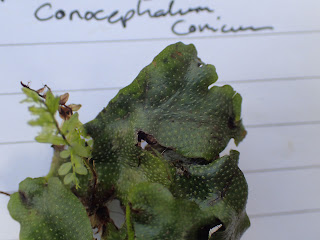
Foxley is an excellent reserve for many groups of species, and Rob Yaxley kindly pointed out some bryophytes as we went round, including the liverwort Conocephalum conicum and Big Shaggy-moss Rhytidiadelphus triquestris. Rob also identified a millipede that I'd spotted underneath a fallen branch as Brachydesmus superus.


New macro moths are always a bonus, and having seen a rather tatty specimen on the ground I was pleased when someone found a fresher looking Spring Usher. There was a new micro moth species too, when Stewart found an occupied leaf mine in Greater Stitchwort containing the larva of Three-colour Groundling, Caryocolum tricolorella. The light was beginning to fade as we walked back to the cars, allowing several group members to use their UV torches to illustrate the luminescence of Sulphur Tuft.