The Whitlingham Bird Report for 2025 is now available to download from the Bird Reports page or from here

Some photos that won't be making the Countryfile 2011 calendar

Late September 2010
.
Having seen loads of top-notch photographs of the Empid flycatcher in the past few days, I have decided to strike back on behalf of everyone that only has a compact camera and no photographic talent. Behold:

I call this one "Nuthatch in a tunnel". This Nuthatch has learnt that sunflower seeds are nicer than peanuts, but is yet to comprehend that it can stay and eat them rather than removing them one at a time and flying off.

This is a personal favourite, entitled "Deer in the garden, oh it's gone". The composition is aided by framing the photo with bits of wall and window, whilst shooting through the glass in poor light signifies the murky sadness of the deer leaving.

This photo, entitled "Nice spinny birds in the pouring rain" tries to show how being out in the rain can be fun, and how different species can get along together. By photographing pale birds in bad light you can save money on expensive black-and-white filters.

None of these pictures have been published yet, however I have set aside an old mug for royalties should they get snapped up.

Oh and yeah I saw the flycatcher if anyone was wondering, but as I can't add anything useful to the ID, I'll just keep my powder dry for now and leave it to others to debate.

Cley

18th September 2010
.
Having finally decided in the week that I would make the 3 hour journey to Holme to see the Arctic Warbler, it inevitably buggered off. Personally I blame the Pope. I decided that I'd spend the day at Cley & Salthouse instead, the weight of being the only Norfolk birder not to have seen a Lapland Bunting this year weighing heavily on me. Unfortunately no Quails from the train. At Sheringham I met Adam, who had just got a 4-skua haul on the seafront, and we watched loads of people in 1940s costumes wandering around.
.
From the central hides it looked like a flock of Canada Geese had eaten everything, but we did find two Little Stints and a few Dunlin. Two Carrion Crows were trying to eat an injured gull alive, which was a bit gruesome. Lots of Wigeon too, maybe a recent influx. The wind had died down completely and there wasn't much of interest on North Scrape. Walking towards Salthouse a Lapland Bunting called somewhere above us, and we eventually got good views of four birds feeding amongst the sea poppies. A couple of Wheatears and a Greenshank were the only birds of note as we walked back to Salthouse. Nothing new from the Dun Cow, although some nice flypasts from Swallows and House Martins still delaying the flight south.

Nuthatch

17th September 2010

My last house had a small paved back garden, which only really attracted Goldfinches with any regularity. Whilst not being much bigger, my current garden is close enough for flocks of birds to pass through from Earlham Cemetery, with nothing so far beating a beautiful Nuthatch on the peanut feeder today. It didn't stay long, pecking at a few nuts before bending its head out in characteristic "L" shape and flying off. It's nice to be able to look out of the window and not know what may be lurking!

Anyone know much about snails?

12th September 2010
.
Not much change on the broad from Friday, although no terns today. I took to the woods to hunt down a Coal Tit, probably the commonest patch bird that I have yet to catch up with, but no luck. Whilst looking at some cup fungi I found these interesting-looking snails. Tony Irwin has suggested they are probably Plaited Door Snails, but I would welcome confirmation from any Snail-experts out there.
.

Whitlingham Sept counts & another Black Tern

10th September 2010
.
With the coast dripping with Redstarts earlier in the week, if ever I was going to find an autumn patch migrant, this should be the time. After spending far too much time checking the tit flocks along the edge of the Little Broad (one Chiffchaff, its a warbler bonanza) I revised my expectations to "nothing" and began my wildfowl count. A Black Swan that turned up a couple of days ago was the first of the year here, presumably last years pair were the ones that bred at Strumpshaw. Count:
.
Black Swan - 1 (Little Broad)
Mute Swan - 86 (6 Little Broad, 80 Great Broad)
Greylag Goose - 3
Canada Goose - None, but three Thorpe side of the river
Egyptian Goose - 6 (Mass exodus, now only 3 pairs)
Mallard - 140 (including Domestic Mallard types)
Gadwall - 28 (increase on last count)
Tufted Duck - 5 (flew over)
Great Crested Grebe - 5
Coot - 234 (5 Little Broad, 229 Great Broad)
Moorhen - 4
Cormorant - 31+ in roost trees
.
The walk around the broad was uneventful, with no watersports going on and few other walkers. A Great Spotted Woodpecker was the only bird of note along the south shore. The Coot were rather flighty, continuously half flying/half running along the water, particularly a group of 117 near the centre of the broad. I was scanning the conservation area bay to complete my Coot count when I spotted a Black Tern hawking along the east end of the broad. Going back round to the south shore I watched it near the island, marvelling at each swoop and soar up just above the water surface. Having twitched one here a couple of days ago it was nice to see this one and spend some time watching it. I called Cathy, who came and had a look, her first Black Tern.

Patch tick, Wryneck and some bats

7th & 8th September 2010
.
A couple of evening trips after work. On Tuesday I got a lift down to Whitlingham where a juvenile Black Tern was flying back and forth along the Great Broad. We then went to Cley where we got good views of the obliging Wryneck, which seemed happy to sit up and bask in the evening sun. We saw a Redshank/Spotshank/Greenshank treble on Arnold's Marsh, but probably passed the Lapland Buntings about 100m away. No new migrants around Salthouse in a quick search, but Gadwall (95) and Avocet (96) from the Dun Cow edged me closer to my Pub 100.
.
On Wednesday Cathy & I went on a rescheduled walk at Mousehold with Norwich Bat Group. Only Common Pipistrelles (45kHz) were seen & detected, but there were quite a few of them around.

Lots of red things and some more pub birds

5th September 2010
.
The last day of the summer holidays, and an opportunity to look at some migrants whilst Gary kept the yearlist ticking over. We started at Holme, becoming day members of the NOA to have a look at their Red-necked Phalarope. It seemed to have found the pool on Redwell Marsh to its liking, a view not shared by many other birds, and the circling feeding behaviour did make it look like it had been tied to four partially-submerged posts. A nice little earner ;-) The second red bird of the day was a stonking male Redstart spotted by Adam on the posts to the left of the hide.
.
A walk around the forestry was stopped to allow a parade of ramblers through, but eventually we found a Pied Flycatcher. Little else of note, even in the NOA part of the reserve (my first walk around, I'd consider membership if there was a reserve closer to home). Walking back along the entrance track we saw a close Garden Warbler, Stonechat, female Redstart and finally a Red-backed Shrike (one of two present) before two Peregrines soared above us and then flew off south-eastwards.
.
Next up was a bit of pub-birding from everyones favourite beer garden. Keeping our eye on the shingle ridge failed to provide a cheeky Lap Bunting, but we did get Common Tern, Sandwich Tern and Gannet passing through. Two more excellent pub ticks flew in, a Greenshank onto one of the scrapes and then three Whinchat (although there were four initially) on brambles straight out from the pub. A Hobby was a pub tick for Adam, whilst a couple of easy birds missing from my list were picked up in the form of Tufted Duck and Canada Goose.
.
Refreshed we set out again, doubling back to Stiffkey. We waited on the saltmarsh for a while for a furtive Barred Warbler to show itself, seeing yet another Garden Warbler. Eventually the Barred Warbler did come out in the open, working its way down a small tree before vanishing again. We stopped briefly at Cley, seeing a couple of Wheatears on the Eye Field and getting some good views of passing Arctic Skuas. Two times one of the Arctics landed on the sea, and it made a nice change that the winds allowed us to watch them bobbing up and down. The downside of course was that nothing else was being blown towards us, so we left for Weybourne.
.
We headed west from the main carpark, fighting our way through swathes of Pied Wagtails. No sign of the Wryneck seen earlier in the day, but a second Red-backed Shrike of the day was hunched low in the scrub near Moss' Pool. The vast expanse of the camp was inhabited only by Rabbits and Wheatears. We walked back, swotting more Pied Wags out of our hair. By the time I got back to Norwich it was dark - not only is it autumn, winter is coming!

First seawatch of the autumn

30th August 2010
.
I decided to put in an appearance at Sheringham for my first sewatch of the year. A combination of Bank Holiday trains and not wanting to put Cathy off before she'd started meant that we didn't arrive until 8.45, which as suspected was too late. Having been informed that I had missed Long-tailed Skua, Pom Skua and Sooty Shearwater, we stood to the left of the seawatching shelter and hoped. Nothing amazing, a few Great Skuas, 2 Manx Shearwaters, Gannet, Fulmar, Common Scoter, Teal, Oystercatcher and Tern spp. flew past . We went up to the boating lake to see if we could get better views, but the winds were too strong to keep the 'scope steady. Back to work next week, so I'm going to need some North-easterlies on a Saturday if I'm ever going to catch up with a Long-tailed Skua!

N.N. Coast with bonus lark

28th August 2010
.
Friday night a Booted Warbler was seen on Blakeney Point. There was no chance of me being able to get there at the time, so I decided to head to the coast on Saturday. Predictably it had cleared out overnight, so I turned to my secondary target of Icterine Warbler. Arriving at Walsey Hills there was no sign of the warbler, and no-one there had seen it either. Maybe it was going to be one of those days. Paul W introduced me to John Furse, who offered to give me a lift to Wells Woods, as long as I could deal with his puns. I agreed, and we set off for Wells.
.
We reached the beautifully maintained and reasonably priced carpark at Wells after a short stop at the Stiffkey Scarecrow Festival (for John to buy Jam). We went a long way in before finding a single bird, and lunch in front of the Dell produced one Wren. Finding nothing in the woods we looked around the scrub on the landward side, seeing what was probably a Garden Warbler dart into cover. Shortly before this a phonecall had told us there was a Greenish Warbler at East Hills. Why there and not here darnit.
.
Following this complete lack of success, it became us vs. migrants. Warham Greens, Friary Hills, Cley beach carpark and Gramborough Hill were all checked, giving us one Whinchat. It was at Gramborough that John got a "no further sign of Short-toed Lark" message. Having not got the first one this was a surprise, but it also meant that whilst we were at Cley it had just been found. We went back, determined to see something half-decent. The lark had gone to ground when we arrived, but I saw it fly up and west. Most of the group missed it, so we walked further along, only for it to fly again. At this point no-one could find it, and after walking much further along the shingle and a couple of false-starts we were beginning to think "sod it". Luckily the Short-toed Lark was relocated as we walked back to the carpark, and showed nicely running along the shingle near some yellowy-green vegetation. Ending on a positive note we left, and I managed to get a lift back to Norwich. Many thanks to John for an entertaining day!

Common Sandpiper passage

27th August 2010
.
Having opted for a lay in rather than seawatching (thats another chance of L-T Skua gone!), I decided to see if the northerly winds had blown any Common Scoter inland. At the start of Whitlingham Lane I walked across a rather soggy Trowse Meadow, and on reaching the eastern end I heard a sandpiper call, followed by two Common Sandpipers flying past and onto the riverbank. Walking quietly along I located them, and noticed four more bobbing up and down near the first two. I watched them for about a minute before they got restless and all six flew downriver, followed shortly behind by another two. I can't recall seeing 8 Common Sandpipers at the same site before, and certainly not at Whitlingham.
.
For once there wasn't a single car parked along the lane, so I was hopeful that there wouldn't be much watersport going on. I stopped along the edge of the Little Broad to look through the Long-tailed Tit flock, turning up two silent Chiffchaffs. Leaving the Little Broad behind I began my wildfowl count, which was made harder by a fleet of around 30 small sailing boats. Great.
.
Mute Swan - 100 (6 Little Broad, 94 Great Broad)
Mallard - 107 (45 Little Broad, 62 Great Broad)
Hybrid-type Mallard - 9, "Peking" Duck - 1.
Coot - 151 (4 Little Broad, 147 Great Broad)
Egyptian Goose - 3
Hybrid/Domestic Goose - 7
Moorhen - 2
Great Crested Grebe - 2
Cormorant - 10
.
Notably not a single pure Greylag, Canada Goose, Tufted Duck or Pochard, presumably because of the disturbance. Large numbers of hirundines (mostly House Martin) were hawking low because of the cloud cover, whilst Sparrowhawk, Common Tern and Bullfinch were also decent birds for the area.

Strumpshaw Fen

25th August 2010

With the holidays nearly over and sunshine at a premium, I headed out with Cathy to find her a first Swallowtail butterfly. Second broods are difficult to predict, but as I also wanted to have a go at locating Ben Lewis' Willow Emerald Damselflies we decided to try our luck at Strumpshaw. We got lucky with the Swallowtails, with a flypast in front of the Tower Hide. Although never seeing more than one at a time, there were probably two present. In the scrub along the path tens if not hundreds of Dark Bush Crickets were calling, and a Garden Tiger Moth was trying to look inconspicuous at the edge of the path.
.
Unfortunately from a damselfly point of view, the path along the Lackford Run all the way from the Tower Hide to the railway line has been shut for conservation work, and will remain so until the spring. This area is by the far the best Willow Emerald habitat, and a search of the other ditches only turned up large numbers of Common Emerald (mostly males). Bird wise it was quiet, three Common Terns, three Grey Herons and a couple of Stock Doves from the Tower Hide and heard only Bearded Tits and there flyover Green Sandpipers from the Fen Hide. The Osprey was seen whilst I was there but was apparently seen off by a Marsh Harrier.
.
Notice 1
The Pelican Inn in Tacolneston has opened an Ale shop promising to sell beers from all 31 Norfolk breweries, which sounds worth a visit.

Notice 2
http://www.bouproc.net/ has papers up for download relating to a recent conference on non-native species in Britain. A few interesting bits there, for me it seems a complete cop-out that we are now five years from the time when the Ely Muscovy population was shown to meet all of the criteria to be elevated to category C (it even recovered from a cull) but apparently more information is required as to their reliance on supplementary feeding. Presumably the idea is that as people will continue to feed them this study will be impossible and they can be kept in Cat E indefinitely. Yes they look horrible and have a restricted gene pool, but why have criteria for inclusion on a list if you don't act on it?

A photographic catch-up

24th August 2010

Finally I am settled into the new house, albeit with no sofa and lots of boxes of tat that I refuse to throw away strewn around the place. My garden almost backs onto Earlham Cemetery, so I am hopeful of some good garden ticks come the winter. So far I've had Coal Tit and Long-tailed Tit on my new feeders, and a pair of Sparrowhawks have flown over. I haven't found much info about birds in the cemetery other than a lone report of a Firecrest a few years ago, so if anyone has seen anything of note (yellow-browed warbler maybe?) in there I would be interested to hear about it.

In between waiting in for appliances to be delivered I have been out a few times, firstly to have a look at the Lesser Grey Shrike. Unfortunately it was Cromer carnival week, which added some time to the journey (as did the homicidal Romanian at Salhouse who tried to de-rail the train by putting concrete blocks on the track). At least at Sheringham I got to watch some of the Red Arrows flypast whilst waiting for the bus.

Red Arrows

The Lesser Grey Shrike ducks to avoid the Swallows that were mobbing it. A rubbish digiscoped shot, but it shows the breast contrast nicely.


I also canoed down the River Bure between Skeyton and Coltishall. A pleasant stretch of river, but only one Kingfisher to show for it.

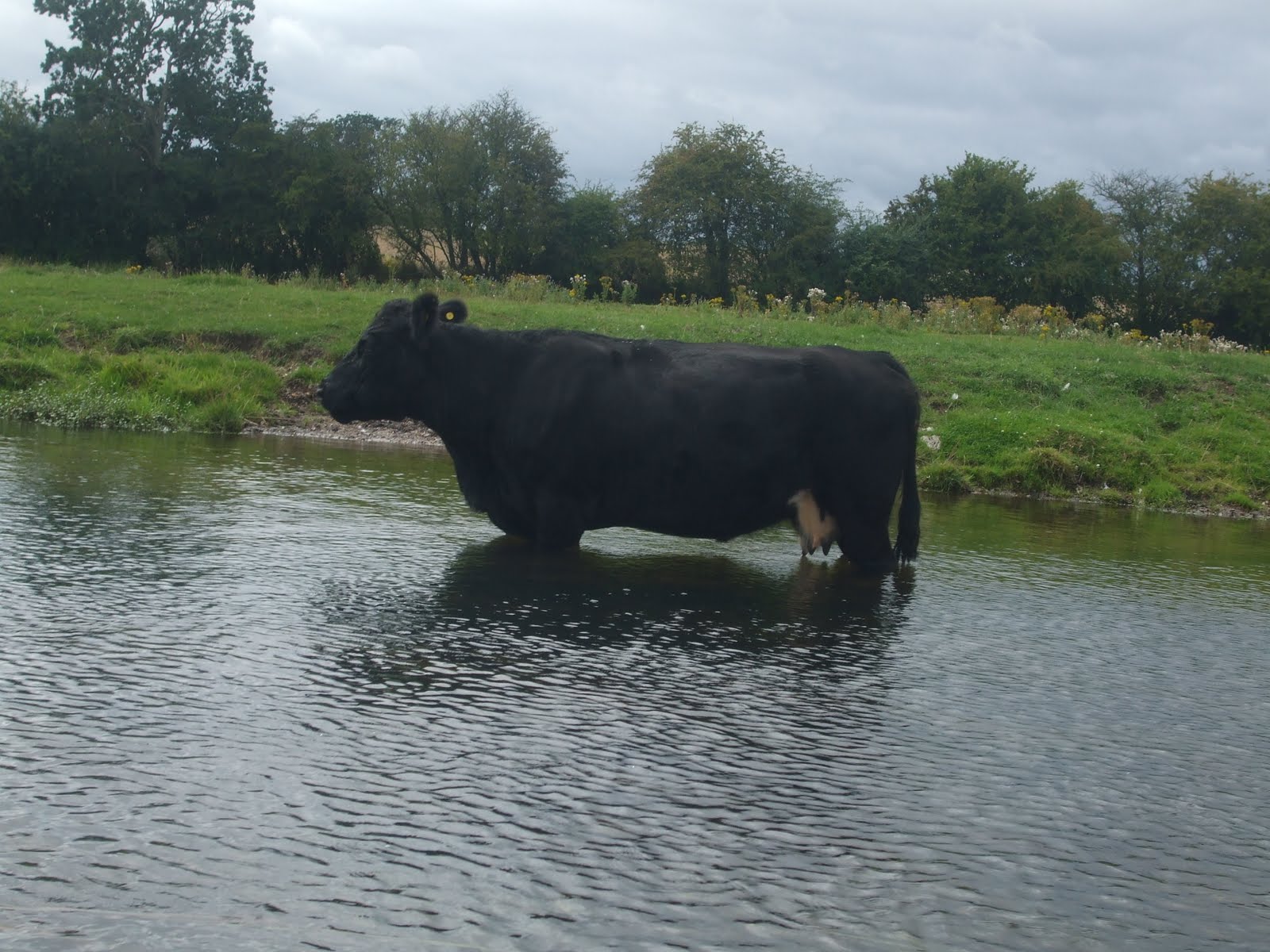
A whole field to graze in, but no, it wanted to be in the river.

After several years of thinking I should go, me & Cathy finally went to Warham Camp to see the Chalkhill Blue butterflies. If anyone from the council is reading this, an important historical site is probably worthy of some sort of sign directing you towards it. The butterflies are at the end of the flight period and rather tatty, but it was a nice place to spend the afternoon.

Chalkhill Blue

Overnight rain has meant that we hadn't put the moth trap out for a while, but of the few that came to the outside light there is only one record of Orange Swift on the Norfolk Moths website this year, making it of particular interest.

Orange Swift

Thats enough for now, I'm off to learn Greenish Warbler calls.

The end of an era

August 2010

After four years of Trinity Street fun, it is time to move. Adam has moved into a house made entirely of large John Lewis cushions with his girlfriend Laura, and this weekend I will be moving too. Of course this is all entirely over-dramatic, I'm still going to be living in Norwich. However, due to all of the stuff that comes with moving house and sorting out internet access, I will probably not be updating the website until the end of August. In the nicest possible way, I hope that nothing good turns up in Norfolk until the autumn. Enjoy the rest of the summer!

The Rose Tavern, a quality local pub.

Whitlingham August counts

5th August 2010
A visit to Whitlingham to do a wildfowl count, particularly of the Coot, which have been accumulating steadily over the summer. Almost all of the Greylags had gone (presumably onto the river at Thorpe) as a result of intensive sailing over much of the broad. A strange-looking vehicle was also motoring around the broad, apparently removing waterweed on a barrel at the front.
.
Anyway, main counts:
Mute Swan - 121 (6 Little Broad, 115 Great Broad). 9 birds were large cygnets (4 & 5).
Mallard - 177 (84 Little Broad, 93 Great Broad) All eclipse-type, 9 obvious black-and-white type "domestic Mallards"
Egyptian Goose - 31
Tufted Duck - 7 (all conservation area)
Pochard - 1 male (Conservation area)
Great Crested Grebe - 4
Gadwall - 7
Moorhen - 4
Coot - 156 (133 in the conservation area)
.
Little other birdlife, one Cetti's Warbler and one Chiffchaff called briefly from near the Little Broad. Butterflies included my first Painted Lady of the year, Red Admiral, Ringlet, Gatekeeper, Meadow Brown, Small White and Large White.

Cley again

2nd August 2010
.
Another visit to Cley, this time with Cathy. Birdlife was similar to my previous visit, a large number of Spoonbills on North Scrape (one actually moved!), a summer plumage Curlew Sandpiper, Green Sandpiper, c150 Dunlin and three Whimbrel. We had a brief seawatch, seeing one Fulmar west along with a few Terns and Cormorants. The large numbers of Swallows and Sand Martins that had been on the fences along the Eye field were gone, presumably on their way back to Africa. After lunch we checked out the central hides, one Spotted Redshank the pick of a meagre bunch. On the way back I had a chat with Andy Musgrove before we got the bus back to Norwich.