The Whitlingham Bird Report for 2025 is now available to download from the Bird Reports page or from here

Strumpshaw Fen

25th August 2010

With the holidays nearly over and sunshine at a premium, I headed out with Cathy to find her a first Swallowtail butterfly. Second broods are difficult to predict, but as I also wanted to have a go at locating Ben Lewis' Willow Emerald Damselflies we decided to try our luck at Strumpshaw. We got lucky with the Swallowtails, with a flypast in front of the Tower Hide. Although never seeing more than one at a time, there were probably two present. In the scrub along the path tens if not hundreds of Dark Bush Crickets were calling, and a Garden Tiger Moth was trying to look inconspicuous at the edge of the path.
.
Unfortunately from a damselfly point of view, the path along the Lackford Run all the way from the Tower Hide to the railway line has been shut for conservation work, and will remain so until the spring. This area is by the far the best Willow Emerald habitat, and a search of the other ditches only turned up large numbers of Common Emerald (mostly males). Bird wise it was quiet, three Common Terns, three Grey Herons and a couple of Stock Doves from the Tower Hide and heard only Bearded Tits and there flyover Green Sandpipers from the Fen Hide. The Osprey was seen whilst I was there but was apparently seen off by a Marsh Harrier.
.
Notice 1
The Pelican Inn in Tacolneston has opened an Ale shop promising to sell beers from all 31 Norfolk breweries, which sounds worth a visit.

Notice 2
http://www.bouproc.net/ has papers up for download relating to a recent conference on non-native species in Britain. A few interesting bits there, for me it seems a complete cop-out that we are now five years from the time when the Ely Muscovy population was shown to meet all of the criteria to be elevated to category C (it even recovered from a cull) but apparently more information is required as to their reliance on supplementary feeding. Presumably the idea is that as people will continue to feed them this study will be impossible and they can be kept in Cat E indefinitely. Yes they look horrible and have a restricted gene pool, but why have criteria for inclusion on a list if you don't act on it?

A photographic catch-up

24th August 2010

Finally I am settled into the new house, albeit with no sofa and lots of boxes of tat that I refuse to throw away strewn around the place. My garden almost backs onto Earlham Cemetery, so I am hopeful of some good garden ticks come the winter. So far I've had Coal Tit and Long-tailed Tit on my new feeders, and a pair of Sparrowhawks have flown over. I haven't found much info about birds in the cemetery other than a lone report of a Firecrest a few years ago, so if anyone has seen anything of note (yellow-browed warbler maybe?) in there I would be interested to hear about it.

In between waiting in for appliances to be delivered I have been out a few times, firstly to have a look at the Lesser Grey Shrike. Unfortunately it was Cromer carnival week, which added some time to the journey (as did the homicidal Romanian at Salhouse who tried to de-rail the train by putting concrete blocks on the track). At least at Sheringham I got to watch some of the Red Arrows flypast whilst waiting for the bus.

Red Arrows

The Lesser Grey Shrike ducks to avoid the Swallows that were mobbing it. A rubbish digiscoped shot, but it shows the breast contrast nicely.


I also canoed down the River Bure between Skeyton and Coltishall. A pleasant stretch of river, but only one Kingfisher to show for it.

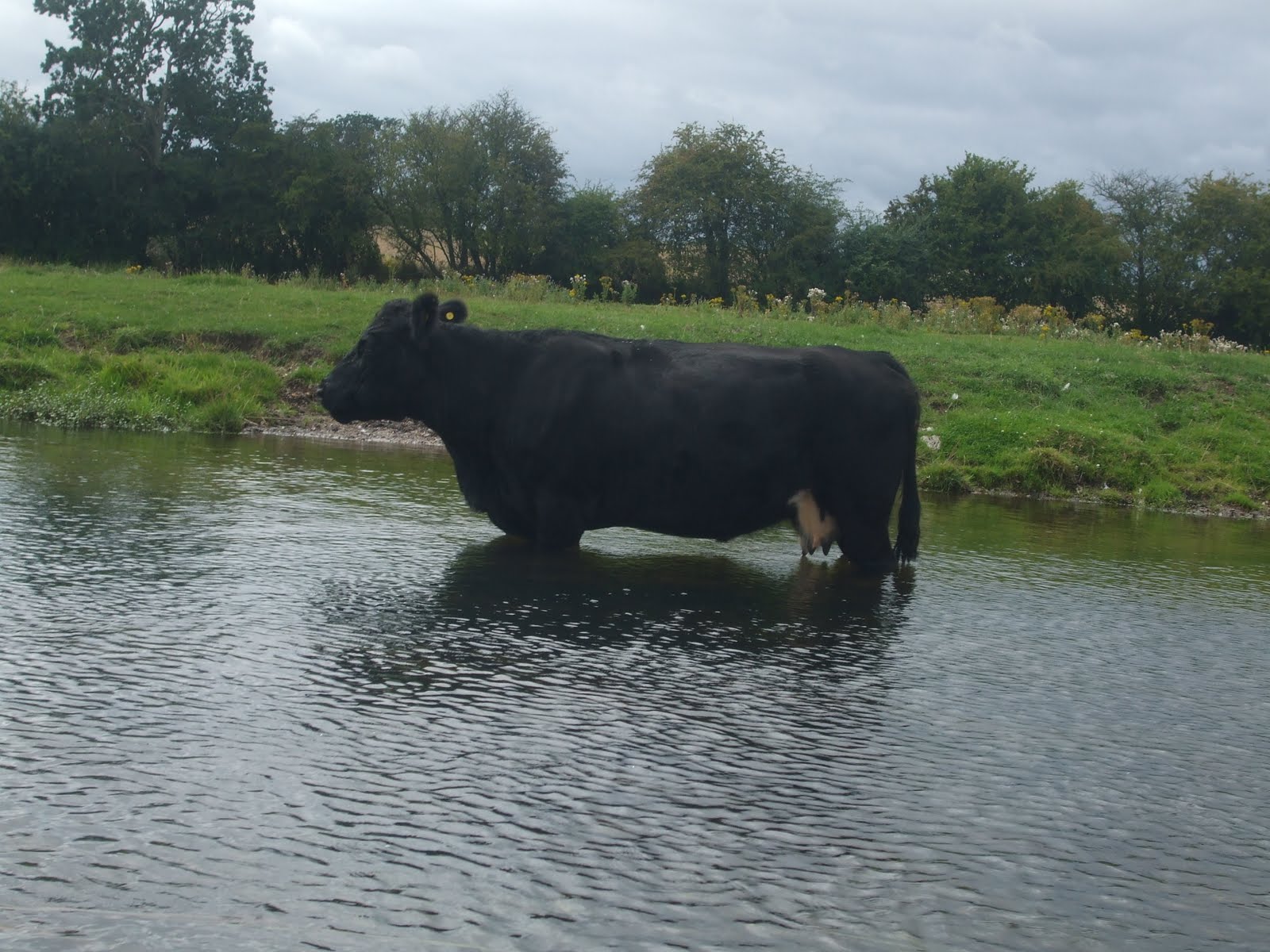
A whole field to graze in, but no, it wanted to be in the river.

After several years of thinking I should go, me & Cathy finally went to Warham Camp to see the Chalkhill Blue butterflies. If anyone from the council is reading this, an important historical site is probably worthy of some sort of sign directing you towards it. The butterflies are at the end of the flight period and rather tatty, but it was a nice place to spend the afternoon.

Chalkhill Blue

Overnight rain has meant that we hadn't put the moth trap out for a while, but of the few that came to the outside light there is only one record of Orange Swift on the Norfolk Moths website this year, making it of particular interest.

Orange Swift

Thats enough for now, I'm off to learn Greenish Warbler calls.

The end of an era

August 2010

After four years of Trinity Street fun, it is time to move. Adam has moved into a house made entirely of large John Lewis cushions with his girlfriend Laura, and this weekend I will be moving too. Of course this is all entirely over-dramatic, I'm still going to be living in Norwich. However, due to all of the stuff that comes with moving house and sorting out internet access, I will probably not be updating the website until the end of August. In the nicest possible way, I hope that nothing good turns up in Norfolk until the autumn. Enjoy the rest of the summer!

The Rose Tavern, a quality local pub.

Whitlingham August counts

5th August 2010
A visit to Whitlingham to do a wildfowl count, particularly of the Coot, which have been accumulating steadily over the summer. Almost all of the Greylags had gone (presumably onto the river at Thorpe) as a result of intensive sailing over much of the broad. A strange-looking vehicle was also motoring around the broad, apparently removing waterweed on a barrel at the front.
.
Anyway, main counts:
Mute Swan - 121 (6 Little Broad, 115 Great Broad). 9 birds were large cygnets (4 & 5).
Mallard - 177 (84 Little Broad, 93 Great Broad) All eclipse-type, 9 obvious black-and-white type "domestic Mallards"
Egyptian Goose - 31
Tufted Duck - 7 (all conservation area)
Pochard - 1 male (Conservation area)
Great Crested Grebe - 4
Gadwall - 7
Moorhen - 4
Coot - 156 (133 in the conservation area)
.
Little other birdlife, one Cetti's Warbler and one Chiffchaff called briefly from near the Little Broad. Butterflies included my first Painted Lady of the year, Red Admiral, Ringlet, Gatekeeper, Meadow Brown, Small White and Large White.

Cley again

2nd August 2010
.
Another visit to Cley, this time with Cathy. Birdlife was similar to my previous visit, a large number of Spoonbills on North Scrape (one actually moved!), a summer plumage Curlew Sandpiper, Green Sandpiper, c150 Dunlin and three Whimbrel. We had a brief seawatch, seeing one Fulmar west along with a few Terns and Cormorants. The large numbers of Swallows and Sand Martins that had been on the fences along the Eye field were gone, presumably on their way back to Africa. After lunch we checked out the central hides, one Spotted Redshank the pick of a meagre bunch. On the way back I had a chat with Andy Musgrove before we got the bus back to Norwich.

The fun of wader ID

31st July 2010

I was settling down for lunch on Saturday when I got a call from Gary offering a lift to look for the Hooded Crow that as been seen in the Cley area for a while. Deciding to go (HC was a Norfolk lifer) I got to the train in time and was picked up from North Walsham station. Handily the bird was relocated around the time we got to Sheringham, but some incredibly slow driving along the coast road limited our progress. We got there nonetheless, to find a crowd of 12-15 birders watching the Hooded Crow showing on-and-off in a stubble field. It flew off along with a flock of Woodpigeons, however it doubled back and perched in a coniferous tree nearby. Finding a decent vantage point we were able to watch it for some time, getting decent views and checking that it wasn't a hybrid.
.
As we were in the area, we decided to take a look at Cley. The large flock of Spoonbills was still on North Scrape (I counted 16 on most sweeps, but am assured that there were still 17, and the other one was directly behind one of the front birds). As we went back to the car I picked up 11 of them flying west. They flew past a birder who came up to ask if the Spoonbills were still there, but luckily once we'd told him he managed to spot them flying off! One more flew past before we left to try the middle hide complex. A Snipe has feeding in the open, and a number of Green Sands, Spotted Redshank (1 black bird) and Greenshank were obvious. We then began the unenviable job of checking through the Dunlin.
.
Most of the Dunlin were in summer plumage and very straightforward. A few weren't, but were still straightforward. We then came upon a bird with its head tucked in. It was noticeable initially because of its size, it was slightly larger than the Dunlin running around in front of it. Nowhere near as large as nearby Ruff, but enough to be larger than every other nearby Dunlin. The second point we noticed was the paleness of the underparts. There were no blotches, merely a few pale streaks on the upper breast and side. The bird occasionally lifted its head up to preen, revealing a long, black beak, slightly downcurved at the end. The bird had pale lores but no supercilium. The back was made up of black on chestnut, with cream fringes. There appeared to be small amounts of white either on the back or at the edges of feathers on the wing. As a Sparrowhawk flew over, the Dunlin flock shot off as a group. Our bird showed no intention of joining them, instead crouching low to the water.
.
By this point we had decided that the combined appearance and behaviour of this bird was odd. What we hadn't decided was what it could be if it wasn't a Dunlin. The lack of a supercilium and size ruled out most waders, and the bird lacked the jizz of Curlew Sand or White-rumped Sand. We hoped that it would give us a nice flypast, to check the rump and be on the safe side. As luck would have it after 45 minutes of not moving (despite a Marsh Harrier clearing te rest of the waders for a second time) it chose to fly when Gary was re-adjusting the 'scope. I kept on it with binoculars and picked up white on the tail area, but I was unable to be certain how far up the back it extended. The bird settled down in its new position, staying put low in the mud. It would sometimes swivel round on one leg, and also had "fit" type episodes of shaking and moving its beak.
.
Not wanting to leave in case we were missing something, we watched the bird for 2 hours+. A few birders came into the hide, but we realised that none of them had a great deal of experience with waders. Eventually Gary found two more experienced birders in Daukes who came and had a look. The conclusion was that the bird was a Dunlin, a slightly atypical one, but within the variation of the species. The non-flock behaviour, along with the inclination to not flush and shaking was suggested to be the result of a recent close encounter with a bird of prey. So there it was. We had spent the evening watching a Dunlin. Whilst there will undoubtedly be people that may scorn that, it was a useful excercise. It highlighted that by identifying common birds by jizz alone you miss out on seeing subtle differences in plumage, gave an insight into the variability of the species, and also showed the difference that light conditions can make (we went from 100% cloud cover to bright evening sun, with a noticeable difference in perceived colour of the crown and throat). It was also a good opportunity to make some field notes (attached below).

Wader notes. Ignore the bottom left flight drawing, the bird didn't show a white rump, I saw some white and was unable to be sure where. I also have to work on my "side-flight" views, as for most of its brief flight it was side on to me.

To end the day we went for a quick half at the Dun Cow. As we watched a pair of Linnet, the local Barn Owl flew in and landed on a post. We thought it couldn't get any better, until a Hobby flew in from the direction of Cley, swooping past before returning west. Pub tick!

Sandringham area

29th July 2010
.
No, I didn't go to the flower show. The main focus of the day was a social visit to West Newton, on the edge of the Sandringham estate. This left me able to explore east to Flitcham and west to Dersingham (I didn't say I was being sociable!) whilst Cath's parents met friends. The time before lunch was spent in the hide at Flitcham Abbey Farm. The local cows were pressed up against the fallen oak tree, but a scan along the posts behind located one of the family of Little Owls. Turtle Doves were calling, but it wasn't until a pair flew into a bare tree to the right of the hide that I could locate some, and we watched the male sing away for a while. Good numbers of Stock Doves were feeding in the area. On the way back young pheasants and rabbits chanced their luck along the edge of the road.
.
After lunch we set out in the other direction to Dersingham Bog. Despite a pleasant walk the heath was bird-light. A Kestrel perched at the top of a lone conifer was visible a mile off, whilst the call of Stonechats alerted us to at least four males. A lap around the boardwalk with not a dragonfly in sight was notable only for the amount of Round-leaved Sundew around the edges. A couple of Linnets later and we were walking back through the woods. Family groups of Coal Tit and Long-tailed Tits were calling, but nothing else stirred. Just before we headed back to Norwich we watched hundreds of gulls flying over towards the Wash, many appearing to have begun to moult primary feathers.

King Eider

27th July 2010
.
The start of the summer holidays had been uneventful up to this point, filled by house-hunting and local walks around Norwich. Mothing had been good, passing the 100 mark for Cath's garden (Iron Prominent and Chocolate-tip being the pick of the recent ones), but bird wise the only thing of note was a July-high of 107 Coot in the conservation area bay at Whitlingham.
.
I was at home filling out forms on Tuesday morning, when I brought up Birdguides and saw that a probable 1st-summer drake King Eider had been seen off Sheringham. Total time to get there (walk to the station, train, walk to the seafront) is about an hour and 45 minutes, and I had to go into the city to see a letting agent, so I consigned myself to not seeing it. By the afternoon the eider was still being seen, and rather than wait in hope that it would still be around on Wednesday, me & Cathy decided to give it a go. This seemed a bad decision as rain began to pour from the skies 10 minutes later, but thankfully by the time we reached Sheringham it had subsided to persistent drizzle.
.
As we headed along the promenade I was struck by the lack of birders. I know at least one of the previous birds was a long-stayer, but even for a weekday it seemed odd. I spoke to the one birder who was still there, who told me that he had been watching it for a while but then it had vanished, presumably drifting west. We walked along to the seawatching shelter, which was similarly devoid of birders, but then got a bit of luck when a guy walking past asked if we'd found it yet. He had just relocated the King Eider near the lifeboat station, and got me onto it via a long sequence of coloured flags. We then walked further west and got slightly closer views, although it was always distant. When light shone through the clouds it was possible to see paler areas and the bill colour, and the structure of the head was discernible against a pale sea. King Eider was a bird that I missed in Scotland ealier this year, so I am grateful to the finder and the birders on site for relocating the bird. I also hope that it went far enough west for a couple from Weybourne that I spoke to be able to "garden tick" it!

Station Marsh anti-wader scrape

18th July 2010

As wader passage is now underway I decided to give Thorpe Station Marsh a look. The only wading birds I saw, and this is using the term loosely, were Lapwings. The scrape was completely dry. Whilst obviously the lack of rainfall has played a major part in this, the relatively high water levels in the ditches suggests that the site may have been too well drained. The paths have been built up with gravel, but a new one along the eastern edge of Thorpe Broad has barbed wire across the southern end, presumably someone has forgot to take it away or put a "path closed" sign at the other end. Birdwise a few Stock Doves, 60 Canada Geese and a Kingfisher were the avians of choice. Two White-rumped Sandpipers were found at Breydon today, so very much a question of right idea, wrong (and overly optimistic) location.

Giving up on birds for the day I walked around Carey's Meadow, where a large number of plants were in flower. 16 Burnet moths were flying, 1 Silver Y, Red Admiral, Comma, Small Skipper (FOY) and loads of Ringlets and Gatekeepers. A couple of Brown Hawkers were patrolling the edges as well.

Nightjars & Moths

16th July 2010

The main purpose of the evening was to show Cathy some Nightjars. She wanted to see a perched one, but I've only managed that once, so I persuaded her that flight views would be just as good. Standing at our chosen heathland location we picked out a Noctule Bat each before the churring started at around 9:30. Despite at least three churring males and occasional flight calls, we failed to pick out any as darkness fell. Finally we saw a Nightjar, as a female ghosted across our path. We saw presumably the same bird in flight another two times, but by now picking up birds against the dark trees was becoming impossible. Whilst waiting I heard my first Turtle Dove for the site and a Tawny Owl called from nearby woodland.

We spent a further hour-and-a-half around a moth trap that had been set up close by. There was a marked contrast between the species we'd been getting in Norwich and the ones caught, unsurprisingly. Highlights included a number of Rosy Footmen, Pine Hawk Moth, Buff Arches, Black Arches and my first Pretty Chalk Carpet.

Pine Hawk Moth

Swallowtailed Moths

8th July 2010

Presumably the nice weather has encouraged Swallowtailed Moths to emerge. Cathy found this one, and another two came to the outside light once it got dark.


North & South of Norwich

4th July 2010
.
Part 1 - The North.
With Whitlingham offlimits (triathlon), I walked up to Mousehold Heath, hoping to jam in on the recent emergence of White Admirals. With few flowers out I concentrated on banks of brambles, but with no luck. I did pick up my first Essex Skipper of the year near Zaks. Two Brown Hawkers were flying over the heath, but Vinegar Pond has completely dried up, leaving them with nowhere to lay their eggs. A Green Woodpecker was the only bird of note. I stopped on the way back for a pint at the Murderers. The Woodfordes beer "Game On" (my beer of the month) is a special for the world cup, so I have to make the most of it in the next week.

Part 2 - South-east of Norwich
Like most people who heard that a River Warbler was singing at a site south-east of Norwich, I tried to guess where it might be. I guessed a private bit of the Yare valley, and hoped that it was at Whitlingham Sewage Works so that it would be a patch tick. My reaction to finding out that it was near Haddiscoe was to hope that the person responsible wasn't an estate agent. I managed to get a lift with Adam & Laura and we joked that there would be signs saying "River Warbler this way" up. Then there actually were! Thats real organisation.
.
Arriving onsite we were waved in by Dick Filby and then greeted by some friendly Americans (the landowners presumably?). We walked out of the parking area and round to the side, where after half an hour or so we heard our first bit of River Warbler song. The sewing machine comparison is a pretty good one, and there are similarities with the first few notes of Yellowhammer song as well. We stood and waited, as did Jim, before murmurs filtered through that it was showing from the carpark area. We walked back round, and sure enough we managed to see the River Warbler skulking low down in a small Alder. At first I could only see the back of it, but it moved slightly when it began singing, still partly obscured by vegetation most of the time.
.
Laura still hadn't seen it, being too short to look over the crowds, and me & Adam wanted better views, so we stuck around until 9.30. In the meantime David Norgate came over and said hi, as did Connor. The warbler did show again, long enough for Adam & Laura to look down another birders 'scope, but hopes that it would perch nicely on top of the bush were unfulfilled. Still, brief views are better than no views! The evening sun shining on the reeds was a lovely sight to add to the evening, and a Barn Owl briefly hunted the marshes behind the warbler bush.
.
A big thanks to everyone involved in finding the bird and arranging access, the effort is very much appreciated.

Eaton Park moth night

3rd July 2010
.
As part of a drive to encourage people to use Eaton Park, the friends of Eaton Park organised a moth night. Around 30 people turned up, and Peter Walton was part way through his introduction when classical music started from the rotunda. Apparently its a new deterrent to stop troublemaking young people from loitering. Rather amusingly despite the people who had it installed being present, they couldnt turn it off, so we passed around moths to music.
.
So the important question, does it work? No. Two teenagers walked into the rotunda and started to slow-dance, which was quite funny, but most of the other groups of young people (or nomadic tribespeople, it was dark by now) just shuffled through and loitered out of earshot. Most just made tired "I've got moths in my wallet" jokes, although two drunks did come over and pestered everyone for rizzlers. Anyway, a mediocre 14 species of moth were caught, the most spectacular a Lime Hawk Moth and scarcest a Clay Triple Lines.

Flycatcher at last

2nd July 2010
.
Deciding to finally nail this Spotted Flycatcher I spent a while scanning all of the open areas of scrub along the lane. After giving up with this I walked down the lime avenue, and looking out over the ruined hall I saw a bird fly out and then back to a tree branch out of the corner of my eye. It sat there long enough to get a good look at my latest patch tick, Spotted Flycatcher at last. It then flew onto one of the old walls, within photographic range but facing the wrong way. I didn't mind, a lovely little bird.
.
In a good mood I conducted a wildfowl count:
Mute Swans - 76 (5 cygnets)
Canada Goose - 30 (1 gosling)
Egyptian Goose - 62* - this is what I recorded but it seems high, maybe I wrote a number in the wrong column?
Greylag Goose - 143
Hybrid Goose - 3
Domestic Goose - 3
Mallard - 113
"Peking" type Duck - 1
Tufted Duck - 14
Pochard - 1 female (unusual for July)
Gadwall - 1 female
Coot - 79 (61 in the conservation area bay, two on nests)
Great Crested Grebes - 5
Moorhen - 1
.
I also had a good day with dragonflies, including my first site Norfolk Hawker, 3 Emperors, 30+ Black-tailed Skimmers and thousands of damseflies. In terms of butterflies I saw Ringlet, Meadow Brown, Large Skipper, Comma, Small Tortoiseshell, Large White and Red Admiral. Last but not least I saw a Honey Bee swarm on a willow branch over the path.


Taswood Lakes

1st July 2010

As last year I accompanied a group to stay the night at the fishing lakes near Tasburgh in order to have a look at the wildlife at this otherwise private site. Unfortunately the grass had been mown short and "tidied" around the edges of the lakes, and I was unable to find any glowworms. Check this link to see last years hot glowworm action: http://jamesbirdsandbeer.blogspot.com/2009/07/taswood-lakes.html.

What I did see was some good typical lakey stuff, a constantly feeding Common Tern was present for the whole time we were there, and a Kingfisher and a Barn Owl were flybys. A Black-tailed Skimmer jostled for possesion of the nearest swim, and a Dark Arches moth made itself at home in Michelle's tent. Unlike last year there was no sign of breeding from the Tufted Ducks.