Following a morning out I returned home to find an email letting me know about a Ruddy Shelduck at Whitlingham. I considered whether to go and look for it. On one side I hadn't batted an eyelid when two were reported from Marlingford a week or so ago, but once again the "but its on my patch" mentality crept in, so after lunch I went down to Whitlingham again to have a look. Suffice to say it was gone. Birdlife was similar to my previous visit, with the addition of two Goosander, one Oystercatcher and a singing Marsh Tit. I saw the Water Rail again, getting better views as it wasn't dusk!


NORWICH: First butterflies of the year
12th March 2011
.
A trip to the Cathedral so that Cathy could see the Peregrines was unsuccessful, but the warm weather had brought a number of butterflies out. On our walk in along Lakenham Way we saw 2 Brimstones and 4 Commas, whilst on our return the Comma numbers were up to 6 and single Peacock and Small Tortoiseshells were also out.
.


In the evening whilst watching the gulls stream eastwards towards Breydon, a very early Swallow flew through.
WHITLINGHAM: Week 11 - An evening visit
11th March 2011
The increased daylight and nice weather allowed me to go out birding after work for the first time this year. Whitlingham was pleasantly quiet, but the downside was that many birds were already settling down to roost/sleep. In fact the first thing of note was more than halfway round, a small bat sp. (presumably Common or Soprano Pipistrelle) hunting purposefully around the woodland edge. The walk back along the southern edge of the Great Broad was similarly uneventful, before a Song Thrush and Water Rail near the Little Broad added a couple to my patch year list.

NORFOLK: Dips and Egrets
6th March 2011
I went out for a jaunt around Norfolk with Gary & his dad, intending to look for the Great White Egret and then make our way up to the North Norfolk coast. In half-hour or so at Marlingford there was no sign of the egret, although we did hear a Grey Wagtail at Marlingford Mill and watched Buzzards displaying over a local woods. Our dip-fest continued by not seeing two species of owl and not seeing Woodlarks. "Surely that isn't going to be the highlight?" was the groan as we came away from the first three hours birding with distant views of a Stonechat.
We reached Titchwell and sprinted for the food hatch, Gary being the winner of the one sausage roll, whilst the losers received the Cornish Pasties. Presumably we can't call these Cornish pasties anymore, as they now have some sort of European regional protection. Anyway, by the time Phil got to the hatch there was no pastry-based products of any description. On the beach we walked along towards Thornham to get level with the scoter flock. No sign of any Velvets, but we did see a small flock of Eider and two Red-necked Grebes. A flock of Snow Buntings flew over our heads and we were stalked by two Black-headed Gulls.
Other stuff at Titchwell included Twite, Water Pipit and Water Rails. Beginning our way back to Norwich we stopped at Choseley, where we were serenaded by the jingling song of Corn Buntings, which was lovely. Back at Marlingford, looking at the same field as before, the Great White Egret was bang in the middle of it. We blinked and it had gone, hidden in a sttep-banked bit of river. Blinking again it was back, staying in view for about five minutes before vanishing behind a clump of Alders. We lingered a while, but it seemed content behind its trees so we headed back to Norwich.
I went out for a jaunt around Norfolk with Gary & his dad, intending to look for the Great White Egret and then make our way up to the North Norfolk coast. In half-hour or so at Marlingford there was no sign of the egret, although we did hear a Grey Wagtail at Marlingford Mill and watched Buzzards displaying over a local woods. Our dip-fest continued by not seeing two species of owl and not seeing Woodlarks. "Surely that isn't going to be the highlight?" was the groan as we came away from the first three hours birding with distant views of a Stonechat.
We reached Titchwell and sprinted for the food hatch, Gary being the winner of the one sausage roll, whilst the losers received the Cornish Pasties. Presumably we can't call these Cornish pasties anymore, as they now have some sort of European regional protection. Anyway, by the time Phil got to the hatch there was no pastry-based products of any description. On the beach we walked along towards Thornham to get level with the scoter flock. No sign of any Velvets, but we did see a small flock of Eider and two Red-necked Grebes. A flock of Snow Buntings flew over our heads and we were stalked by two Black-headed Gulls.
Other stuff at Titchwell included Twite, Water Pipit and Water Rails. Beginning our way back to Norwich we stopped at Choseley, where we were serenaded by the jingling song of Corn Buntings, which was lovely. Back at Marlingford, looking at the same field as before, the Great White Egret was bang in the middle of it. We blinked and it had gone, hidden in a sttep-banked bit of river. Blinking again it was back, staying in view for about five minutes before vanishing behind a clump of Alders. We lingered a while, but it seemed content behind its trees so we headed back to Norwich.

Egret hide-and-seek
WHITLINGHAM: Week 10 - Finally some Goosanders
5th March 2011
Last weeks fence around the Little Broad, which I presumed would be to create a separate area on the north shore for use by educational bodies, has in fact been extended all the way around the east shore of broad. Suggestions that the fence is only a temporary measure until an 8ft tall brick wall can be built were denied by an imaginary Broads Authority spokesman. A Black Swan resting on the small sliver of mud within the fence gave it that wildfowl collection feeling. Of more interest was a hybrid Wigeon x Gadwall (initially seen by David Norgate a couple of weeks ago) along the far shore. It stayed along the far shore, but patience paid off as a couple of hours later it swam within photographic range.
Last weeks fence around the Little Broad, which I presumed would be to create a separate area on the north shore for use by educational bodies, has in fact been extended all the way around the east shore of broad. Suggestions that the fence is only a temporary measure until an 8ft tall brick wall can be built were denied by an imaginary Broads Authority spokesman. A Black Swan resting on the small sliver of mud within the fence gave it that wildfowl collection feeling. Of more interest was a hybrid Wigeon x Gadwall (initially seen by David Norgate a couple of weeks ago) along the far shore. It stayed along the far shore, but patience paid off as a couple of hours later it swam within photographic range.

I'm lonely, I want Bar-headed Geese and Puna Teal, now!

Gageon or Wigwall? I can't decide what sounds least stupid.
Walking around the Great Broad it was evident that the drizzle was keeping people away (the exception being the model yachters, but they were having a race from the bank rather than roping off the slipway). Looking over onto Thorpe Broad I saw my first Whitlingham Oystercatcher of the year, it appears that there has been a decent move inland over the past week as I also saw some at Marlingford and Flitcham on Sunday. Birds of the day were two redhead Goosanders in the conservation area bay. Another year patch tick, although they have presumably been at Whitlingham since Monday when Adam saw two there.

NORWICH: Birds and beer in the local news
2nd March 2011
There are a number of beers named after birds, including the Wagtail Brewery's Best Bittern. Today Norfolk's best known brewery, Woodforde's, announced that their "Once Bittern" Ale will go on sale in pubs across Norfolk. It had initially been brewed last autumn exclusively for Wetherspoons pubs, but will now be released as a seasonal beer for this spring. For every pint sold 1p will be donated to the NWT. The press release doesn't say where it will be stocked, but if you're into your ale you probably know which pubs tend to get Woodfordes seasonal beers (Trafford Arms, Murderers etc).

For more information see EDP article
Also in the news today, Norwich Cathedral and the Hawk & Owl Trust have announced that they have erected a custon nest box for the Peregrines that have frequented Norwich Cathedral for the past few years. There are cameras focused on it, and they hope to follow the pair breeding via screens in the catherdral visitors centre. A welcome addition to Norwich's birdlife, and something to keep the Feral Pigeons on their toes!
Some pictures from the EDP can be found here
WHITLINGHAM: Soon with extra reedbed
1st March 2011
Whilst on the internet I happened to come across the winter 2010/2011 Whitlingham report, available here:
http://www.broads-authority.gov.uk/visiting/activities/whitlingham-country-park.html
It answers one of my questions - it appears that the fenced off area of the Little Broad is going to be another private area for schools and educational activities. The bit that I'm not won over by is the decision to remove the last remaining open edge at the east end of the broad (and with it the last chance of passage waders) to create that desirable habitat "dense reedbed".
"To improve its potential as a haven for wildlife, the Little Broad at Whitlingham is to be planted with reeds along its eastern shore and around its fringes. Reeds have already grown naturally in some places and new planting will extend the reeds to form dense beds where warblers and waterfowl can live and breed."
Whilst on the internet I happened to come across the winter 2010/2011 Whitlingham report, available here:
http://www.broads-authority.gov.uk/visiting/activities/whitlingham-country-park.html
It answers one of my questions - it appears that the fenced off area of the Little Broad is going to be another private area for schools and educational activities. The bit that I'm not won over by is the decision to remove the last remaining open edge at the east end of the broad (and with it the last chance of passage waders) to create that desirable habitat "dense reedbed".
"To improve its potential as a haven for wildlife, the Little Broad at Whitlingham is to be planted with reeds along its eastern shore and around its fringes. Reeds have already grown naturally in some places and new planting will extend the reeds to form dense beds where warblers and waterfowl can live and breed."
"In a new project funded by Norfolk County Council who run Whitlingham Outdoor Education Centre, a piece of land beside the Little Broad will be fenced off and planted with a screen of trees to create a secure site where groups from schools and other educational bodies can study nature.and other educational activities. Planting is due to start in spring."
NORWICH: Garden gratification
27th February 2011
.
.
My garden is close to a cemetery, and as such I get a decent variety of birds. However there are some notable absentees, including Greenficnes and Goldfinches. Everyone I know who has put up a niger* seed feeders has them by the bucketload. I have seen a flock of up to 40 in a tree in the cemetery, but they just aren't interested in the niger, sunflower seeds or millet. Anyway, whilst listening to the cricket this afternoon I was watching a Coal Tit and a Nuthatch in the small tree in the garden when I noticed a bird on the niger feeder. A male Siskin! Joined soon after by a female, which alternated between the sunflower seeds and the niger. I see Siskins almost every time I go birding over the winter, but there really is nothing like seeing them in your own back garden.
* niger, nijer, nyger, nyjer. Take your pick, its the little black seeds that Goldfinches eat in other peoples gardens.
WHITLINGHAM: Week 9 - Egretless
27th February 2011
.
I did consider going to look for the Marlingford Great White Egret, but its a few miles too far from Norwich to be a comfortable walk. Instead I didn't check BirdGuides on Sunday morning and went to Lakenham Mill to check the nearest stretch of the Yare in case it had moved east along the river. Alas it hadn't, but it was a much nicer walk to Whitlingham than following the ring road, and I did see a Grey Wagtail and hear my second Cetti's Warbler of the year.
.
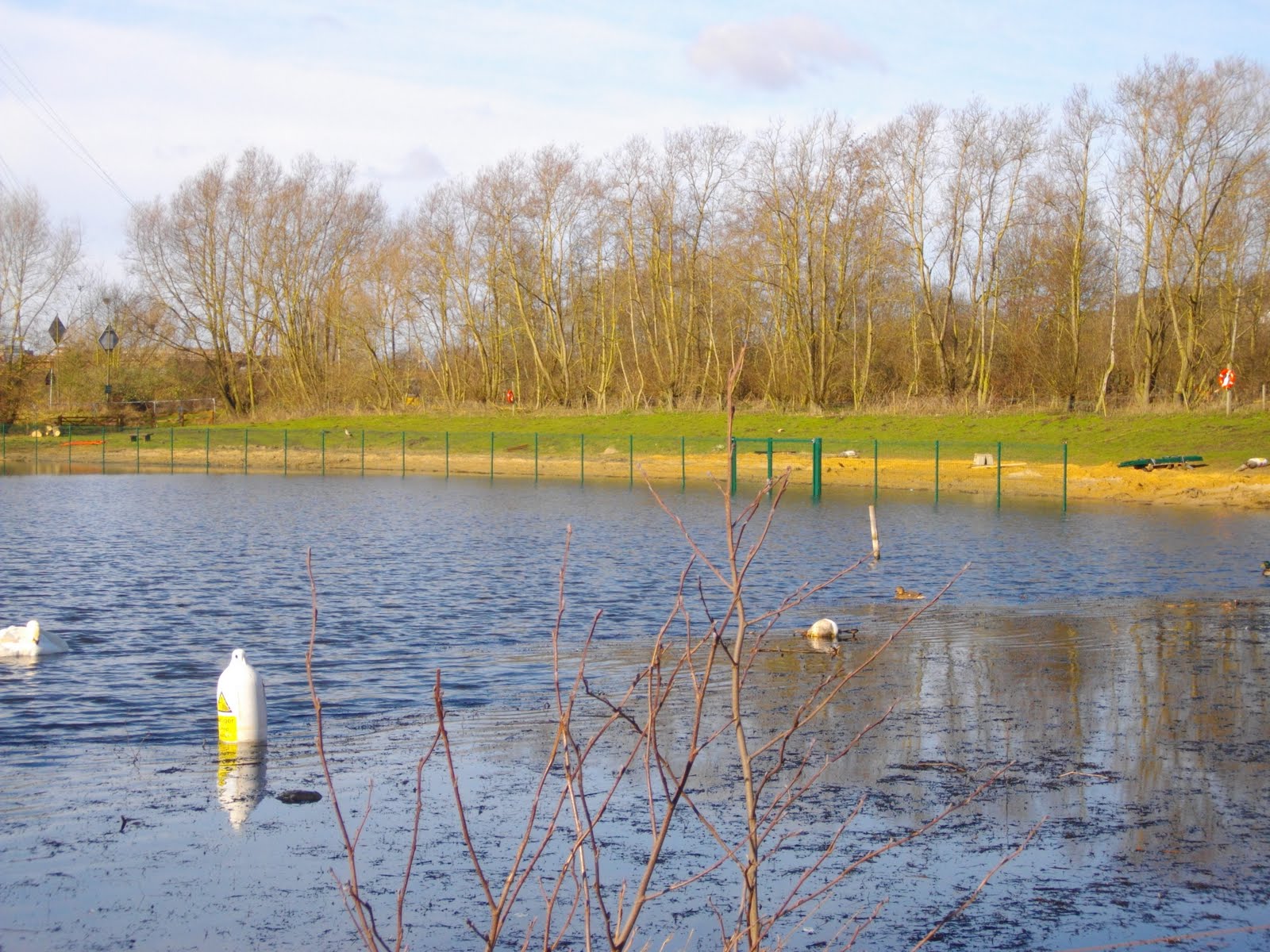
Looking at the Little Broad it appears that someone in their infinte wisdom has decided to fence off the flagship "beach" from the water, presumably as a reaction to people not swimming within the designated areas only. A sad state of affairs.
.
 .
. I've given up on seeing Bramblings beneath the feeders, but did stop for a while to watch the rats (now numbering at least seven) which happily scamper around eating the seed. I had a nice chat with another onlooker, who was clearly older than she looked, as she said that whenever she sees rats they remind her of the plague. There was even fewer waterbirds on the broad than last week, only the c50 Teal being a decent number. Again I added a single bird to this years patch list, with a singing male Reed Bunting returning to the same bush for at least the third year running
NORWICH: Rosary Cemetery & Carey's Meadow
23rd February 2011
.
 .
.
.
Taking advantage of the sunny weather Cathy & I went for a walk in Rosary Cemetery. We saw the expected selection of common woodland birds, but the main attraction at this time of year is the crocuses that carpet large areas. Add in the Snowdrops, Aconites and first Primroses of the year and its got to be one of the nicest areas to spend some time near the city. The warm weather had brought large numbers of 7-spot Ladybirds out, mostly in the ivy.
.
 .
. Afterwards we had a quick walk around Carey's Meadow. Most of the vegetation has been cut back to allow new growth, but we did get good views of a Green Woodpecker under one of the small trees. On the way back we intended to have a drink at the Mustard Pot, but it only opens at 4pm! What is the world coming to?
NORFOLK: Titchwell
21st February 2011
.
Before Christmas I had agreed to give one of my non-birding friends a guided walk of Titchwell. On the way we stopped to watch a Barn Owl sat on a roadside post just past Docking, and after arriving we saw a second one hunting over the marshes west of the main path. A large flock of Siskins were in the alders by the feeders, along with a carpet of Chaffinches below them. The water level seemed a bit high, but we saw the expected waders (Avocet, Golden Plover, Ruff etc) and my first Pintail of the year.
.
It was my first look at the new Parrinder hide, and it was a mixed reception. The large windows and even floor are a plus, but I didn't even attempt to use the window-opening mechanism. I was puzzled by the use of a connecting door in the lower section, dividing the hide into two parts. That could be rather annoying when the hide is packed and a bird moves along the freshmarsh. I also have to wonder whether more money than was necessary was spent on the "futuristic" design to make the building conform to some aesthetic ideal, or whether there is a good reason for it. Still, its new and its not broken yet, and with those individual seats you can reasonably tell people talking cr*p to "go swivel", so its not all bad.
.
In a quick scan of the sea I saw the Common Scoter flock, Red-breasted Mergansers, Goldeneye and a Long-tailed Duck, whilst a Sanderling running along in front of us kept Cathy & Emma entertained. On our way back we picked up the Twite flock and some Reed Buntings, and a quick stop at Choseley revealed a few Yellowhammers. After lunch we went home, the first time this year that I've gone birding out of Norwich and someone hasn't been or ended up on crutches!

WHITLINGHAM: Miss of the month
I've just found out that a drake Baikal Teal was seen at Whitlingham at the end of January! The chances of it being of wild origin are somewhere between nil and zero, but it would have been a cracker to see. As it happens I was at Whitlingham the morning after it was seen, so I can at least be content that I would have seen it had it stayed around.
.
On a more serious note, first the Red-breasted Goose, now Baikal Teal (not to mention the Red-crested Pochard and Mandarin of unknown origin last year) - is someone nearby forgetting to lock the pen doors?!
WHITLINGHAM: Week 8 - Wildfowl count
20th February 2011
.
Today's visit was dedicated to doing a wildfowl count of the Little Broad, Great Broad and Thorpe Broad. For the first hour or so the country park was as quiet as I've seen it in ages, possibly due in part to the discovery of a body late last week putting people off. Later it did get busier, with a group of joggers and some scuba divers. I won't bore you with the counts, but 400+ Black-headed Gulls and 52 Teal were noteworthy. I did add one bird to the year list, an overdue Snipe.
WHITLINGHAM: Week 7 - Black Swan (no, not the weird ballet film)
13th February 2011
 I had presumed that the missing Gadwall and Coot would be in the conservation area bay, but it seems they have just gone. A few Teal, Pochard and Shoveler remained, and there was a raft of loafing gulls, 150+ Black-headed and c20 Common. It started to drizzle, and the day was only redeemed in part by the re-appearance of the Black Swan.
 Aussie vagrant
Trowse Meadows were short on birds, but some territorial Egyptian Geese stopped it from being quiet. A Marsh Tit was in the hedge along Whitlingham Lane. At the country park there was a notable increase in bird song from the previous week, and there has been a noticeable clearout of Gadwall and Coot from both broads. The area around the slipway had been chained off by the Norwich Yacht Club. This group of eccentric individuals used to walk along the bank of the broad every so often racing their model boats, but now appear to have become more organised. Presumably its a once-a-month job, but it does seem to set a precedent for allowing groups to close bits off, which is rather annoying bearing in mind that the North shore of the Little Broad is now private and the Great Broad is often disturbed by watersports. Maybe I can have one day a month to set up a watchtower and shoot dogs that are being allowed to attack swans.
 I had presumed that the missing Gadwall and Coot would be in the conservation area bay, but it seems they have just gone. A few Teal, Pochard and Shoveler remained, and there was a raft of loafing gulls, 150+ Black-headed and c20 Common. It started to drizzle, and the day was only redeemed in part by the re-appearance of the Black Swan.
 Aussie vagrant
WHITLINGHAM: Week 6 - Kingfisher & Goldeneye
5th February 2011
.
.
Blimey it's February already, surely only a matter of time until a good bird turns up locally? Trowse Common was shaping up to be a disappointment until a Kingfisher shot along the ditch between the common and Whitlingham Lane. Finally a first glimpse of the year of my favourite bird. The Little Broad Alders were quiet, but I found myself surrounded by Siskins further along near the ruins of Trowse Newton Hall. Within the flock was a Treecreeper, a Lesser Redpoll and another redpoll, which flew off before I could clinch it. I had a quick chat with Dave Appleton, who was on the lookout for a hybrid duck, before setting off around the Great Broad.
.
There's no point bulking out the rest of the post - it was windy, two brown-head Goldeneye were in the conservation area bay. Otherwise it's as you were at Whitlingham.
Subscribe to:
Posts (Atom)