The Whitlingham Bird Report for 2025 is now available to download from the Bird Reports page or from here

CENTRAL NORFOLK: Whitwell Common

1st November 2015

On Sunday afternoon Cathy & I decided to go for a walk, but without a destination in mind I chose a site from my 'I should really go and have a look around there at some point' list. That site was Whitwell Common, a SSSI near Reepham. We parked up at the small pull in near one of the entrances to the common and had a look at the map on one of several professional-looking display boards. Despite being nominally a common we read that there was no specific public rights of way, but there was a permissive circular trail that was regularly cut. As it turned out, this was the most sensible route anyway as much of the site was quite wet.


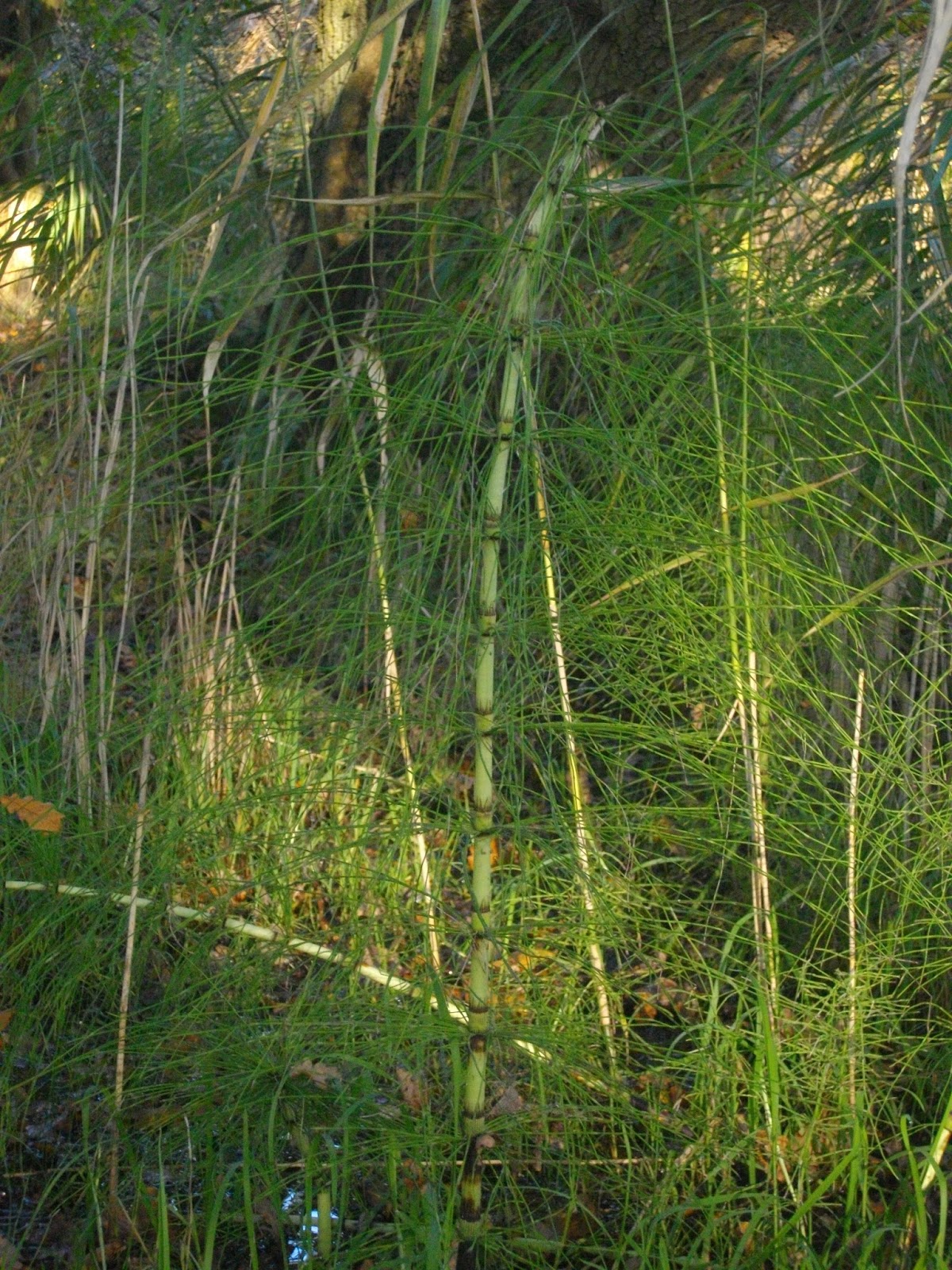
There are quite a few fungus records for Whitwell Common, including Crimson Waxcap, but I didn't notice any grassland fungi, or indeed any dry grassland areas where they would normally grow. I did notice some Giant Horsetail growing in an area of wet woodland between a path and the road. This large version of the commoner horsetails is rather scarce in Norfolk - I had only seen it once before. As we emerged from the wooded area I raised my arm to shield my eyes from the sun, and within seconds a Common Darter dragonfly had landed on my hand. It flew up and returned briefly, before relocating to a nearby branch. This was a very satisfying feeling, somehow connecting with the landscape.

After walking through some wet reedbed areas we crossed a ditch into the woodland. On our left hand side was a small river (I'm not sure which one, but I think it is a tributary of the River Ainse). We saw some bright-pink seeded Spindle trees, but not much else of note until we were almost back at the road, where there was a flush of fungi. I heard a Treecreeper calling, and spotted it working its way up a nearby Oak. This was a nice site, and I'm sure in the spring there would be many more things of interest to look for.


WHITLINGHAM: Snails, trees, fungi & a moth

31st October 2015

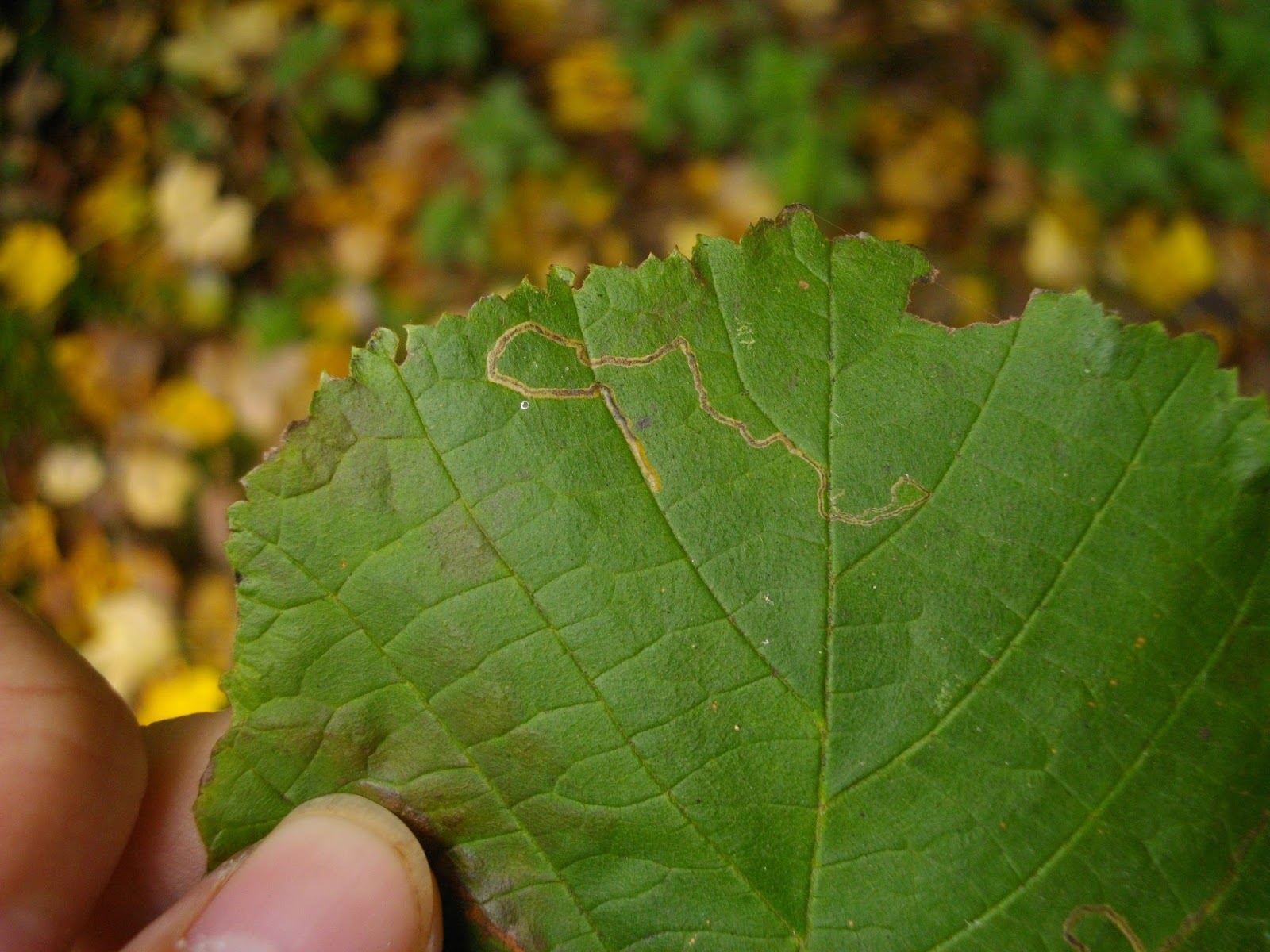
On Saturday I headed down to Whitlingham, but as it was a sunny day and rather busy, I decided to start off in the woods. As I entered the woods I noticed some Norway Maple saplings. I had previously not counted Norway Maple on my patch list as it would have been planted originally, but as it appears to be regenerating naturally, on it goes (958). The next thing I noticed was a caterpillar inside a leaf mine on a Hazel leaf. I photographed this, hoping that the pattern of the mine and the 'frass' (leaf miner poo!) would enable me to identify it at home. I was almost right - I got it down to two species of micro moth, but have been advised that I need to take a picture lighting up the mine more clearly to be sure which one it is.

 Norway Maple
Mine in Hazel caused by a Phyllonorycter sp.

As it has been a wet week there were lots of snails about. Many of them were different patterned versions of the White-lipped Banded Snail, but I did find a new species for me, Hygromia cinctella, which I keyed out at home (959). Plaited Door Snail was another interesting snail, but one that I had seen in the woods several times before. There was a bit of fungi about, but not as much as there has been in the other places I've visited recently. One interesting species was the Fire-rug Inkcap, so called because the mycelium forms an orangey-brown furry mat, which is often visible on logs. Along the telegraph pole alley I photographed an adult Hawthorn Shieldbug, which I will add to my Shieldbugs species guide soon (currently there is only a late instar photo in it).

 Hygromia cinctella
 Plaited Door Snail
 Fire-rug Inkcap - note the orangey 'fire rug'
 Hawthorn Shieldbug

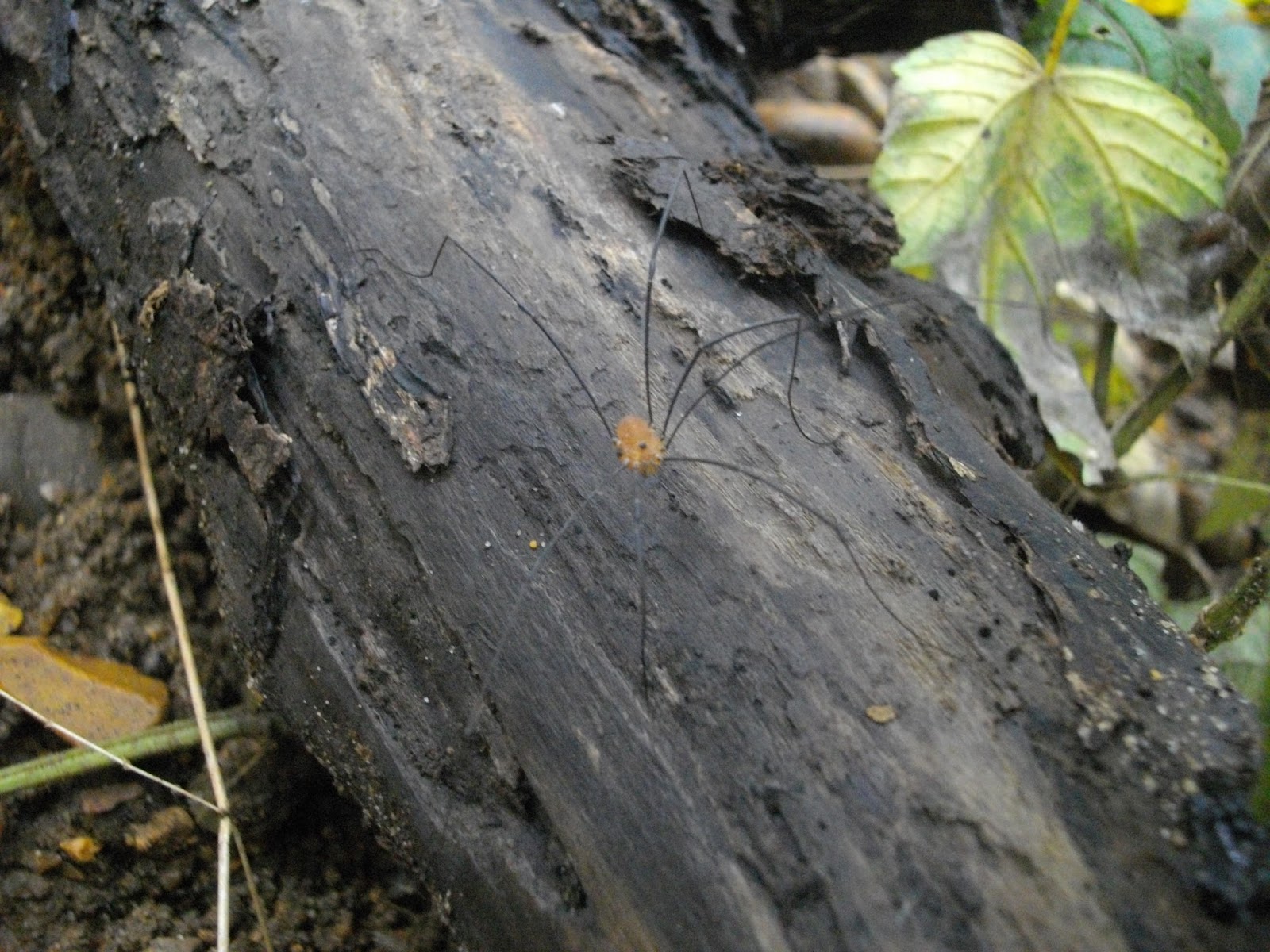
The next new species on my list was a Harvestman, Leiobunum rotundum (960). The males of this species are round and orangey, but they need to be looked at carefully to separate them from L. blackwalli. The key bit to look at is between the eyes, which is black on rotundum but white on blackwalli. In a hedgerow I saw the bright pink flowers seed cases of Wild Spindle. I wasn't sure whether this would have been planted or grown naturally, however I later saw it in a second location. The most recent Flora of Norfolk says that Spindle is "not infrequent on base rich soils", and given the chalky nature of Whitlingham Woods I reckon this is reasonable (961).

 Leiobunum rotundum
 Wild Spindle

Emerging from the woods I walked back as far as the island to scan for birds. A flock of Tufted Ducks flew east and most of the gulls had left the water and were circling around, making me suspect a Peregrine had just flown through, but I didn't see it. When the birds settled I picked out at least six Pochard and seven Great-crested Grebes, but not much else of note. I walked as far as the eastern end of the broad to scan over to Thorpe, but didn't see any of the Goldeneye that have been frequenting Thorpe Broad of late. On my way back I did noticed some very inconspicuous fungi, Slender Clubs, growing on some bark chippings (962). These could easily be mistaken for dead bits of leaf or shoots, and was a species that I hadn't seen for years, so were pleasing to see.

Slender Clubs

There was still time for a couple more interesting sightings. Firstly a brightly-coloured Comma butterfly was resting on some ivy. Probably the latest I've seen one flying, only a day off November. The second sighting was pure luck, I spotted a 'growth' on a tree branch and upon investigation it was a Vapourer moth cocoon, covered in eggs. Well camouflaged next to it I found the female moth. Female Vapourers are flightless, having only stubby vestigial wings. They emerge from their cocoon, attract a male by releasing pheromones and then lay their eggs on the cocoon they emerged from, often hardly moving at all as an adult! I think several other moths undergo a similar life cycle, but Vapourer is the most familiar one.

Female Vapourer moth and eggs

NORTH NORFOLK: Felbrigg fungi

30th October 2015

I was in North Norfolk to drop Cathy off in Tuttington, so I called in at Felbrigg Hall to have a look for fungi. Felbrigg is one of the best sites in the county for Waxcaps, and the only place in Norfolk that the rare Pink Ballerina has been recorded. I didn't find any of those, but I did see Scarlet, Parrot, Golden, Meadow and Snowy Waxcaps. The rarest species I saw was a tiny parasitic fungus that turns the gills of Snowy Waxcaps a purple colour. Provided that this record is accepted from a photo then it will be the 4th Norfolk record. A pale yellow club fungus was probably Apricot Club, although it requires microscopy to be sure. There was no sign of any Mandarins on the lake, but there were a couple of Little Grebes, plus 34 Tufted Ducks and some Gadwall.

 Scarlet Waxcap
 Paecilomyces marquandii on Snowy Waxcap
Putative Apricot Club (or Yellow Club)

CENTRAL NORFOLK: St Faith's Common fungi

29th October 2015

We popped out in the afternoon for a short walk at St Faith's Common near Horsford. It didn't take long for us to find Hoof Fungus (Fomes fomentarius), a relatively common species that I hadn't seen before. It used to be found in Norfolk as it fossilised ones have been found, but in recent times it has only spread back from the west and is still not paricularly widespread. In one of the open areas there was a lot of Common Rustgill (Gymnopilus penetrans) growing, and Cathy found some more Orange Peel fungus (Aleuria aurantia). I spotted some Fluted Bird's-nest Fungi (Cyathus striatus), which was nice to find having previously been shown it earlier in the year at Earlham Cemetery

 Hoof Fungus
 Common Rustgill
 Fluted Bird's-nest Fungus
Orange Peel fungus

NORFOLK: Earlham & Holt fungi

27th October 2015

Cathy & I headed out today to have lunch at Natural Surroundings. Whilst signposted as a wildflower centre, the best bit for many people is the little cafe in the woods, where you can have lunch whilst watching woodland birds on the feeders.

On the way we called in at Earlham Cemetery, where I had got directions from Ian for Jellybaby fungus (Leotia lubrica). This was a new species for me, although Cathy wasn't particularly impressed with its similarity to actual jellybabies, despite my demonstration of just how similar they are.

Jellybabies

At Natural Surroundings we had some big slabs of cheese on toast whilst watching Nuthatches and Coal Tits on the bird feeders just outside the window. After lunch we went out into the nature reserve, having a walk around the wooded areas before reaching the river. Here we saw some Brown Trout in the River Glaven. We stopped in the hide, but didn't see much from it. On our way back to the cafe a large flock of Siskins called from the trees nearby.


On our way back to Norwich we decided to call in at Holt Country Park. Near the car park I stopped to look at the remains of Golden Bootleg Fungus, which looked like it had encountered someone elses' boot. Luckily I had seen photos of it before the damage, so knew what it was. We headed off into the totem pole clearing, which always used to be good for fungi when I was younger. I was a bit surprised to see a woodland garden - presumably it has been there ages but on all of my recent visits I have always headed off towards the pond or around the edges.

 Golden Bootleg - seen better days
The garden proved to be full of fungi. Large amounts of Hairy Curtain Crust were growing on the wooden edging, and Cathy set about finding lots of fungi, including Orange Peel fungus and some impressive Redlead Roundheads. We saw many different species, including an old favourite of mine, Ear Pick fungus. This species grows from pine cones and has spines rather than gills.

 Orange Peel fungus
 Redlead Roundhead
 Ear Pick fungus
 Common Mazegill

NORWICH: Earlham Cemetery October fungus walk

25th October 2015

Today was the monthly Friends of Earlham Cemetery walk, with a fungi and trees theme. In the absence of Ian, who maintains the sites fungi list, I helped lead the walk. We began in the small areas of nutrient-poor grassland alongside the drive. Pleated Inkcap was the first fungus of the day, followed by Ivory Bonnet and Meadow Coral. We soon found some Waxcaps, including some bright red ones which turned out to be Vermillion Waxcaps (rather than Scarlet, which I thought they might be at the time). In the same area were Golden Waxcap, Parrot Waxcap and Snowy Waxcap, whilst further round we saw Blackening Waxcap and the tan-coloured ochraceopallida variant of Snowy Waxcap. Other species in this area included Ivory Coral and Earthtongue spp.

Vermillion Waxcap
 Parrot Waxcap
 Golden Waxcaps
Snowy Waxcap var. ochraceopallida

Continuing along the path Jeremy showed some of the group the effects of Ash dieback disease, whilst we found the strong-smelling Sulphur Knight and looked at the diversity of form of the Deceiver. Further round we compared the gill structures of Tawny Funnel, Clouded Funnel and a Mycena sp. A lone Sessile Earthstar was growing by the path, but it was a bit eaten around the edges, which was a shame. We saw some Milky Bonnets, Butter Caps and Smoky Bracket as we headed round to the area where the Death Caps are found. That species had gone over, but we did see some Dog Stinkhorns nearby.

 Milky Bonnets
 Sessile Earthstar
 Smoky Bracket

Finally we checked an area near the entrance where the coral Ramaria flaccida grows, and also saw some Lilac Fibrecaps. The next Friends of Earlham Cemetery walk is on Sunday 15th November at 2pm if anyone is interested.

Ramaria flaccida

EAST NORFOLK: Siberian Stonechat & Puffballs

24th October 2015

Whilst there has been a clearout of birds from the North Norfolk coast, another rare bird had been located mid-week at Caister-on-sea. Siberian Stonechats had until fairly recently been treated as a sub-species, but are now considered a full species in their own right (and indeed may be further split in the future). The Caister bird is a male, and a particularly nice looking bird, so Cathy & I decided to go and have a look.

We parked up near the lifeboat station and walked south through the dunes. A Common Stonechat flew out of some scrub, but we didn't see much more until we had reached a small group of people scanning inland. I set up the 'scope and quickly picked out the Siberian Stonechat perched on some brambles along the edge of the golf course. It remained faithful to this area, frequently flicking up to feed and returning to its favoured perch. It showed off the large, unstreaked rump patch that helps identify this species, and I even got an out-of-focus photo of it.


After having a look at the Stonechat Cathy went over to look out to sea. She had found a seal, but then called me over to check out a large bird she had found. I had a look and found that it was a 1st-year Swan - not the sort of thing you would expect to see offshore, although I had seen a couple of Whooper Swans off Titchwell a few years back. Distance prevented me from identifying this one conclusively (I suspect Whooper), so I would be interested if someone got better views and knows for sure. Cathy had also noticed some large puffballs, which based on the long stipe and 'spikiness' were Pestle Puffballs, although in slightly unusual habitat. We also saw Dusky and Grassland Puffballs on our way back to the car.

 Swan sp.
Pestle Puffball

NORTH NORFOLK: Burnham Overy Dune fungi

18th October 2015

Whilst at work during the week, I had read about the recent influx of migrant birds, particularly along the north Norfolk coast, with a degree of envy. On Sunday I had kept the day clear to attend a NNNS walk at Burnham Dunes, which would include the opportunity for a bit of birding, but was more aimed at plants and fungi. As I had been looking forward to this walk I decided to go ahead as planned, but to leave early and spend a bit of time in Wells Woods first. 

Upon arrival I was surprised that dog walkers outnumbered birders, but this state of affairs didn't persist for too long. I decided to devote the bulk of my time to looking for the Blyth's Reed Warbler found earlier in the week, and after hearing it call for a while I eventually got brief views. With time running out before I had to head to Burnham I walked west along the main track, stopping at regular intervals to admire the Goldcrests that adorned many branches. Despite Connor telling me that the Hume's Warbler and Pallas' Warbler were still present further along, I was unable to see either in a brief look before heading back to the car.

I parked up at Burnham Overy Staithe and met Tony Leech who was leading the NNNS walk. We were also accompanied by Andy Bloomfield, who works on the Holkham estate. On the walk out to the dunes Andy stopped to look at a bunting he had seen, which he had heard give a ticking call. Unfortunately it flew out of sight, but he called a friend to come and check it out, and they confirmed that he had found a Little Bunting! As at Wells there were lots of Goldcrests, only here they were flicking about in the Sueada, and later on also amongst the moss and lichen of the dune slacks.

One of the groups that the dunes here are particularly known for are the Earthstars. We saw a minimum of two species, possibly two more (there can be quite a bit of overlap between species, so Tony took samples of two to check microscopic features before confirming their ID). The two definite species were both new for me, Tiny Earthstar (Geastrum minimum) and Dwarf Earthstar (Geastrum schmidelii). The latter species was found in a restricted area of the dunes that we were able to enter whilst accompanying Andy. Here we also saw a pond containing Natterjack Toad tadpoles. Apparently the toads had spawned late, and unfortunately these tadpoles are likely to perish as the weather gets colder.

Tiny Earthstar
 Dwarf Earthstars
Natterjack tadpoles

In addition to the Earthstars we saw a number of other species associated with nutrient-poor grassland. These included five Waxcap species (Blackening, Dune, Snowy, Spangle and Parrot), a yellow spindle sp and some Enteloma sp. Back in the old dunes we came across a large area of Winter Stalkballs (Tulostoma brumale), a species I saw for the first time last year at Holme Dunes.

 Snowy Waxcap
 Spangle Waxcap
 Winter Stalkball

Having searched the old dunes, we headed northwards into the loose sand of the yellow dunes. We had a rough idea of the sort of species we hoped to find here, and managed to see almost all of them. I was pleased to see Dune Stinkhorn, as my only previous sighting had been of a dessicated specimen at Holme a year ago. Field Bird's-nests were common, growing on old Marram debris. Dune Mushroom, Dune Cavalier and Dune Brittlestem were both expected, but the small ink cap Coprinopsis ammophilae growing amongst the sand caused excitement, as it appears to be the first Norfolk record (there are no records on the county database, but a separate national one has to be checked too). 

 Dune Stinkhorn
 Field Bird's-nest
Coprinopsis ammophilae

On the way back it was good to meet Robert Yaxley on the coastal footpath. A crowd had gathered to look for the Little Bunting, which was currently out of sight, but after a full day I decided to head home rather than wait for it to show.