The Whitlingham Bird Report for 2025 is now available to download from the Bird Reports page or from here

Identifying leaf-cutter bees

Many readers will be aware of leaf-cutter ants from wildlife documentaries, but I would guess that fewer are aware that in the UK we have leaf-cutter bees. These bees cut out small sections of leaf then fly back to their nests with them, including 'bee hotels' that can be bought or made for use in gardens.

Since the release of Steven Falks field guide to bees (and more recently Nick Owen's Bees of Norfolk) I have been trying to identify more species of bee. My bee list is currently 39, which might not seem too bad if it wasn't for the fact that in west Norwich friends Vanna and Jeremy Bartlett have recorded 49 in their garden alone! I have also had lots of help with identification and verification of my records. Many species of bee can look very similar to each other, so it is always nice to find a genus or species that is quite distinctive. Identifying leaf-cutter bees to species can be tricky, but identifying them as a group isn't too bad. They are found in a range of habitats, including gardens, so you may well have come across them without realising. Below are some photos and points to help you identify them.

Typically leaf-cutter bees have a chocolate brown thorax (the round body segment between the head and abdomen), a dark brown, flattened-looking abdominal segments and pale furry edges (photo 1). They often strike a distinctive posture with the abdomen pointing upwards (photo 2), and the females have a 'pollen brush' underneath. This is quite distinctive as a mass of orangey hairs, and this replaces the pollen brushes that most species have on their legs to carry pollen. Some species have all orange hairs, whilst others are orange but then darker towards the end (photo 3)


If you're interested, the first two photos show Megachile centuncularis at the edge of a path near my house in Norwich, whilst the last photo is Megachile ligniesca from Alderfen Broad. Note the dark hairs under the end of the bottom bee, and the lack of hairiness on most of the last tergite (abdomen segment). So there we go, a few ID tips there. As for Andrenas? Lump 'em all as "Mining Bee" I say.

RSPB FUNDING APPEAL: Snettisham hide

Early in July some tweets started appearing with the hashtag #Snettshide, a short video of some Knot and the tagline "Keep following #SnettsHide for all the latest information on what's happening on the 10 July. Stay tuned if you #LoveSnetts"

This was of course designed to build up interest in whatever was being unveiled, something to do with a hide at Snettisham. But what could it be? Was the hide going to feature as the TARDIS in the new series of Doctor Who? Had Ed Sheerhan's Game of Thrones cameo been filmed there? Perhaps it had been built underground as was going to rise up out of the earth whilst Wagner's Ring Cycle was played by a live orchestra?

Well no, the big reveal was that the RSPB want to build a hide to replace the two lost in the 2013 storm surge, and have launched a crowdfunder appeal for funds. The design is pictured below, but you can see it in situ and donate to the fund here: http://www.crowdfunder.co.uk/snettishamhide


Birders are a cynical bunch, and whilst many were immediately supportive, there were also quite a few questions about the hide. The RSPB have provided the answers to many of these common questions here: http://www.rspb.org.uk/community/ourwork/b/east/archive/2017/07/13/rebuild-snettisham-hide-crowdfunding-campaign-things-you-might-find-interesting.aspx. A blog entry that just directs you to another website isn't very fun though, so here are some of the points I've seen mentioned, along with either the RSPB comments or my opinion.

1) Does a hide really cost £120,000? 
This is a genuine question, because most of us have never built a hide before, and the old ones do resemble large sheds. It does seem expensive, but the link above explains the reasons for this - it has to be reinforced because it is being built on shingle, has the capacity of two previous hides and will require specialist equipment to build it because of the location. It also has a pit to put photographers in for photographers to go in.

2) Is it being designed by the same people as the Parrinder Hide?
The Parrinder Hide at Titchwell is an award winning hide, but it is perhaps arguable that hides do not need to win awards. The Parrinder design was not universally popular - "Ikea meets a World War 2 bunker" being one of the more family friendly descriptions. The main concerns are two-fold, that the hide would stick out in the landscape and cost more than necesary because of funky architecture. Again the RSPB link reassures us, this hide has a different designer, will fit in with the landscape and is designed purely for functionality.

3) Why use a month-long crowdfunder appeal?
I must admit I wondered this. A month is not a long time to raise that much money. The link provides an answer, but to my mind it doesn't really say why crowdfunder was thought to work better than a 'normal' campaign. It does mean that there are a number of 'rewards' for donating certain amounts. Donate over £30,000 and you might be able to name the hide! If you do, remember that rare birds might be seen from it and be reported on RBA, BirdGuides etc, so definitely don't call it the stringy sightings hide, that would be confusing.

4) Is a hide the best use of money when other organisations are trying to buy reserves?
 Now lets face it, the RSPB have to carry on and raise as much money as they can for their own projects, regardless of the activities of other organisations. That said, many of the potential donators will have donated to appeals for  Cley/Salthouse Marshes and Hickling Broad, and might be wondering whether to donate to this too. When faced with appeals I tend to apply a sort of multi-factor analysis to make up my mind. 
Factors I consider include:
  • What is the wildlife benefit to the proposition?
  • What are the consequences if the scheme doesn't go ahead? 
  • Do I have a personal link/memories of the location?
  • Am I likely to visit/use the facilities in the near future?
Given my first two considerations, it would be hard (in my opinion) to argue that someone with enough benevolence for one more project should donate to the Snettisham hide rather than helping Suffolk Wildlife Trust buy the adjoining land at their Carlton Marshes reserve (see details here: http://www.suffolkwildlifetrust.org/suffolkbroads )

That said, it does look like a nice hide, so if you can stretch to donating to two projects, or have a connection to Snettisham then they will be grateful for your donation.

Details of the Snettisham crowdfunder appeal are here: http://www.crowdfunder.co.uk/snettishamhide

NORTH NORFOLK: Cley Dowitcher and Soldierflies

16th July 2017

On Sunday I knew I would have a few hours free after dropping Cathy off in the city, and I thought I would head out to east Norfolk to look for another one of my target species, Fen Mason Wasp. Those plans changed in the morning, when news came through that Jake had found a Long-billed Dowitcher at Cley. Whilst reasonably regular in the UK, there hadn't been a Norfolk record since 2007, so I decided that I would go and have a look.

Heading north out of the city the roads were wet, and as I carried on towards Holt it began to rain. Not ideal, but at least the weather wasn't likely to do my chances of seeing the Dowitcher any harm. I parked up at the visitors centre in the assumption that the east bank car park would be full, althoug as it turned out I could have parked there and saved myself a bit of time.

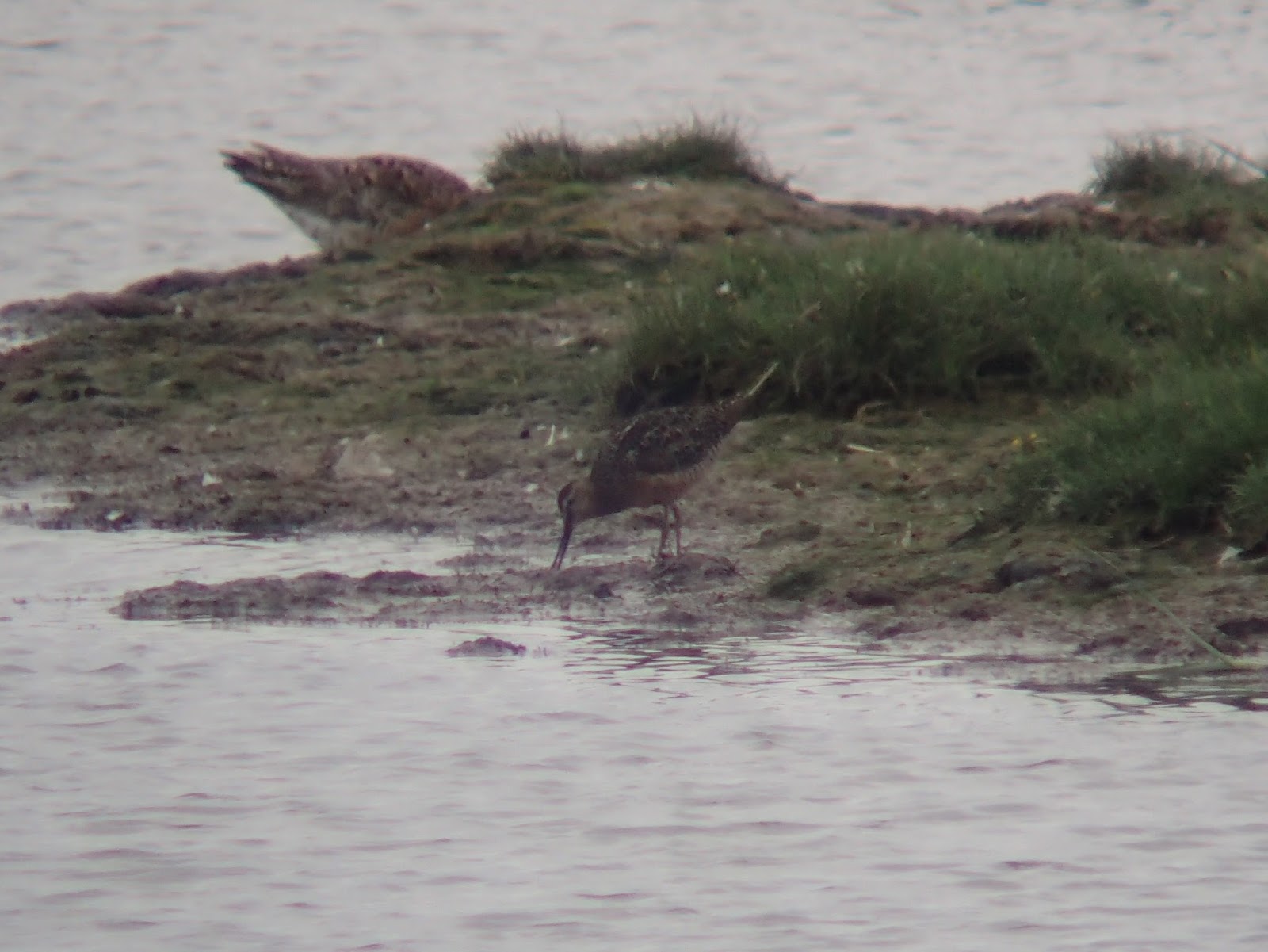
A small group of birders including Paul Woolnough were stood level with the serpentine, watching the Long-billed Dowitcher alongside a few Black-tailed Godwits and Redshank. It showed reasonably well, although the overcast conditions made photographs poorer than normal.


After a while I carried on past Arnold's Marsh and had a quick look amongst the Birdsfoot Trefoil. Six-belted Clearwing moths seem to show well on the equivalent plants at Minsmere, but here there was no sign of any. At that point I got a phonecall from John Furse who was on East Bank and asked how I was getting on, adding that I was about a month late if I wanted to see the clearwings.

On my way down the path I had deliberately avoided looking too closely at the plants as I knew I'd be distracted by the insects. On the way back I made up for this by checking as much Hogweed and Ragwort as possible, finding three species of soldierfly and a new hoverfly to complete a wildlife-filled weekend.

 Barred Snout female
 Barred Snout male
 Flecked Snout male
 Green Colonel
Anasimyia contorta

TARGET SPECIES: Serotine Bat

15th July 2017

In the evening I headed out to help with a bat survey. Ecologist and Norwich Bat Group member Abi had been working with a church that was in the process of commissioning a new roof, and had discovered Serotine and Pipistrelle bats using the church. She had identified where most of the Pipistrelles were exiting, but wanted to locate the Serotine exit points so that gaps could be left in appropriate places. The simplest way of doing this was for people to be placed around the churchyard watching different points. Fellow Norwich Bat Group member Graham and I both volunteered, whilst several locals also came along, making eight of us in total.

I arrived at the church about half an hour before sunset, and was shown a Barn Owl perched up in a tree just inside the churchyard, a silent white sentinel keeping watch on the church. Abi showed us inside the church, where we saw the piles of droppings indicating the likely roosting areas, and also some feeding signs - the bats clearly had a liking for Yellow Underwings!


Twenty minutes before sunset we had assumed positions around the church. My main focus was the flashing between the main roof and a gable where a smaller part of the church joined on. I pitched my camping chair and sat back to begin my vigil. It was surprisingly serene, despite the traffic noise and a nearby combine, that only stopped working at dusk.


Dusk came and went, a lone Swift flew over and a Kestrel did a couple of flypasts. Ten minutes later our first bat emerged, a Soprano Pipistrelle. It was to remain in the churchyard for the rest of the time we were present, circling and darting in front of us. Thirty minutes after dusk and we were beginning to wonder where the Serotines were when I picked up one on my detector. Graham confirmed it (he was using a more advanced detector that displayed sonograms), but neither of us could see that bat. More Pipistrelles were seen, but finally at ten o'clock another Setotine was detected, and flew right in front of us. It defintely didn't come from our 'sectors', and appeared to have flown through the trees rather than from the church.

We remained in place until an hour after sunset, when the light was almost gone and the only sound was a distant Tawny Owl and the static of our detectors. There was one more Serotine flypast, again seen and detected, but it was probably the earlier individual. The most likely explanation for the low number of sightings and no sightings of exiting bats is that they are currently roosting somewhere else close by and using this church to feed in. So not the ideal result, but an interesting experience for me, seeing a new species of bat and reassuring me that I would recognise the echolocation signature of Serotines. Thanks to Abi for allowing us along and for showing us the signs in the church.

BROADS: A first visit to Alderfen

15th July 2017

I started a wildlife-filled weekend with a visit to Alderfen Broad, one of the few Norfolk Wildlife Trust reserves in east Norfolk that I hadn't previously visited. The reason for going was as part of the Norfolk Fungus Study Group programme, but I suspected that given the time of year I was more likely to see new insect species than fungi. The reserve is down a long un-made and un-signed track - fortunately Yvonne was posted on the road to direct us, although I still got the impression that we could end up in a farmyard or discovering a long lost tribe as I travelled along it.

Whilst waiting at the car park I looked around and found an interesting beetle, Malthinus flaveolus. This is one of a sub-family related to the soldier beetles, and my first of this genus. Once we had all assembled we headed off around the circular trail. Tim took the path into the open area, whilst the rest of us went into the woods. We found a few microfungi, including some small black spots on Holly twigs that are probably a second for Norfolk. Tawny Grisette and a Bolete sp. were two of the larger species found.


It began to drizzle, but this first shower just passed over. Raspberries, Redcurrants and Blackcurrants all grew near the path, distracting the hungrier amongst us. A few more small agarics were found, Tubaria, Rickenella, Marasmius and Mycenas. A couple of Willow Emerald Damselflies were present, along with a Chrysotoxum bicinctum hoverfly.


Out in the open we met up with Tim. He pointed out a few things he had found on his walk, including Swallowtail caterpillars at various stages and an interesting moth caterpillar, possibly Pebble Hook-tip. He had also caught a Xylota-type hoverfly that turned out to be Chalcosyrphus nemorum, which was new for both of us.


Tony had a look in the reedbed by the path and found probably the most interesting fungus of the day for me, some tiny cups growing on a dead umbellifer stem. After lunch some of the group headed back into the reedbed, whilst the others tried the woodland. By now it was raining steadily and there didn't seem much about amongst the Bracken, so I returned home to spend some time with Cathy before heading out later that evening. 

As yet unidentified!

NORWICH: Catton Park Six-spot Burnet emergence

9th July 2017

After lunch I headed to Catton Park for a walk around in the sunshine. As I arrived I noticed signs advertising a swing concert in a couple of hours time, which sped me up a little. I have nothing in particular against swing music, but I'm not convinced it does anything to improve your observation and ID skills.

The first thing I noticed was that there had been a big emergence of Six-spot Burnet Moths. I saw at least 30, some feeding on Knapweed and Scabious flowers, others buzzing slowly over the meadow. I also saw several vacant chrysalises poking out of the yellow cocoons - see photo below.


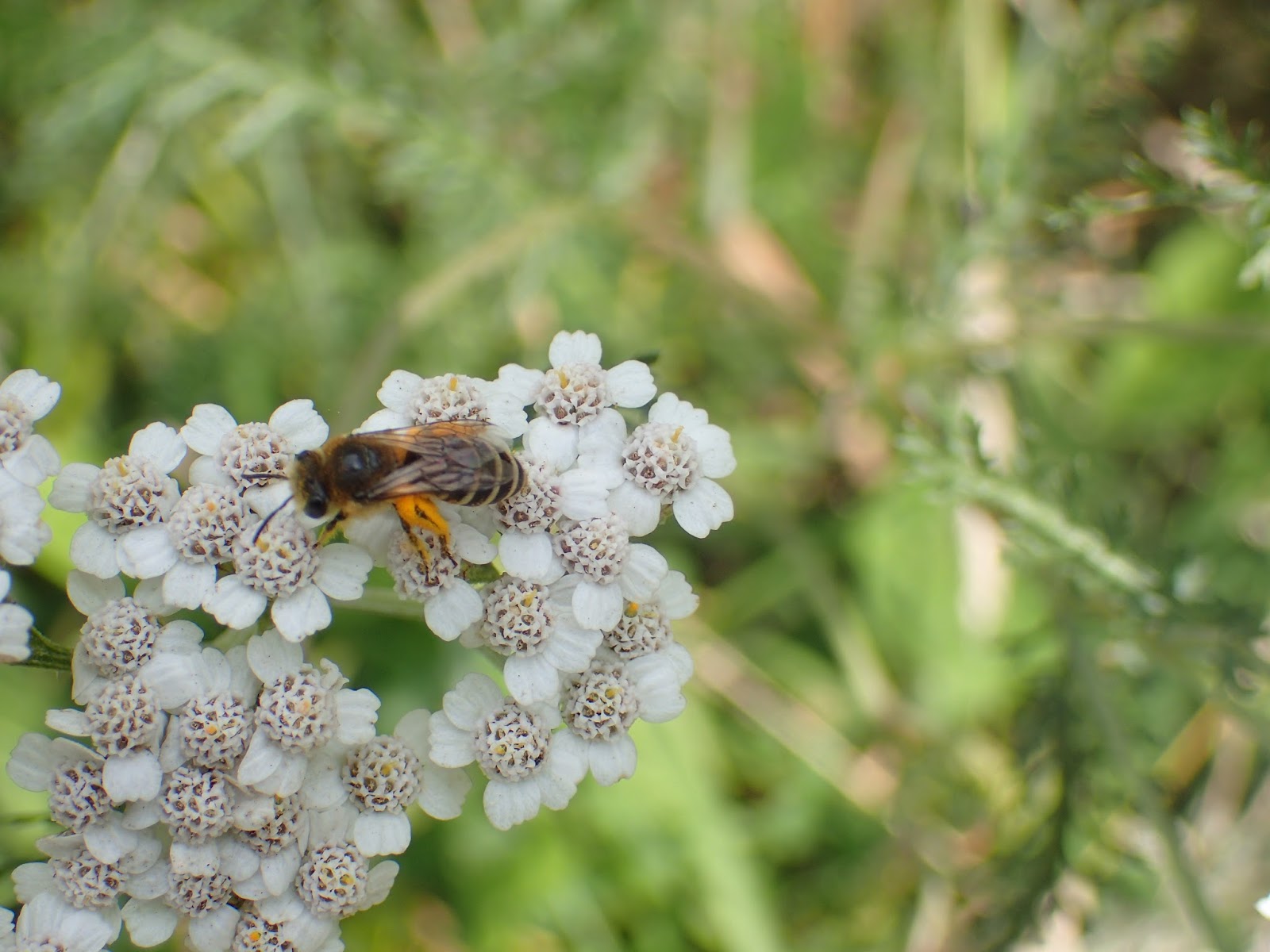
There was a lot of different species about, so this is only a selection of highlights. Some Colletes bees were feeding on Yarrow - technically these cannot be assigned to species without closer examination, but the size, location and flower choice point very strongly to them being Colletes daviesanus, which I've not seen before. Of more interest to me it is the host of a very cool looking bee Epeolus variegatus, which I'll certainly be keeping an eye out for.


I had a close look at quite a lot of Skippers and confirmed both Small and Essex (mostly Small). There were three sawfly species, of which I could only identify one. I'll give Norfolk's new Sawfly recorder a few weeks to get used to the role before I trouble him! Two shiny black hoverflies were also seen, Cheilosia pagana and a Pipizella sp. The latter was new to me, but could only be confirmed to species by examining the male genitalia, which I didn't do. Potato Capsid was a new bug too.

 Cheilosia pagana
 Pipizella sp. (probably P. viridula)

Carrying on my leaf mining theme from Saturday I noticed the 'snail-trail' mine of the Poplar Bent-wing moth, which was a new TG21 record. I was considering heading home when a few drops of rain fell, speeding me up. The concert was yet to begin, so as I left the only noise was the constant hum of distant traffic and the names of the many dogs being frantically called by their owners.


NORWICH: Garden goodies

8th July 2017

I spent most of Saturday at a cousin's wedding, but before getting ready I decided to have a quick look in the garden. This proved to be a good decision, with two interesting species found. The first of these was a groundbug, Nysius huttoni, which I found in a sunny spot on the side of the shed. This genus is quite tricky to separate so I asked Tristan Bantock (webmaster of the excellent British Bugs website) if he agreed with my ID, and he did. Fortunately this species has long hairs around the edges, which were visible on my photo. NBN didn't show any Norfolk records, so I contacted Norfolk bug recorder Rob Coleman to check the current status of this species. He has just got back to me and apparently it was first seen in Norfolk in 2014, but the only records have come from the Brecks, making mine the first East Norfolk vice county record.


The second species of note was a leaf miner in a yellow flowered plant in the back garden. Nick and Jeremy helped me with an ID of the plant, Rose of Sharon, a Hypericum (same family as St John's Wort). With the plant ID sorted I could then search for insects that leaf mine it, and quickly established that the leaf mine was created by the larva of the Hypericum Pigmy moth (Ectoedemia septembrella). It is described as 'local' on the Norfolk Moths site (see here), and my record was the first TG21 record, which was pleasing. I may try to put some muslin around a mine to try to catch an adult if I get round to it.


WHITLINGHAM: A range of beetles and bugs

5th July 2017

On Wednesday evening I headed down to Whitlingham for a quick look round. I had hoped for a flyover Curlew after reports of some moving about the valley earlier in the week, but it was always going to be a long shot. The only bird of interest was a neck-collared Greylag, which turned out to be the same bird seen last summer (originally ringed in Thetford).


In contrast to the birdlife there was a lot of interesting invertebrates, in particular beetles. With this in mind, consider this post a photo special.

 Heterotoma planicornis
 Solitary wasp sp.
Liocoris tripustulatus
 Cantharis flavilabris (sometimes known as C. nigra - this one has a black scutellum)
 A leaf beetle sp - there are several green ones but I think this is Green Dock Beetle (it was on a related plant sp)
 Four-barred Major (a soldierfly)
Cicadella viridis
Plagiognathus arbustorum
 Tachinus rufipes - I think!
 Unidentified beetle sp.
 Figwort Weevil
Chrysolina polita
Unidentified (unidentifiable?) on creeping thistle

YARE VALLEY: Strumpshaw meadow walk

2nd July 2017

Some readers will not be aware that Saturday was national meadows day, and over the weekend events had been arranged in meadow habitats across the country. On the whole I'm not a fan of national days, mainly on account of there being far too many. To illustrate the point I googled the 2nd of July and found that (albeit in the US) it was also anisette day, build a scarecrow day and world UFO day.

Anyway, whilst nobody had asked me to sample anisette, build a scarecrow or claim a close encounter, I had been asked to lead a walk at Strumpshaw Fen, with the intention of showing visitors the range of plants and insects that live in this valuable and decreasing habitat. I arrived a bit early to have a look around before the walk, but spent most of it watching insects around the reception garden. A Swallowtail butterfly flew over, two Woundwort Shieldbugs were mating and at least two species of Yellow-faced Bees were also seen.
 Female Hairy Yellow-face
Male Common Yellow-face

After meeting the small group and David, one of the volunteers, we made our way down towards the meadow trail. We diverted into small grassy quarry meadow, where we had a look at the hybrid orchids and a Black-and-yellow Longhorn beetle. Further along the path I noticed a Common Carpet moth and a Banded General soldierfly, the latter of which unfortunately flew off before the rest of the group saw it. A White Admiral flew around the brambles near the new pond, and the black and red bug Dereacoris ruber was also seen here.

At the pond we paused to watch the water boatmen, then I explained how separate Water Figwort, which was growing at the edge of the pond, from Common Figwort and Green Figwort. Looking closely we saw Figwort Weevils, and a Figwort Mason-wasp was also in attendance.


Finally we entered the meadow, and David took us along the edge where we saw some Skullcap. Whilst here I picked out a Variable Damselfly amongst the Azures, and two more White Admirals were seen. Another plant we looked at was Fen Bedstraw, which has a rough feel to the stems unlike the very similar Marsh Bedstraw. Walking across the meadow we stopped to look at some mid-instar Short-winged Coneheads and a predatory bug sp.

I did a bit of sweep-netting, producing some froghoppers and an adults female Short-winged Conehead. We also went over and had a look at some Marsh Helleborines and Bog Pimpernel before heading over towards the main dyke. A Norfolk Hawker gave excellent views as it flew towards us and hoverered a few feet off the ground, showing the green eyes. I found one of the scarce reed beetles, Plateumaris braccata, to show the group and we also saw some Brookweed, which is apparently a new species for me. Whilst looking at the Brookweed Steve Lane, a national beetle expert, came over with Andy Brown to show us a Marsh Click Beetle and have a chat. They also gave us directions to another rare reed beetle a bit further round.


We crossed the bridge onto the other half of the meadow, pausing to look at the Water Soldier in the dyke. On the other side we noticed the slightly different flora makeup, and saw plants like Marsh Lousewort and Yellow Rattle. There was a lot of dragonflies here - as well as the Norfolk Hawkers we saw Southern Hawker, Four-spotted Chasers and Black-tailed Skimmers.

We left the meadow and followed the path back, stopping at the edge of the river Yare where Steve and Gill spotted a mating pair of Donacia crassipes, the reed beetle that Steve and Andy had seen earlier. Walking back along the sandy path we continued to see interesting invertebrates, including a Six-spot Burnet Moth.


Thanks to everyone who came along, and remember, meadows are great.

NORWICH: The disappearing plant

1st July 2017

On Saturday I headed to Thorpe St Andrew, where I was looking forward to seeing a plant of Purple Viper's Bugloss, a scarce plant not mentioned in the Flora of Norfolk and therefore possibly a county first. It had been found at the start of the week on a roadside verge by Chris Durdin, who fortunately recognised it from leading wildlife tours on the continent. Recognising that this was the sort of thing I'd be interested in, he kindly emailed me with directions.

As it was on a main road, I parked nearby and walked across to the verge. I had seen a photo so knew it was a tallish plant, so I was a bit concerned when I couldn't find it. Naturally I thought I was in the wrong place, so extended my walk a bit in each direction, with no luck. Slowly it dawned on me that the rest of the vegetation was very short. The verge had been recently cut, and the Purple Viper's Bugloss had been completely destroyed. I contacted Chris just to double-check I was in the right place, and he confirmed I was and the plant was gone. Darn. Hopefully it might grow back either this year or next, but if not then it has to be one of the shortest stays of a rare plant in Norfolk.

Whilst in Thorpe I had a look around, hopeing to see a few more plants of interest but again with no luck. I did manage to find something new, a red-and-black wasp that predates shieldbugs and goes by the for some reason excellent name of Astata boops.