The Whitlingham Bird Report for 2025 is now available to download from the Bird Reports page or from here

WHITLINGHAM: Thorpe Marshes Gropper

21st April 2011

Another visit to Thorpe Marshes, and finally a result, my best ever views of a Grasshopper Warbler. It was audible as I was crossing the railway bridge, but it took a while to pin down (don't they always?!). Part of the reason I had trouble pinpointing it soon became apparent - it was actually moving around a lot. Positioning myself at a decent vantage point on the path I was able to watch it reeling from a number of different areas, spending no more than a couple of minutes at each but never going too far in either direction. Many thanks to Paul and Adam for their messages regarding Grasshopper Warblers at this site. A lap around the broad was uneventful, but it was interrupted by a Cuckoo, calling from across the river in the trees at the east end of Whitlingham great broad.

NORFOLK: Snakes at Crostwight Heath

20th April 2011


I spent the day around various villages near North Walsham. After lunch at the Butcher's Arms in East Ruston we then went to Swafield Church, had a walk around Bradfield, had a look along the seafront at Walcott, bought some jam at Ridlington, walked around Crostwight Heath before ending up at Edingthorpe. The birding highlight of the day was a Red Kite hunting over fields between Honing and Briggate, whilst a Yellowhammer at Bradfield is probably (and sadly) of note these days.

I had hoped to find some Green Hairstreaks at Crostwight, but it was immediately apparent that the site was just too gorse-covered. We did however discover an Adder and six Grass Snakes, one of which had been runover. When looking at the Grass Snake picture (click to open it in a new window) notice the head to the left of the main body. It had raised it into the air and was "tasting" the air by tongue flicking until it got bored of us and slid off.


WHITLINGHAM: Another quick visit

19th April 2011


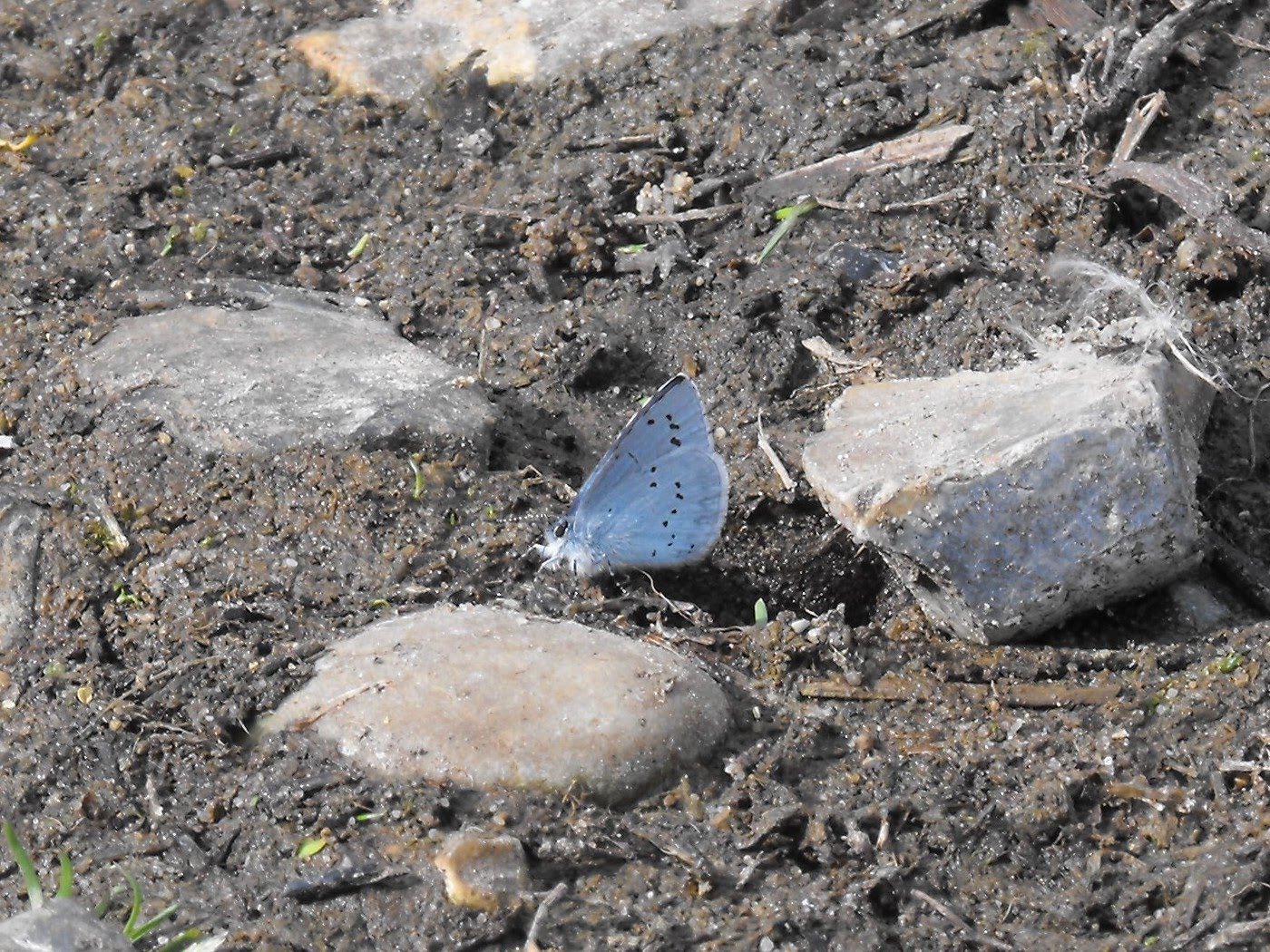
I have this annoying feeling that if I don't go to Whitlingham for a couple of days I'm going to miss something good, so ended up going for a quick walk around in the sun. There was nothing new from last time, and no sign of the Little Gull either. I did see my first Speckled Wood butterflies of the year, and this Holly Blue was having fun in the mud.


NORFOLK: Rockland Broad

18th April 2011

Rockland Broad has a decent track record of attracting Black Terns and Ospreys without the visitor numbers of some of the larger nature reserves, so me & Cathy decided to have a look round on the off chance. We didn't have much luck (although I wasn't too far off, as there was a mini Black Tern influx around Norfolk the next day), but did come up with some insect highlights, including first Red Admiral and Large Red Damselflies of the year. Despite walking along the channel to the river there was no sound of any Bearded Tits. On the adjacent marshes we saw a couple of Chinese Water Deer and a Weasel.


The reedbed west of Rockland channel

WHITLINGHAM: Week 16 - Dawn(ish) chorus

17th April 2011


It was a struggle, but I managed to get up at 5:30 so that I could beat the weekend crowds to Whitlingham. Walking along the Little Broad I could hear my first Reed Warbler of the year singing, but I was spared the walk by another one between the two broads, sharing the small area of reeds with a Sedge Warbler. I gave up counting the warblers in the end, but over the C.P. and Whitlingham Marsh there was a minimum of 15 Sedge, 10+ Chiffchaffs and good numbers of Blackcaps and Cetti's Warblers, including a confiding one at the east end of the broad. Several Chiffchaffs were giving interesting calls, one in the woods was giving a constant "tik tak tuk tuk" call whilst flapping its wings, whilst one at the east end of the Great Broad seemed to be imitating a bit of Willow Warbler song.


My main target was a Grasshopper Warbler that had been heard on the WeBS survey on Saturday, but once again I couldn't find it. I have considered the possibility that I can't hear them, but as I have had no problem in previous years I think they are just being annoying. The conservation area bay held 7 Pochard, a female Goldeneye and best of all my first Shelduck of the year, probably my first on the Great Broad as the last couple have been on the Thorpe side.

As it was still early I went for a walk around Whitlingham Marsh (one Swallow over), looked over the sewage works (Oystercatcher and Rooks) and then came back via the woods. I then walked back around the broad in case the Grasshopper Warbler had started up, with similarly negative results. I did see a pair of Marsh Tits, which brought me to a respectable 52 species for the morning.

NORFOLK: Sculthorpe Phylloscopus opus

16th April 2011

The week before the Easter holidays had got me guessing what my next Norfolk tick would be. The White-tailed Eagle and Black Stork seemed unlikely to stick around, but I had a good feeling about Ring-necked Parakeet (surely one is frequenting gardens in the north-east of the county somewhere?). Anyway, when news came out that a Wood Warbler, the commonest British bird that I was yet to see (having finally got Red Grouse last year) was at Sculthorpe Moor, a favourite reserve of ours, the stage was set for a fourth Phyllosc in three days.

Upon arrival we heard that the Wood Warbler had been seen and heard on a dawn chorus walk earlier that morning, but not heard since. We weren't discouraged, and as we drew near the Frank Jarvis Hide we were met by a birder who had just relocated the bird. We couldn't hear anything, but then the Wood Warbler began calling from woodland across the bridge from Old Gits Corner. It gave good views, flying actively around near the tops of the trees along the boardwalk, calling but not giving full song.

Once the Wood Warbler flew back across the river (and had stopped calling) we carried on to the Whitley Hide, seeing a couple of Orange-tips. Watching the bird table we saw male and female Bullfinches, a pair of Bramblings, male and female Reed Buntings and a Marsh Tit. In the distance my first Cuckoo of the year was calling. On the way back one of the resident plastic Golden Pheasants jumped up into a tree, making a weird squeaky call. A couple of Marsh/Willow Tits on the feeder at Old Gits Corner flew off before I could get a decent look, but we shall undoubtedly be back for another visit soon.


WHITLINGHAM: Thorpe Marshes again

15th April 2011

Realistically I knew that the Wheatear would be gone, but as birds don't find themselves I figured I'd give Thorpe another look. The first half of the visit was the same as the first, although watching three Little Ringed Plovers is never dull. A careful scan of the spit from the bird screen (or is it now a hide now it has three sides?) turned up my first Common Sandpiper of the year, whilst a Whitethroat sang from the riverside trees behind me. I let one of the Thorpe Marsh regulars use the 'scope to look at the Common Sand, and he told me that he is seeing a Red Kite most weeks over his house in Thorpe, so fingers crossed for a much-anticipated patch tick sometime soon.

NORFOLK: Titchwell wagtail fest

14th April 2011

As its been a few years since the Colney Iberian Chiffchaff I managed to convince Cathy that what she really wanted to do was to go and listen to the Titchwell bird. Conveniently the Iberian Chiffchaff was singing and showing well by the pool on the Meadow Trail, and I was able to revise the song that will one day be heard at Whitlingham Lane. The second reason for visiting Titchwell was to have a look at Yellow Wagtails, and we were spoilt with 20+ swarming over the sandy bank near the Parrinder Hide. I failed to find any "headed" ones, but the pictured individual kept me interested for a bit as it peeped over the bank. 10+ White Wagtails added to the wagtail related fun.


Elsewhere on the reserve we saw a pair of Garganey, a large flock of Common Scoter, a Little Ringed Plover and a Spotted Redshank. The Spotted Redshank was a particularly obvious individual, almost into its black summer plumage. I mention this in case the guy in the Parrinder Hide who picked out a Redshank, seemingly at random, and even with field guide open proceeded to tell anyone who'd listen that it was Spotted, reads this.


Spot the difference...

WHITLINGHAM: Just because its spring and I have some time off

13th April 2011


With no particular birding targets in mind but knowing you've got to be in it to win it (or something like that) I went for another wander around Whitlingham. Listening out for anything giving out of the ordinary calls I was disappointed, although I did hear a couple of Sedge Warblers that hadn't been there last time I looked. Another birder was at the birdscreen - I can't remember the last time that happened but it was a few months ago. As we stood there 15-20 Sand Martins flew overhead, a welcome return. A couple of Lapwings were on the spit on Thorpe Broad, but I'm still missing Shelducks from here this year.


Walking along the south shore a lone Swallow broke from the Sand Martins and headed off over the woods, but my eye was drawn to a bird making "Marsh tern-like" swoops over the broad. A closer look showed it to be a Little Gull. It was in 1st winter plumage, although the black on the outer tail was restricted to the corners, with white in the middle. I didn't remember noticing this on previous 1st winters, but its probably just me paying more attention than normal. Having consulted Malling, Olsen & Larsson it appears that some 1st-winters moult the central tail feathers into adult plumage, so now I know! I stopped in to tell one of the Broads Authority guys at the barn it was there, then had a final sweep of the meadows, which remain Yellow Wagtail-less. Upon checking my emails this afternoon I found out that there was a Wheatear at Thorpe yesterday (seen by Ricky - check out his blog, now in the links column under "Shaky's Birding Blog"), so maybe it still isn't too late to add Wheatear, Ring Ouzel or Yellow Wagtail to the patch list!


Another one for the "record shot only" album

NORWICH: Marston Marshes

12th April 2011


Marston Marshes LNR lies to the south of Norwich and makes up part of the Yare river valley between UEA and Whitlingham. When I first moved to the south city I was hopeful that it would be a productive site for birds, and one of the first things I heard about it was that on a warm spring evening you could still see Snipe drumming there. That proved to be a thing of the past (I only saw one Snipe, and it was departing swiftly!). Nevertheless I'm sure with regular watching Marston would clock up a decent list. A ripped notice on the gate suggests that two wader scrapes are going to be created to increase its sppeal to birds. In my experience these articifically created scrapes have a fairly low success rate at actually attracting waders, but I'm all for trying. Anyway, I was there to look for a Hawfinch seen the previous day, but it wasn't there. Having searched tree-by-tree, I spent some time watching a pair of Grey Wagtails on the path before calling it a day.


WHITLINGHAM: Thorpe Marshes LRP

10th April 2011


The temptation to go to the coast is growing, but as it seems like a few more birds are turning up locally I decided to try Thorpe. I'd barely crossed the bridge over the railway when I heard my first Sedge Warbler of the year singing from the reeds adjacent to the railway line. Further round three Little Ringed Plovers were squabbling on the scrape, although when not calling they were elusive, spending large amounts of time behind clumps of vegetation. A chat with one of the locals revealed that the Sedge Warbler had arrived three days ago, and he had also heard a Grasshopper Warbler from Bungalow Lane. Despite loitering a while I couldn't hear the Grasshopper Warbler, but I did see an Orange-tip, bringing the butterfly count up to 8 for the year so far, and another Sedge Warbler.


Thorpe Marshes in the sunshine

Norfolk: Breckland in spring

9th April 2011


Margaret's foot has healed well enough to enable her to drive, but we decided it was wise to keep walking to a minimum for the time being. Thinking of reserves with hides close to the carpark I came up with Weeting Heath. Cathy had never seen Stone Curlews, so this seemed like a good plan of action. By the time we got there a strong heat haze was distorting the edge of the grassland, but we still managed a blurry Stone Curlew going about its business. After a while it flew slightly closer, whilst another one took its place in the haze. Two Buzzards soared over the nearby woods, but we searched in vain for Woodlark.


Rather than eat in the carpark I suggested we go to St Helen's picnic site at Santon Downham/Warren. Along the entrance track we saw Jim, who wasn't having a lot of luck pinning down birds in the plantation. We had lunch in the sunshine, and managed to see eight Crossbills, which flew over before settling in trees on the Suffolk side of the river. We arrived back in Norwich in plenty of time to see the football, which on reflection was probably an error.

WHITLINGHAM: Week 15 - A few Sand Martins at last

8th April 2011

A bright and warm evening at Whitlingham had the feeling of mid-summer about it, not least because we are still waiting for a mass arrival of migrants. Four singing Blackcaps, including one confiding male along the south shore of the little broad, have joined the Chiffchaffs, and a lone Willow Warbler was in the conservation area. One of the Egyptian Goose chicks from last week appears to have died, not helped by the fact that one parent appears to be absent. The rest of the country park was bird-light, although I may upload a picture of a Treecreeper that flew onto a tree right beside me later. I was cursing the lack of hirundines, but managed to locate 13 Sand Martins (and a Sparrowhawk) over the meadows opposite the country park. Initially the martins were too high to see with the naked eye, and it was pure luck that I found them whilst scanning the soaring Jackdaws. Evenutally they came a bit lower, but still showed no inclination to go towards the water.

NORWICH: Mammal dropping opinions wanted

6th April 2011


Not everyone can be out looking for Eagles, or trying to re-catch their Stork collection from the east coast, and accordingly I have been restricted to garden stuff this week. Whilst filling up the feeders I have had to dodge the poo, so in the spirit of Chris Packham I want to get some reader interaction to ID it. I'm pretty sure poo number 1 is a fox, but I have no idea about poo number 2. The garden is suburban, but it is close to a cemetery, so stuff like small deer are possible (I've seen Muntjac).


If you would like to enter the competition (provisionally called "I'm a crap expert") then please leave your guesses via the comments box.

Poo #1

Poo #2

SUFFOLK: Short-toed Treecreeper

2nd April 2011


I sometimes wonder what happens to vagrant species that turn up in the UK. Some probably re-orientate themselves and go back to where they should be. A few stay (e.g. "Sammy" at Titchwell) whilst others probably snuff it (e.g. The Hume's at Wells this winter). The majority just "disappear", often shortly before I decide to go and have a look. I was concerned that the Short-toed Treecreeper at Landguard would depart before the weekend, but I had one thing in my favour - North of Landguard is Ipswich, and South is the sea. Faced with this tricky choice, it had decided to stay a while.


Neil had offered me a lift on Saturday morning, and we made good progress as we headed south seeing 4 Kestrels, 1 Swallow, 1 Brimstone and 2 dead Badgers. First impressions of Landguard were positive, a cracking duney piece of land. We walked amongst the Linnets over to the bird observatory, learning from a departing birder that the treecreeper hadn't been seen yet. Seeing that all of the birders were standing in one area, we decided it would be prudent to check the small trees along the northern side of the fence. When this drew a blank we looked up, and found all of the birders were gone. As neither of us had been drinking, we took this to mean that the bird had been relocated, and continued walking along the compound.


It turned out to be a case of "right place, right time". We walked up and were immediately put onto the Short-toed Treecreeper low on a Holm Oak trunk. We then watched it fly between several small trees before getting even better views as it slowly made its way up the trunk of a bare tree inbetween the two stands of Holm Oaks. Rather than follow it along the fence we waited near this tree in the hope that it would return, but instead it headed off into the denser oaks (viewing appeared to be possible if you pressed yourself up against the fence. I didn't try it). A sunny and successful twitch, giving me my first lifer of the year. Rather than attempt to take a typically poor digiscoped record shot I spent all my time looking at the bird. In order to prevent this post being too dry, I have created an artist's impression of the scene for you.


.


It's almost like you're there...