The Whitlingham Bird Report for 2025 is now available to download from the Bird Reports page or from here

WHITLINGHAM: October counts & fungi

17th October 2015

This week has seen large numbers of migrant birds arriving at the coast, but before worrying about those there was this months WeBS counts to get done. As I pulled into the car park at Whitlingham I thought it was odd that there was a caravan parked up, until I looked around the rest of the car park, where many more large caravans were also positioned. The penny dropped that travellers had taken over and set up camp, so I had to turn round and managed to find a space in the next car park along.

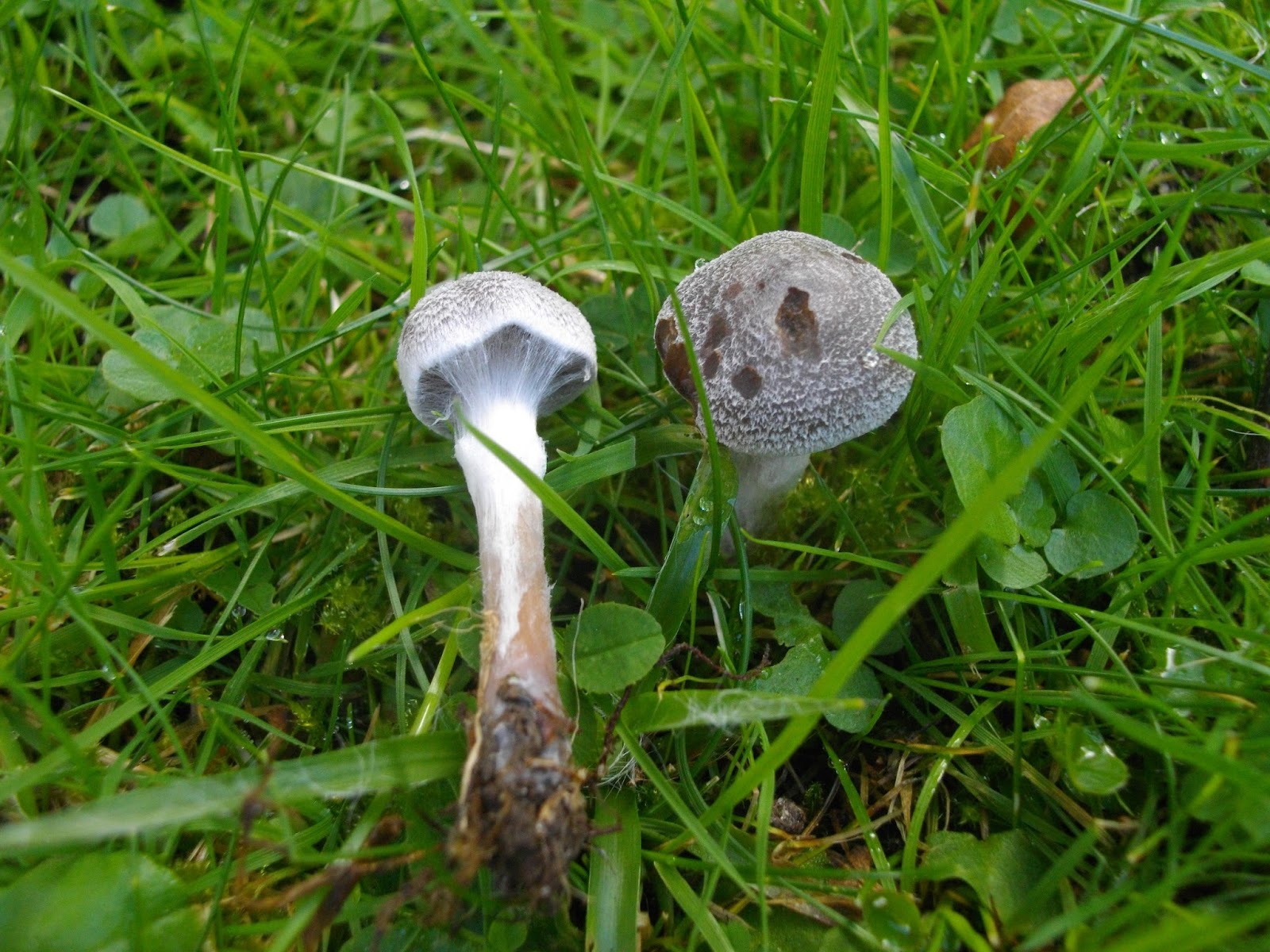
Before leaving the car park I heard my first Redwings calling as they flew over. Along the edge of the little broad there were lots of reddish-orange Tawny Funnels (Lepista flaccida) growing amongst the leaf litter. A Water Rail squealed from the broad edge, and a Grey Heron perched up on one of the bales floating in the water. Some more fungi were growing between the two broads, this time Clustered Domecap (Lyophyllum decastes), a new patch species for me.

 Tawny Funnel
 Clustered Domecap

There has been a significant increase in wildfowl since last month, although nothing particularly spectacular. In terms of ducks there were 81 Mallard, 43 Gadwall, 27 Tufted Ducks, 6 Pochard and 1 Teal. Other species included 103 Coot, 2 Great-crested Grebes and 2 Little Grebes. 41 Cormorants was a large non-roost count, and interestingly a group of 16 were fishing together, a behaviour I seldom see here. A Kingfisher flew past, 2 Cetti's Warblers called, and several Siskin flew over.

The most interesting avian sighting of the day occurred as I scanned across to Thorpe Marsh. Seven Teal were visible on the spit, when I noticed some black-and-white stripes showing amongst the vegetation behind them. I expected it to be a Water Rail, so was surprised when a Red-legged Partridge came into view! Viewing through some trees and in the rain prevented me from getting more than a record shot of this slightly out-of-place bird.

Red-legged Partridge at Thorpe

SUFFOLK: Brandon CP Bioblitz

11th October 2015

Sunday was UK Fungus Day, and we spent the afternoon of it at Brandon Country Park, just over the border into Suffolk. Brandon was hosting a Bioblitz, organised jointly with NBIS and Breaking New Ground, a lottery-funded project aiming to connect people with the landscape and wildlife of the Brecks. 

Bioblitzes are a relatively recent concept, and basically involved trying to record as many species of wildlife as possible within a set time period, usually 24 hours or less. They vary quite a bit - at one end of the spectrum lots of experienced recorders go off and get on with recording their specialist areas, whilst at the other end there are lots of child/family friendly events, which enthuse young people about nature but don't generate many records. This one was nicely balanced, with regular guided walks and events, but also a number of very knowlegeable recorders, many of them from the Norfolk & Norwich Naturalists Society.

As Cathy & I hadn't been to Brandon CP before we called in to the visitors centre to see what had been seen already. We then set off on a walk around the nearby woodland, paying particular attention to the fungi we saw. Cathy found a number of interesting species, the highlight being Green Elf Cups. This fungus stains wood green, but it is less common to see the fruiting bodies growing from it. I had mentioned this to Cathy when we saw some of the green wood, and she promptly went and found some of the small cups growing a nearby small branch.


We headed back to the visitors centre and added some of our sightings to the species lists, before stopping for lunch. After lunch we headed out to look for more fungi in an area near the playgrounds. Here we saw a good range of different species to our first walk, including White Saddle (Helvella crispa) and Elfin Saddle (Helvella lacunosa). As the bioblitz drew to an end we returned to the visitors centre, where someone had brought in two Pale Tussock moth caterpillars. We also saw a Bank Vole and a couple of different species of harvestman (identified by Andy Musgrove). When we left 254 species had been recorded, with more to be added as further identifications are made at home.


NORTH NORFOLK: Felmingham fungi & beetles

10th October 2015

On Saturday I met Adam in North Walsham and we headed to Felmingham to visit Bryant's Heath. When I was growing up my dad and I would visit the heath every spring to look for Adders, Common Lizards, Green Hairstreak and Green Tiger Beetles, but it had been over ten years since I last visited. The track down to the heath had some large water-filled divots in it, so I parked on the verge and we walked the rest of the way.

Felmingham Heath has a SSSI designation because of the mixture of habitats (areas of wet and dry heathland, plus areas of wet and dry woodland too). Given the time of year we decided to focus mostly on fungi, so we entered the woodland  around the north-western edge of the heath. It was immediately obvious that there was a lot of fungi about, with large amounts of Ochre Brittlegill, Butter Cap and Amethyst Deceiver growing along the sides of the path. We were to see hundreds of the first two species, perhaps even thousands. We also bumped into Gordon Woolcock, a local naturalist that who posts on the Norfolk Wildlife Facebook page. We had a chat about some of the species he has seen on his regular walks here, and it was nice to put a face to a name.

Ochre Brittlegill (formerly Common Yellow Russula before the crazy re-namers got it)

The first non-fungal thing of interest we saw was a dead Dor Beetle. It was lying on its back, and the underside was a metallic bluey-purple (this feature separates it from female Minotaur Beetles). Further along we saw some absolutely huge Earthballs, several species of Milkcap and Russula, and our first Boletes of the day. I spotted some tiny stalked cup fungi growing from an acorn, which delight in the name 'Nut Disco'. Whilst it sounds a rather silly name, the boring explanation is that the 'disco' part is short for discomycete, an old taxonomic grouping of small, disc like fungi.

The underside of a Dor Beetle. This is probably Common Dor Beetle, but there is a similar one called Common Dumble Dor. No, there actually is.
 Larger than normal Common Earthball, which has burst open.
 Nut Disco growing on an acorn

Heading out onto the heathland we saw the first of many Fly Agarics. Many were the deep red you would normally associate with this species, whilst others were more orangey as a result of age and weathering. A recent online discussion had highlighted that there is actually an orangey form of Fly Agaric called var aureola, and at least one young-looking specimen may have been of this form. Another interesting fungus was Earthfan, which was growing along the edge of a heathland path.

 Earthfan
 Fly Agarics (possible var aureola on the left)

Having seen some rather large holes in the ground (too big to be made by Field Digger Wasps, which also dig here) we finally tracked down the culprit, a Minotaur Beetle. It reared up and pointed its 'horns' at us, so we took a few photos and allowed it to go about its business, which mostly involves rolling dung into balls and hiding it in holes. Still, each to their own. On the way back to the car we stopped to watch a flock of birds flying past, which included several Goldcrests mixed in with Long-tailed Tits. A Treecreeper and at least two calling Bullfinches were also nice to see.

 Male Minotaur Beetle

Before dropping Adam home we stopped at one of North Walsham's car parks to look for Ivy Bees, a species that has only begun to colonise Norfolk in the past few years. We found a clump of Ivy in flower, but it was rather overcast and it didn't come as any great surprise that we didn't see any bees.

CENTRAL NORFOLK: Wensum valley

3rd October 2015

Passage Ospreys seem to have become commoner in Norfolk in recent times, but I am still yet to encounter one along the rivers either side of Norwich. There have been up to three individuals seen along the Wensum this autumn, so Cathy & I decided to make a brief visit to one of the places where there have been regular sightings, Three Bridges Farm lake. I was familiar with nearby Sparham Pools, but hadn't been to this particular part of the Wensum before. The lake is between Lyng and Fustyweed, although a local woman who we chatted to whilst scanning told us that the area we were in is actually in the parish of Elsing.

Three Bridges Farm lake is a private fishery, which explains its attraction to passing Ospreys. Accordingly we parked up and viewed from the roadside. A dead tree looked like a good perching spot, but whilst we were there we didn't see any of the Ospreys (I am told one was seen later on in the day). Nonetheless we enjoyed our visit, the sunny autumn morning being accompanied by constant bird calls, in particular a flock of Long-tailed Tits and another of Siskins constantly flying around us. We headed a bit further along to the bridge at Mill Street, but there was no sign of any Ospreys from there either. Hopefully the day when Ospreys are present in the county as breeding birds rather than just migrants isn't too far away.

NORWICH: Earlham Cemetery 2 - more fungi

26th September 2015

Following my mid-week excursion to Earlham Cemetery, I returned on Saturday for a better look around. I met Ian Senior at the cemetery gates, which meant that I got the Smiths song of that name stuck in my head whilst I was waiting. Ian lives nearby, and was able to show me some interesting species that have recently emerged, including the one I was looking for on Wednesday, Fluted Bird's Nest.

The first place we went to was the area of unimproved grassland that holds a range of Waxcaps, Corals and Spindles. Most of the species were ones that I saw here last year, such as Meadow Waxcap, Parrot Waxcap, Slimy Waxcap, Blackening Waxcap and Meadow Coral (you can use the blog entry dates menu on the right of the blog to see last years entries if you didn't see them at the time). Amongst these there was a new Waxcap for me, Goblet Waxcap (Hygrocybe cantharellus), a small orangey-red species found yesterday by Ian. Another new species was Earthy Powdercap (Cystoderma amianthinum).

 Goblet Waxcaps

 Earthy Powdercap

Heading to a disturbed area of ground we saw a range of plants, including an interesting grass called Orange Foxtail. I remarked that it was unusual to see Himalayan Balsam in this habitat and then we found another indicator that the ground was damp in the form of Marsh Cudweed.

 Orange Foxtail
 Marsh Cudweed

Heading across the road to the western part of the cemetery we went straight to the Fluted Bird's Nests (Cyathus striolatus). It turns out that I was in the right general area, but hadn't gone far enough down the road to see them. Further along we located some rather nice Bloody Brittlegills (Russula sanguinarius) growing in grassland near pine.

 Fluted Bird's Nest

 Bloody Brittlegill

Walking back to the car we still had time to find one more new species, Frosty Webcap (Cortinarius hemitrichus). My thanks to Ian, without whose local knowledge and regular searching I wouldn't have seen many of these fungi.

Frosty Webcap

NORWICH: Earlham Cemetery fungi

22nd September 2015

Recently a friend of mine had been recording fungi at Earlham Cemetery and had found a species called Fluted Bird's Nest. This interestingly shaped fungus resembles a tiny dark brown bun case with small white or grey eggs in, and is one of my target species for this year. In the past some of the fungi in the cemetery have been destroyed by mowing before I have had a chance to see them, so I went to the cemetery after work on Tuesday to attempt to find the Fluted Bird's Nests.

I wasn't sure exactly where Ian had seen them, so I headed for an area of woodchips that seemed a likely place to look. On my way I stopped to have a look at some Death Caps, which seem to be having a very good year.


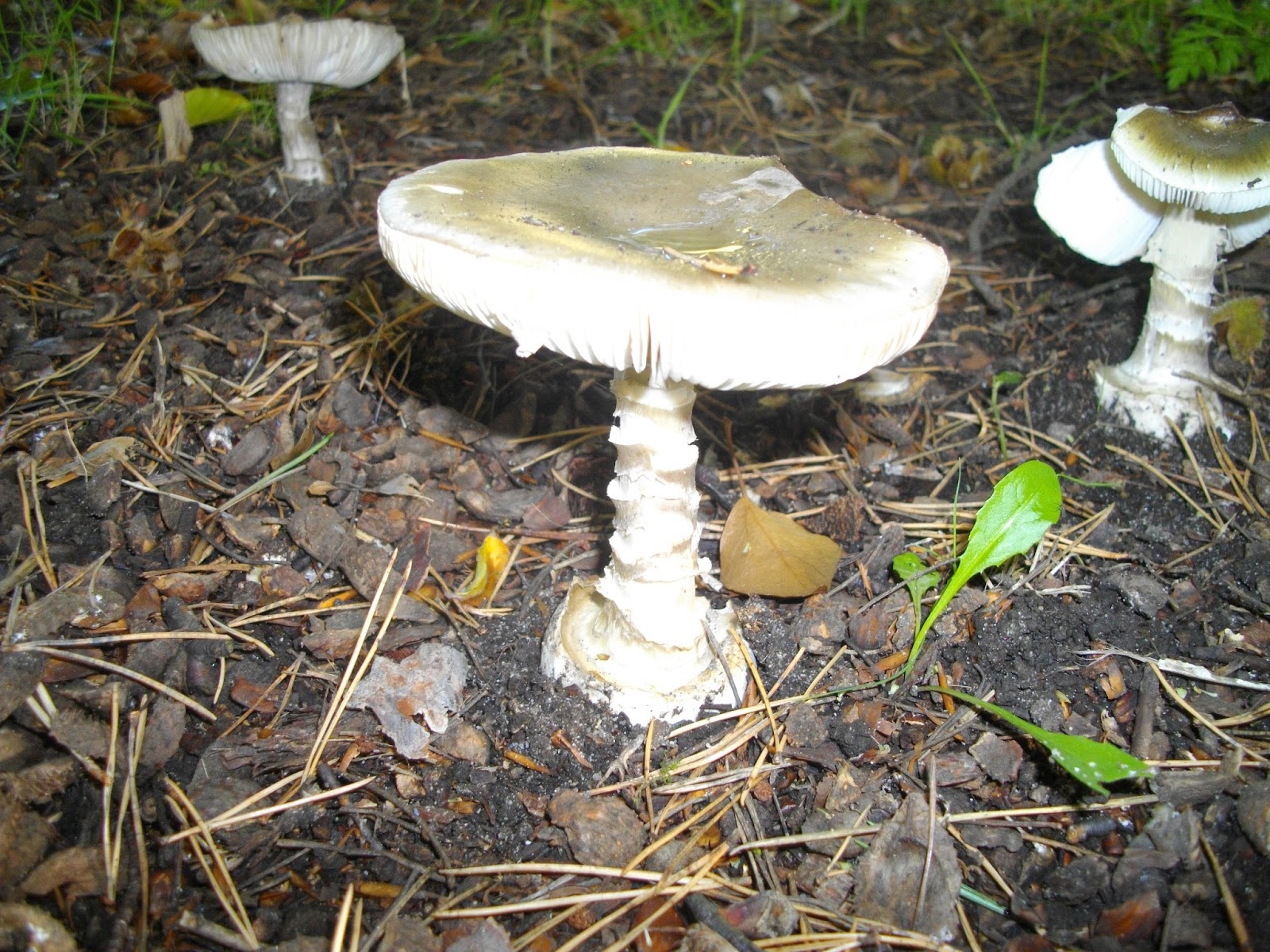
 Death Caps

I scoured the woodchips without success, although I did see some Dog Stinkhorns, growing in the same place that I saw them last year. Having failed to find the Fluted Bird's Nests on my own I texted Ian for directions. He told me that he had actually seen them in the western half of the cemetery, so I crossed the ring road to look there. Despite finding the area of trees where they were growing I couldn't find the tiny fungi amongst the grass. I eventually gave up, but hopefully I will have time to return at the weekend and find them.


Dog Stinkhorns

YARE VALLEY: Wheatfen mammals & fungi

19th September 2015

On Saturday morning Cathy, Margaret & I visited Wheatfen for an event focussing on small mammals. Dan Hoare had set a series of live mammal traps (e.g. Longworth traps) in a range of habitats around the reserve the previous night, and we went round to see them checked and emptied. The main attraction for me was the presence of Yellow-necked Mice, with Wheatfen being one of very few Norfolk sites for this species. I was in luck, as the second trap we checked contained a male Yellow-necked Mouse, a new species for me. It was to be the only one caught, there were quite a few mice caught, but the others were all Wood Mice.


As we walked around the reserve I found myself getting repeatedly destracted by the large amounts of fungi. Some of the highlights included my first Fly Agarics of the year, along with a Parrot Waxcap and some Pointed Clubs. There was a range of Russulas and Milkcaps that deserved more attention had they been the focus of my visit.


Other species of interest included a Chiffchaff amongst a flock of Long-tailed Tits, an Elephant Hawk Moth caterpillar and a fern gall. Having collected all of the traps we went to the education centre for a cup of tea and to examine some skulls and droppings of mammals found on the reserve. Many thanks to Dan for putting out the traps and leading the walk.

SUFFOLK: Death's-head Hawk Moth!

13th September 2015

If you are given a book of moths to flick through and asked to pick a few that you would like to see, then I would suggest there is a high likelihood that one of the ones you would pick is the Death's-head Hawk Moth. Not only is it big, spectacularly marked and rare, it has also entered the popular consciousness as a result of featuring on the DVD cover of Silence of the Lambs and as an omen of death. Being a rare migrant to Britain, your chances of catching one, even if you regularly moth trap are rather slim. 

I was having my lunch on Sunday when I saw on Twitter that a Death's-head Hawk Moth had been caught overnight in Westleton. I admired the photos, but thought little of it until there was a follow-up message that it was being taken to Minsmere from 14:30 and would be available to see until the visitors centre closed. Given the limited opportunities to see one I was keen to go, and luckily Cathy wanted to go too. I went out and hurriedly did the shopping before we set off for Minsmere. 

As we drove towards Suffolk it started raining heavily, which slowed our journey slightly, but we made good progress and reached Minsmere at about three. On arrival the moth had been taken to cool down as it had started fluttering, but after around 20 minutes the Death's-head Hawk Moth was brought back, perched on a Silver Birch log. It seemed unpurterbed by the attention from admirers and photographers, and everyone present at the time managed to get a good look at it. Our thanks go to Clive who trapped it, Matthew who tweeted instructions and the staff at Minsmere for accommodating the extra visitors.


WHITLINGHAM: September count & Bronze Shieldbug

13th September 2015

On Sunday I carried out the September wildfowl counts at Whitlingham. There was nothing particularly unusual, although there was a very large number of Greylag Geese. I counted 143 on the Great Broad, with 20 more on the river. This was actually a case of useful disturbance, as only about 40 of the geese were initially visible, but as some canoeists went past along the edge of the main island the rest all poured into the water and away in a long line! Incidentally five of the geese were mostly white, so I would be interested to hear from anyone that sees a flock of Greylags containing five white ones, to help work out where they come from. Of the rest, a Water Rail called from the Little Broad, and there was a female Gadwall and three Tufted Duck. As I walked round I saw five Chiffchaffs, including three singing birds, which is unusual for the time of year.

I added a few more species too, the best one in my opinion being a late-instar Bronze Shieldbug. I'd never seen this species before, and had been envious of Mark Clement who photographed one at Beeston Common recently, so a pleasing find. A snail, Trochilurus striolatus, and a plant called Water-pepper growing in the river were also new. Frustratingly a couple of crane flies were almost certainly Tipula paludosa, but only females can be identified in the field and both of the ones I saw were male! I also finally saw a definite Willow Emerald damselfly, and an Agaricus mushroom that I might be able to ID later.

Late-instar Bronze Shieldbug eating a fly
 Trochilus striolatus
Water-pepper
Tipula sp.

NORTH NORFOLK: Gramborough Hill

12th September 2015

After leaving the Cley moth morning I had planned to pop in somewhere nearby to have a quick look and see if the showers had dropped any migrants in. Gramborough Hill seemed as good as anywhere, so I parked up on beach road and set off to the hill. I looked at the Sea Aster in the hope of seeing a Sea Aster Mining Bee, but there weren't any. It's probably too small an area for them, but the overcast conditions wouldn't have helped either.

I did a slow circuit of the hill, paying particular attention to some of the berry-laden bushes. A Kestrel hovered close by, and a couple of Meadow Pipits flew over, but that was about it birdwise, which was rather disappointing. There were lots of Parasols, along with a few small puffballs. In the absence of birds I noticed an interesting looking snail, and noted some galls on Hawkweed stems. I found two 11-spot Ladybirds and a 7-spot Ladybird in a curled up leaf, along with a tiny orangey beetle that I think is another member of the ladybird family, Rhizobius litura.


NORTH NORFOLK: Cley moth morning

12th September 2015

This weekend has been designated National Moth Weekend (in previous years there has just been a National Moth Night), and as well as people trapping in their own gardens, several events were put on around the county. I decided to go to the trap opening at Cley NWT visitors' centre in the hope that they might have caught some coastal specialties or migrant moths. Even without these I haven't seen quite a few fairly common autumn species, so despite the rain I was confident of seeing a few new ones.

We didn't get off to a particularly good start, because having arrived early I was waiting in the car park in the rain before we realised that the traps were already being opened around the corner. It turned out that there had been a mistake in the publicity for the event, with the NWT advertising it as a 9.30 start and Butterfly Conservation as a 10.00 start. Luckily I hadn't missed much. Five traps were opened, but there was little in the way of migrants (one Rusty-dot Pearl and one Silver-Y). There were two species that I hadn't seen before, so it was still worth going, particularly as both are scarce. The two new ones were Pale Eggar and Hedge Rustic.

 Hedge Rustic
Pale Eggar

WHITLINGHAM: Yellow-legged Gull

11th September 2015

Another evening visit to Whitlingham, this time looking for mirgants. The closest I got was a Chiffchaff with a flock of tits in the conservation area, and a bird singing from deep in the bramble scrub that I think was a Whitethroat in sub-song. This time of year there is often quite a few large gulls washing in a pre-roost gathering during the evening, and looking through the mixture of Lesser Black-backs, Herring and Black-headed Gulls I managed to pick out a 1st-winter Yellow-legged Gull, my first of the year here.

In terms of insects, the highlight was Coremacera marginata, a Snail-killing fly sp. I had seen this species last month with Tim Hodge, but on that occasion it had flown off before it could be photographed.


In terms of my patch list, I had to remove a species as a ladybird expert had a look at my Coccidula rufa record and pointed out that the antennae on my specimen were too long for this species. It looks like it is actually a Neocrepidodera species, but there are two and my photo isn't high enough quality to view the markings on the elytra and show which of the two it is. On the bright side I did add three based on specimens that I hadn't identified at the time, Nettle Ground Bug and two common mosses, Hypnum cupressiforme and Atrichum undulatum. Finally I made a point of going and looking for Fairy Ring Champignon (Marasmius oreades), which I'm fairly sure I have seen previously but not recorded. I saw some, and it becomes species 953.

WHITLINGHAM: Unsuccessful Osprey search

9th September 2015

I hadn't intended to go out on Wednesday evening, but when I saw that an Osprey had just flown over the Little Broad at Whitlingham I thought I'd better head down there in case it hung around or flew back over. Unsurprisingly it didn't, and for now Osprey remains a notable gap on my patch list. There have been a number of sightings recently, I'm not sure whether there is just one roaming bird or different ones west of Norwich and in the mid Yare. I walked to the end of the broad to scan over Thorpe Marsh as well, but with no sign there either I headed back. On the way I counted the Cormorants in the roost trees, counting at least 42, which is high for this time of year.


Fungi - common sense please

7th September 2015

The recent rain has brought up a number of fungi in recent times, and they are a theme that will probably occur regularly in my posts through the next few months. Even for those with little interest in fungi identification, the sight of something spectacular like a Fly Agaric or perhaps a large Parasol is enough to make many people reach for their camera. 

This post however, is not about a particular species, it is something of a plea for people to be sensible with regards to eating fungi. The catalyst was a post on the internet, that went something along the lines of "I've picked these, do you think I should eat them?" The answer (thankfully given by many people who commented) is of course NO! Whilst there are a number of edible fungi in Britain, if you are going to eat something you have picked then you need to be sure what it is. In addition to that, you also need to know how to identify any poisonous species that might look similar. In short, if you have to ask on the internet if something is edible, clearly you do not know exactly what it is and shouldn't be eating it.

Another issue, one that applies to internet identification in general, is that of course anyone can offer an opinion. The person answering your query could be a national expert, or someone with extensive knowledge of the particular subject. However, they could just as easily be someone who has no idea what they are talking about, or who has just made a guess. Even comments like "I ate something like this before and was fine" could give undue confidence to an uncertain ID. There are no consistent features that will tell you whether a fungus can be eaten or not - you have to identify it.

Around Norwich there are several poisonous species. Yellow-stainer Mushrooms (Agaricus xanthodermus) looks like any other mushroom until it is cut, and causes severe stomach problems. The Death Cap (Amanita phalloides) occurs at several locations nearby, including Whitlingham, and as the name suggests is fatal. Anyone picking mushrooms to eat who doesn't know how to recognise either of these species needs to have a serious think about what they are doing. Even if you are sure what you are eating, make sure you keep one back in case you do fall ill, as people can react in different ways to some species.


Back to more light-hearted posts from next week...

BROADS: White-winged Black Tern at Ormesby

5th September 2015

Around lunchtime I found out that a juvenile White-winged Black Tern had been found at Ormesby Broad. I had seen this species before, but not in Norfolk, so as I had some time free I thought I'd go and have a look. In addition to the straight-forward reasoning that I thought I'd enjoy watching it, White-winged Black Tern is probably one of only a handful of county rarity species that could realistically turn up (pun not intended) at Whitlingham, so having a good look at a juvenile seemed to be a useful exercise.

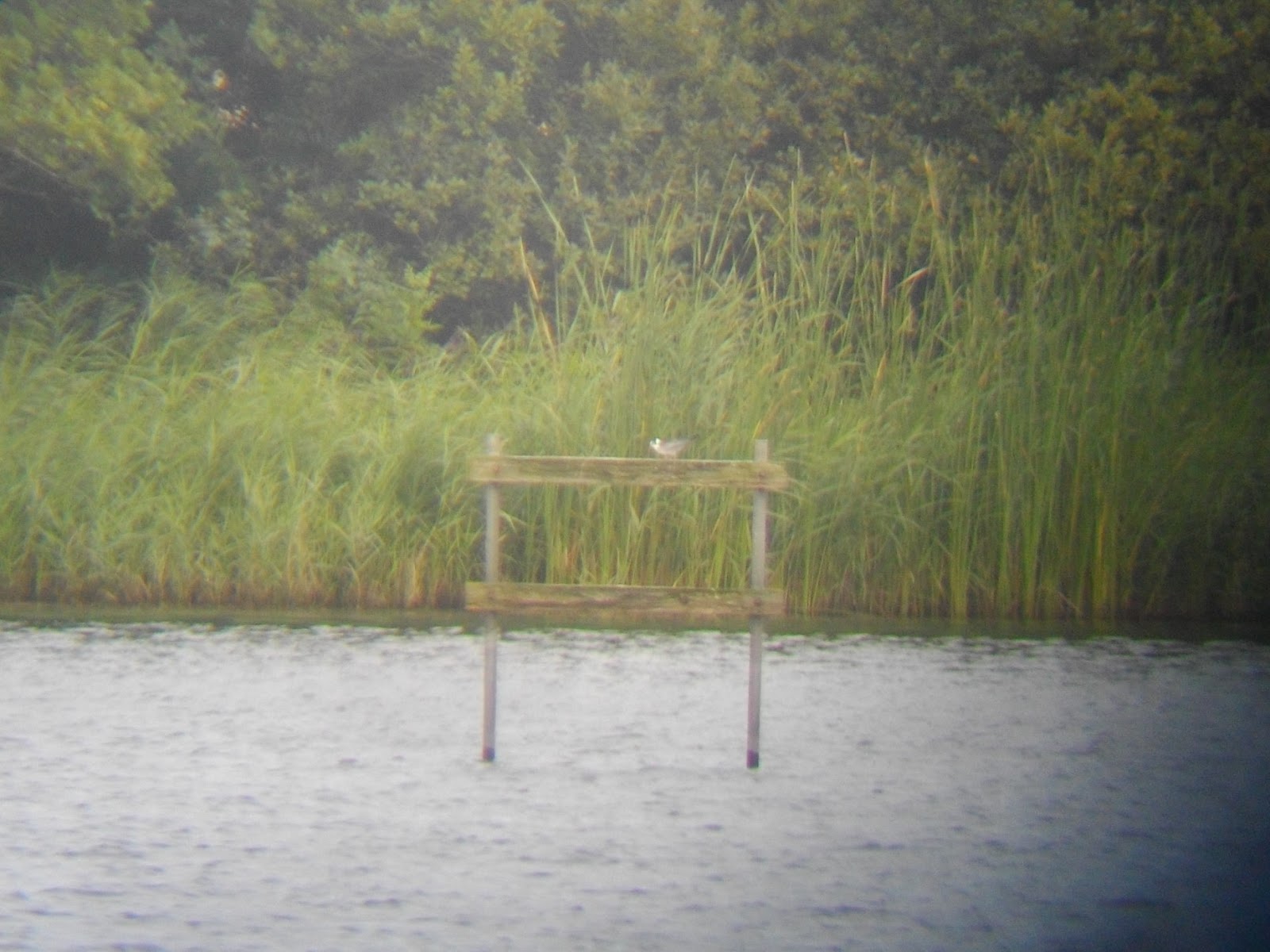
Arriving at Ormesby Broad (there is sometimes a bit of confusion around place names here - the place is Rollesby, north of the bridge is Ormesby Broad, south of the road is Rollesby Broad and further south is Ormesby Little Broad) the White-winged Black Tern was immediately on show although distant. James Lowen was already there, and having seen a photo very similar to one I took I think I was stood next to Kayn without introducing myself, so sorry if that was the case. Hirundines, mostly Swallows, swept over the broad in waves, although they were completely outmaneuvered by the tern, which twisted and dived with seemingly effortless abandon. It briefly perched up on the only frame available, but spent most of the time in flight. I did get a very distant record shot, but also took the opportunity to make a couple of sketches and take a few notes.